Revisiting Learning-based Video Motion Magnification for Real-time Processing
作者: Hyunwoo Ha, Oh Hyun-Bin, Kim Jun-Seong, Kwon Byung-Ki, Kim Sung-Bin, Linh-Tam Tran, Ji-Yun Kim, Sung-Ho Bae, Tae-Hyun Oh
分类: cs.CV, eess.IV
发布日期: 2024-03-04
备注: 19 pages
💡 一句话要点
提出一种实时视频运动放大模型以解决处理速度不足问题
🎯 匹配领域: 支柱七:动作重定向 (Motion Retargeting) 支柱八:物理动画 (Physics-based Animation)
关键词: 视频运动放大 深度学习 实时处理 网络架构优化 计算效率 运动分析
📋 核心要点
- 现有基于深度学习的运动放大方法在实时性能上仍存在不足,限制了其在实际应用中的使用。
- 本文提出了一种高效的深度学习运动放大模型,通过逐模块分析网络架构,优化了计算效率与任务质量。
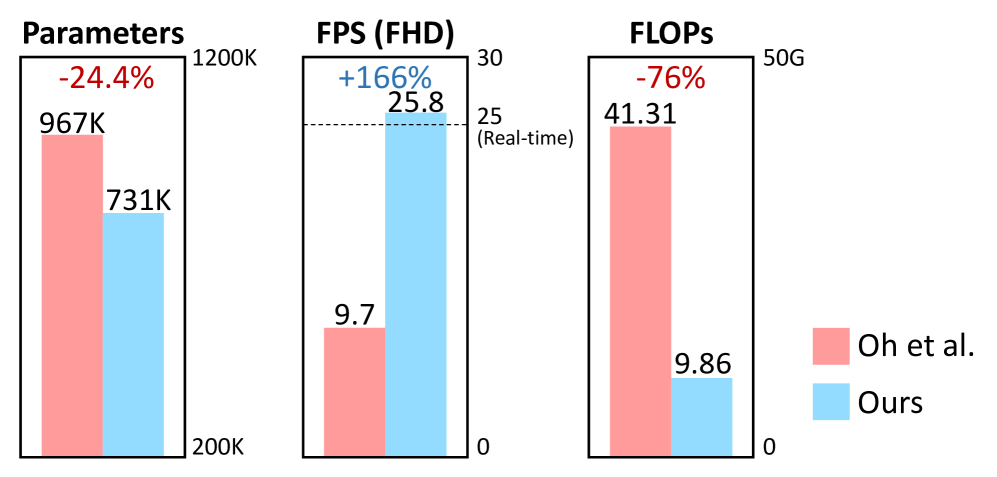
- 实验结果表明,所提模型在计算量上减少了4.2倍,处理速度提升了2.7倍,且保持了与现有方法相当的质量。
📝 摘要(中文)
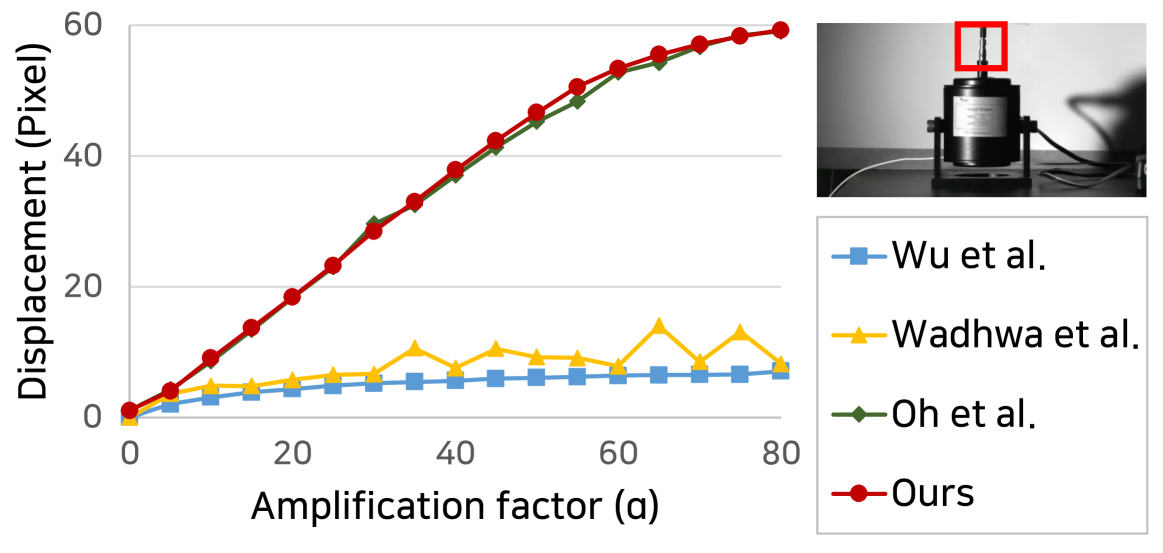
视频运动放大是一种捕捉和放大肉眼无法察觉的微小运动的技术。基于深度学习的先前研究成功展示了运动放大问题的建模,质量优于传统信号处理方法。然而,实时性能不足限制了其在在线应用中的扩展。本文研究了一种高效的深度学习运动放大模型,能够在全高清分辨率视频中实时运行。通过逐模块分析现有网络架构,发现降低解码器中潜在运动表示的空间分辨率在计算效率与任务质量之间提供了良好的平衡。此外,令人惊讶的是,仅需一个线性层和一个分支即可满足运动放大任务的需求。基于这些发现,本文提出的模型在计算量上减少了4.2倍,速度提升了2.7倍,同时保持了相当的质量。
🔬 方法详解
问题定义:本文旨在解决现有深度学习视频运动放大方法在实时处理速度上的不足,导致其无法广泛应用于在线场景。
核心思路:通过逐模块分析现有网络架构,提出了一种新的运动放大模型,优化了计算效率与任务质量的平衡。
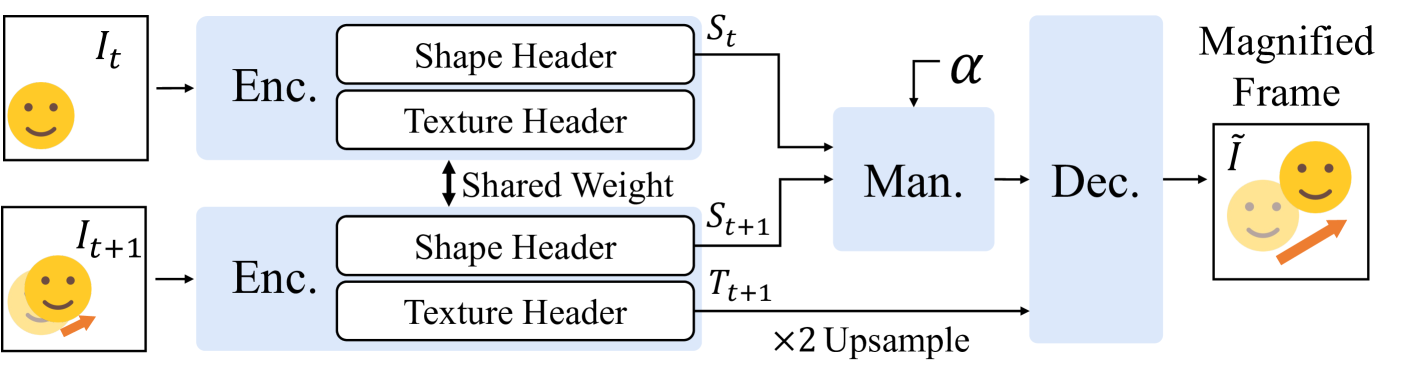
技术框架:整体架构包括一个编码器和解码器,编码器负责提取运动特征,解码器则进行运动放大的重建。
关键创新:最重要的创新在于发现降低解码器中潜在运动表示的空间分辨率能够有效提升计算效率,同时仅需一个线性层和一个分支即可完成运动放大任务。
关键设计:在网络设计中,采用了特定的参数设置和损失函数,确保了模型在减少计算量的同时,仍能保持高质量的运动放大效果。
🖼️ 关键图片
📊 实验亮点
实验结果显示,所提出的模型在计算量上减少了4.2倍,处理速度提升了2.7倍,相较于现有方法在实时性能上有显著提升,同时保持了相似的运动放大质量。
🎯 应用场景
该研究的潜在应用领域包括医疗监测、运动分析、安防监控等,能够实时捕捉和放大微小运动,提升相关领域的监测和分析能力。未来,该技术有望在智能监控和人机交互等多个领域发挥重要作用。
📄 摘要(原文)
Video motion magnification is a technique to capture and amplify subtle motion in a video that is invisible to the naked eye. The deep learning-based prior work successfully demonstrates the modelling of the motion magnification problem with outstanding quality compared to conventional signal processing-based ones. However, it still lags behind real-time performance, which prevents it from being extended to various online applications. In this paper, we investigate an efficient deep learning-based motion magnification model that runs in real time for full-HD resolution videos. Due to the specified network design of the prior art, i.e. inhomogeneous architecture, the direct application of existing neural architecture search methods is complicated. Instead of automatic search, we carefully investigate the architecture module by module for its role and importance in the motion magnification task. Two key findings are 1) Reducing the spatial resolution of the latent motion representation in the decoder provides a good trade-off between computational efficiency and task quality, and 2) surprisingly, only a single linear layer and a single branch in the encoder are sufficient for the motion magnification task. Based on these findings, we introduce a real-time deep learning-based motion magnification model with4.2X fewer FLOPs and is 2.7X faster than the prior art while maintaining comparable quality.