MS-Net: A Multi-Path Sparse Model for Motion Prediction in Multi-Scenes
作者: Xiaqiang Tang, Weigao Sun, Siyuan Hu, Yiyang Sun, Yafeng Guo
分类: cs.CV, cs.AI, cs.RO
发布日期: 2024-03-01
备注: Accepted by IEEE Robotics and Automation Letters (RAL)
💡 一句话要点
提出MS-Net以解决多场景下人类行为运动预测问题
🎯 匹配领域: 支柱七:动作重定向 (Motion Retargeting) 支柱八:物理动画 (Physics-based Animation)
关键词: 运动预测 多场景学习 深度学习 自动驾驶 多任务学习 进化算法 稀疏模型
📋 核心要点
- 现有的运动预测方法通常采用统一模型,无法有效处理不同驾驶场景,导致预测效果不佳。
- 本文提出的MS-Net通过多路径稀疏模型和进化算法,针对不同场景进行参数选择和共享知识,提升预测精度。
- 实验结果显示,MS-Net在多个数据集上表现优异,参数显著减少的同时,超越了现有的最先进方法。
📝 摘要(中文)
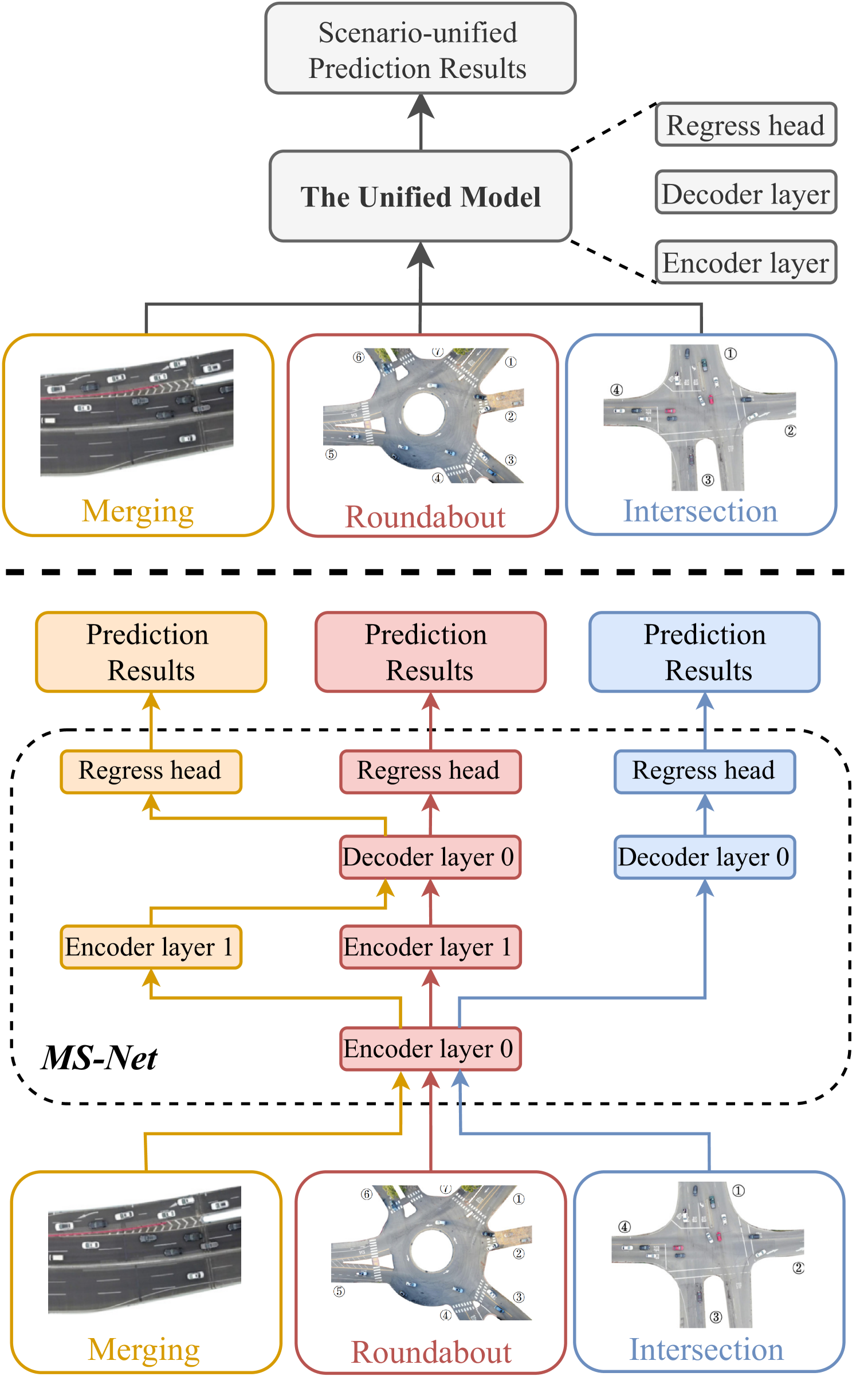
人类行为的多模态和随机特性使得运动预测成为一项极具挑战性的任务,尤其在自动驾驶领域。尽管深度学习方法在此领域展现了巨大潜力,但现有方法通常使用统一模型来预测不同场景下的轨迹,导致个别场景的预测效果不佳。为了解决这一问题,本文提出了多场景网络(MS-Net),该网络通过进化过程训练的多路径稀疏模型,在推理阶段选择性激活参数子集以生成每个场景的预测结果。实验结果表明,MS-Net在减少参数的同时,在知名的行人运动预测数据集上超越了现有的最先进方法,并在INTERACTION挑战赛中获得第二名。
🔬 方法详解
问题定义:本文旨在解决多场景下人类行为的运动预测问题。现有方法通常使用统一模型进行预测,无法充分考虑不同场景的特性,导致预测效果不理想。
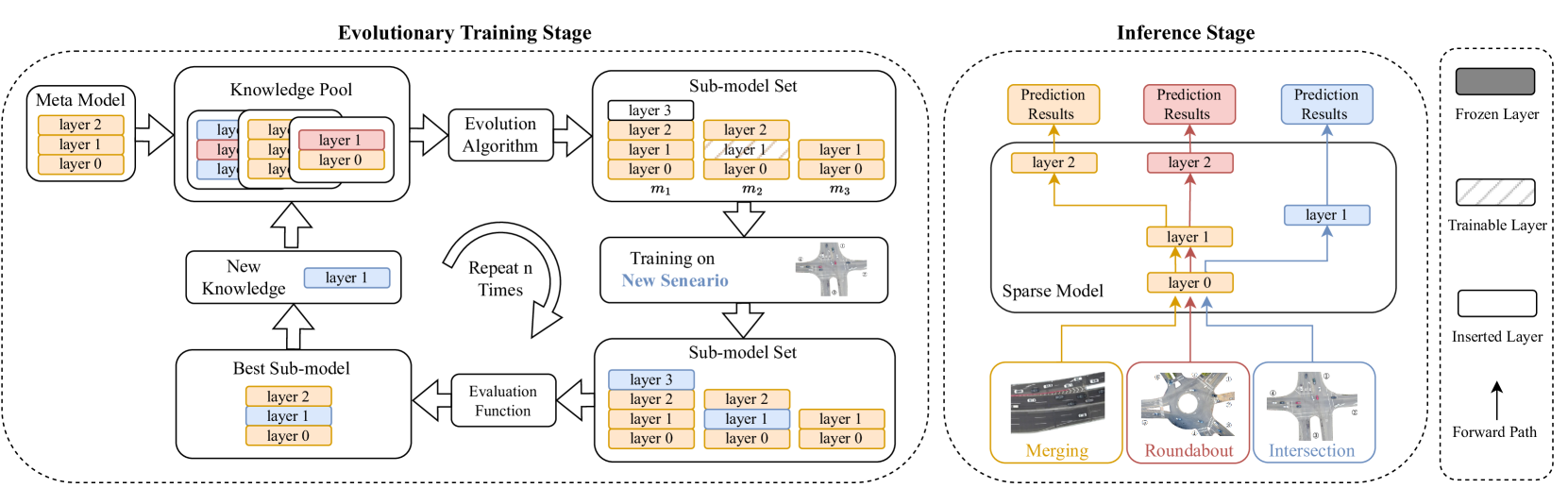
核心思路:MS-Net通过将运动预测任务抽象为多任务学习问题,利用进化算法优化每个场景的参数,同时共享不同场景之间的知识,从而提高预测的准确性和效率。
技术框架:MS-Net的整体架构包括训练阶段和推理阶段。在训练阶段,网络通过进化算法学习不同场景的最佳参数;在推理阶段,网络根据场景选择性激活相关参数以生成预测结果。
关键创新:MS-Net的主要创新在于其多路径稀疏模型设计,能够在推理时动态选择参数,显著减少计算量并提高预测精度。这一设计与传统的统一模型方法形成了鲜明对比。
关键设计:在网络结构上,MS-Net采用了多路径设计,允许在不同场景下激活不同的参数子集。此外,损失函数的设计也考虑了场景间的知识共享,以增强模型的泛化能力。
🖼️ 关键图片

📊 实验亮点
实验结果表明,MS-Net在ETH和UCY等知名行人运动预测数据集上表现优异,超越了现有的最先进方法,且在INTERACTION挑战赛中获得第二名,显示出其在多场景运动预测中的强大能力。
🎯 应用场景
该研究在自动驾驶、智能交通系统和人机交互等领域具有广泛的应用潜力。通过提高运动预测的准确性,MS-Net能够有效提升自动驾驶系统的安全性和可靠性,同时为未来的智能交通管理提供支持。
📄 摘要(原文)
The multi-modality and stochastic characteristics of human behavior make motion prediction a highly challenging task, which is critical for autonomous driving. While deep learning approaches have demonstrated their great potential in this area, it still remains unsolved to establish a connection between multiple driving scenes (e.g., merging, roundabout, intersection) and the design of deep learning models. Current learning-based methods typically use one unified model to predict trajectories in different scenarios, which may result in sub-optimal results for one individual scene. To address this issue, we propose Multi-Scenes Network (aka. MS-Net), which is a multi-path sparse model trained by an evolutionary process. MS-Net selectively activates a subset of its parameters during the inference stage to produce prediction results for each scene. In the training stage, the motion prediction task under differentiated scenes is abstracted as a multi-task learning problem, an evolutionary algorithm is designed to encourage the network search of the optimal parameters for each scene while sharing common knowledge between different scenes. Our experiment results show that with substantially reduced parameters, MS-Net outperforms existing state-of-the-art methods on well-established pedestrian motion prediction datasets, e.g., ETH and UCY, and ranks the 2nd place on the INTERACTION challenge.