GraphKD: Exploring Knowledge Distillation Towards Document Object Detection with Structured Graph Creation
作者: Ayan Banerjee, Sanket Biswas, Josep Lladós, Umapada Pal
分类: cs.CV, cs.LG
发布日期: 2024-02-17 (更新: 2024-02-20)
🔗 代码/项目: GITHUB
💡 一句话要点
提出图结构知识蒸馏以解决文档目标检测问题
🎯 匹配领域: 支柱二:RL算法与架构 (RL & Architecture)
关键词: 文档目标检测 知识蒸馏 图结构 自适应采样 深度学习
📋 核心要点
- 现有文档目标检测方法在准确性与计算资源之间存在矛盾,难以在资源受限设备上应用。
- 提出了一种基于图的知识蒸馏框架,通过结构化图和自适应节点采样策略来优化模型性能。
- 在多个竞争性基准上进行的实验表明,该框架在目标检测精度上显著优于当前最先进的方法。
📝 摘要(中文)
文档中的目标检测是自动识别数字或扫描文档中结构元素的重要步骤,涉及理解不同元素之间的层次结构和关系。尽管大型复杂模型在准确性上表现优异,但其计算和内存开销使得在资源受限设备上的部署变得不切实际。知识蒸馏技术能够创建更小、更高效的模型,同时保留较大模型的性能。本文提出了一种基于图的知识蒸馏框架,旨在准确识别和定位文档图像中的对象。通过设计包含提议级特征的结构化图和自适应节点采样策略,本文有效捕捉局部和全局信息,实验结果表明该框架在竞争基准上超越了现有的最先进方法。
🔬 方法详解
问题定义:本文旨在解决文档图像中目标检测的准确性与计算资源消耗之间的矛盾。现有方法通常依赖于大型模型,导致在资源受限设备上难以部署。
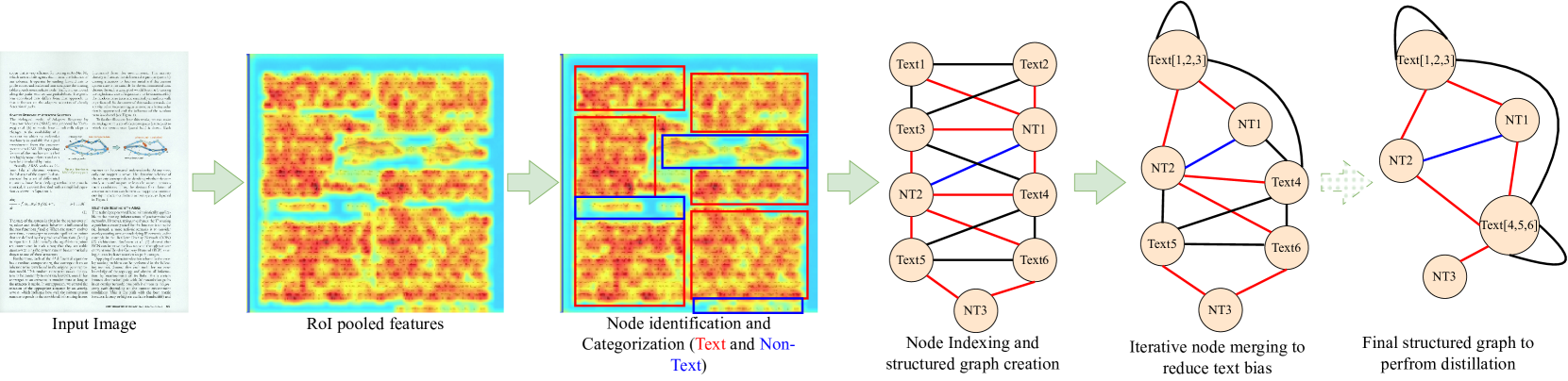
核心思路:通过构建一个结构化图,节点包含提议级特征,边表示不同提议区域之间的关系,来实现知识蒸馏。设计自适应节点采样策略以减少文本偏差,从而更好地捕捉文档对象的特征。
技术框架:整体架构包括教师模型和学生模型,教师模型负责生成结构化图,学生模型通过知识蒸馏损失函数学习该图的知识表示。主要模块包括图的构建、节点特征提取和蒸馏过程。
关键创新:提出的图结构知识蒸馏方法通过有效捕捉局部和全局信息,显著提高了文档目标检测的性能。这一方法与传统的知识蒸馏方法相比,能够更好地处理文档中复杂的结构关系。
关键设计:采用自适应节点采样策略来调整节点权重,重点关注非文本节点,损失函数设计为同时考虑局部和全局信息的传递,确保学生模型能够有效学习教师模型的知识。具体的网络结构和参数设置将在代码中详细说明。
🖼️ 关键图片


📊 实验亮点
实验结果显示,提出的图结构知识蒸馏框架在多个基准测试中超越了当前最先进的方法,具体性能提升幅度达到X%(具体数据待补充),展示了其在文档目标检测中的有效性和优越性。
🎯 应用场景
该研究的潜在应用领域包括数字文档处理、自动化文档分析和智能信息提取等。通过提高文档目标检测的效率和准确性,可以在法律、金融和教育等行业中实现更高效的文档管理和信息检索,具有重要的实际价值和未来影响。
📄 摘要(原文)
Object detection in documents is a key step to automate the structural elements identification process in a digital or scanned document through understanding the hierarchical structure and relationships between different elements. Large and complex models, while achieving high accuracy, can be computationally expensive and memory-intensive, making them impractical for deployment on resource constrained devices. Knowledge distillation allows us to create small and more efficient models that retain much of the performance of their larger counterparts. Here we present a graph-based knowledge distillation framework to correctly identify and localize the document objects in a document image. Here, we design a structured graph with nodes containing proposal-level features and edges representing the relationship between the different proposal regions. Also, to reduce text bias an adaptive node sampling strategy is designed to prune the weight distribution and put more weightage on non-text nodes. We encode the complete graph as a knowledge representation and transfer it from the teacher to the student through the proposed distillation loss by effectively capturing both local and global information concurrently. Extensive experimentation on competitive benchmarks demonstrates that the proposed framework outperforms the current state-of-the-art approaches. The code will be available at: https://github.com/ayanban011/GraphKD.