Learning by Reconstruction Produces Uninformative Features For Perception
作者: Randall Balestriero, Yann LeCun
分类: cs.CV, cs.AI, stat.ML
发布日期: 2024-02-17
💡 一句话要点
揭示重建学习与感知学习之间的失调问题
🎯 匹配领域: 支柱二:RL算法与架构 (RL & Architecture)
关键词: 重建学习 感知学习 去噪学习 特征选择 深度学习
📋 核心要点
- 现有的重建学习方法在感知任务中表现不佳,导致模型学习到的特征缺乏信息量。
- 论文提出通过分析重建学习与感知学习之间的失调,探索去噪学习策略的有效性。
- 实验结果显示,使用不同噪声策略对模型性能的影响显著,某些策略能提高测试准确率。
📝 摘要(中文)
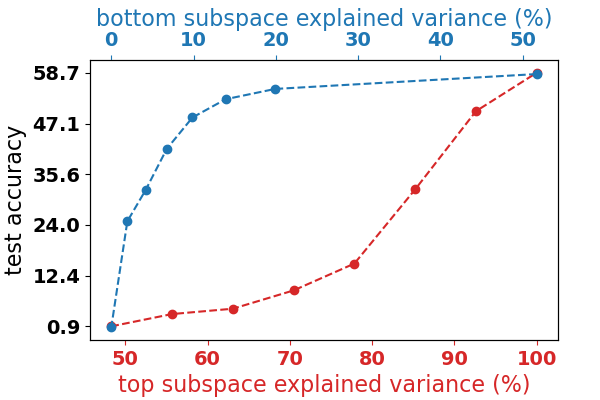
输入空间重建是一种有吸引力的表示学习范式。尽管重建和生成具有可解释性,本文指出重建学习与感知学习之间存在失调。研究表明,重建学习将模型的能力分配到解释观察到的方差的子空间,而该子空间对感知学习而言特征不具信息量。例如,在监督的TinyImagenet任务中,投影到解释90%像素方差的子空间的图像仅能达到45%的测试准确率,而投影到仅解释20%方差的子空间则能达到55%的测试准确率。感知特征的学习通常发生在训练的后期,这解释了长时间训练的必要性。去噪学习是一种流行的策略来缓解这种失调。我们证明了某些噪声策略如掩蔽确实有益,而其他如加性高斯噪声则无益。即使在掩蔽的情况下,效果也会因掩蔽形状、比例和数据集而异。我们提供了初步线索,以检测某些噪声策略在任何感知任务中都无益。
🔬 方法详解
问题定义:本文旨在解决重建学习与感知学习之间的失调问题,现有方法在特征学习上存在不足,导致模型性能不佳。
核心思路:通过分析重建学习的特征分布,论文探讨了如何通过去噪学习策略来改善感知特征的学习效果,强调了噪声策略的选择对模型性能的影响。
技术框架:整体架构包括输入数据的重建、特征提取和感知任务的训练,主要模块包括重建网络、去噪模块和感知学习模块。
关键创新:论文的创新点在于揭示了重建学习与感知学习之间的失调,并通过实验证明了去噪策略的有效性,尤其是掩蔽策略的优越性。
关键设计:在实验中,采用了不同的噪声策略(如掩蔽和加性高斯噪声),并对掩蔽的形状和比例进行了系统的调优,以评估其对模型性能的影响。
🖼️ 关键图片
📊 实验亮点
实验结果表明,投影到解释90%方差的子空间的图像在TinyImagenet任务中仅能达到45%的测试准确率,而投影到解释20%方差的子空间则能达到55%的测试准确率,显示出特征选择对模型性能的显著影响。
🎯 应用场景
该研究的潜在应用领域包括计算机视觉、图像分类和自动驾驶等领域。通过优化特征学习过程,可以提高模型在复杂环境下的感知能力,进而提升智能系统的整体性能。未来,该研究可能推动更高效的深度学习模型设计,改善模型在实际应用中的表现。
📄 摘要(原文)
Input space reconstruction is an attractive representation learning paradigm. Despite interpretability of the reconstruction and generation, we identify a misalignment between learning by reconstruction, and learning for perception. We show that the former allocates a model's capacity towards a subspace of the data explaining the observed variance--a subspace with uninformative features for the latter. For example, the supervised TinyImagenet task with images projected onto the top subspace explaining 90\% of the pixel variance can be solved with 45\% test accuracy. Using the bottom subspace instead, accounting for only 20\% of the pixel variance, reaches 55\% test accuracy. The features for perception being learned last explains the need for long training time, e.g., with Masked Autoencoders. Learning by denoising is a popular strategy to alleviate that misalignment. We prove that while some noise strategies such as masking are indeed beneficial, others such as additive Gaussian noise are not. Yet, even in the case of masking, we find that the benefits vary as a function of the mask's shape, ratio, and the considered dataset. While tuning the noise strategy without knowledge of the perception task seems challenging, we provide first clues on how to detect if a noise strategy is never beneficial regardless of the perception task.