MM-Point: Multi-View Information-Enhanced Multi-Modal Self-Supervised 3D Point Cloud Understanding
作者: Hai-Tao Yu, Mofei Song
分类: cs.CV, cs.AI, cs.MM
发布日期: 2024-02-15 (更新: 2024-02-25)
备注: Accepted by AAAI 2024
期刊: AAAI 2024
💡 一句话要点
提出MM-Point以解决3D点云理解中的多模态信息整合问题
🎯 匹配领域: 支柱二:RL算法与架构 (RL & Architecture)
关键词: 3D点云理解 自监督学习 多模态融合 对比学习 深度学习
📋 核心要点
- 现有方法在3D点云理解中常常依赖单一视角的2D信息,导致信息不足,难以全面理解3D对象。
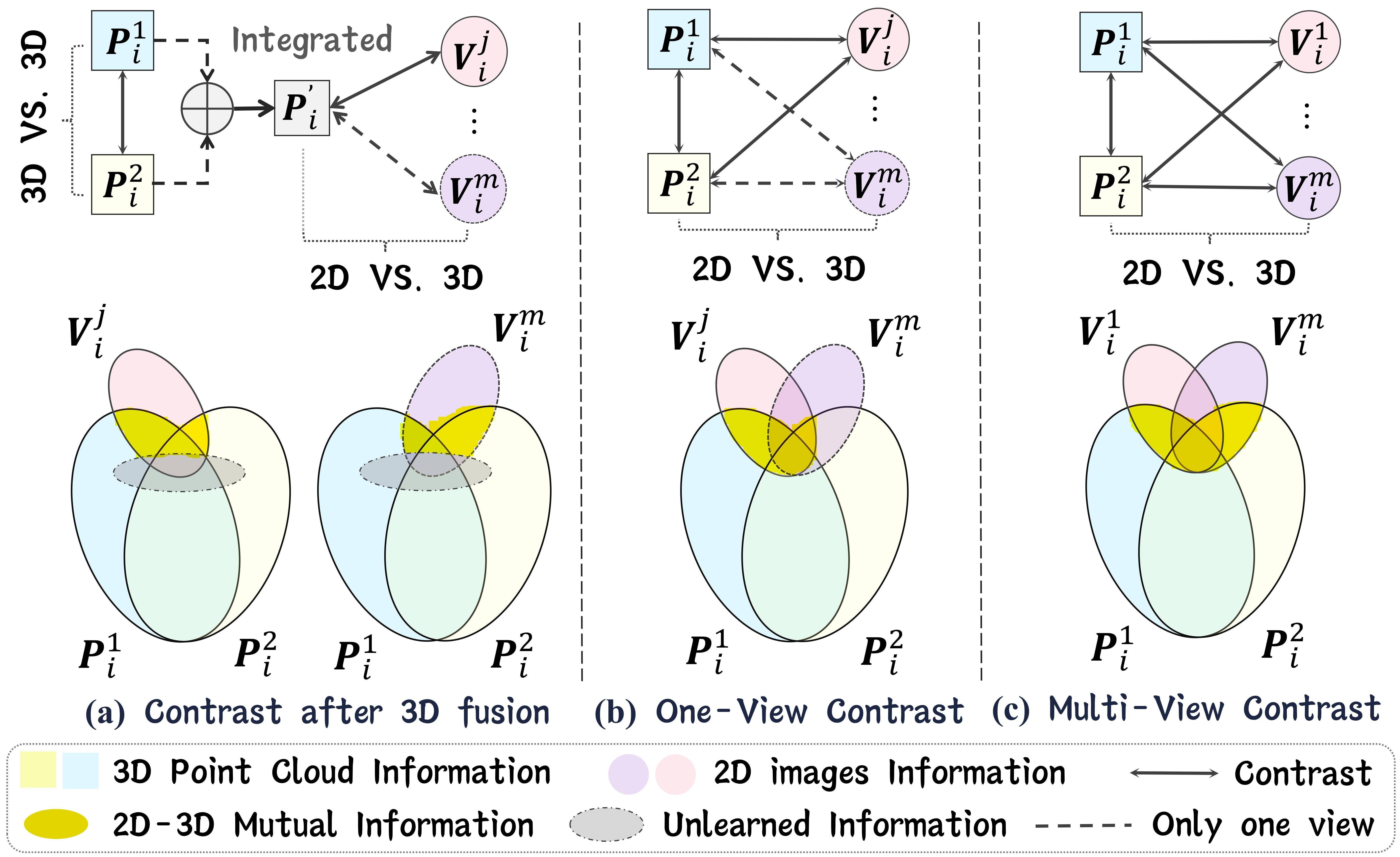
- 论文提出MM-Point,通过多模态交互和对比学习,利用多视角2D信息增强3D点云表示的自监督学习。
- 实验结果表明,MM-Point在ModelNet40和ScanObjectNN数据集上分别达到了92.4%和87.8%的准确率,表现优于许多全监督方法。
📝 摘要(中文)
在感知过程中,多种传感器信息被整合以将2D视图的视觉信息映射到3D对象上,这对于理解3D环境非常有益。然而,从不同角度渲染的单一2D视图只能提供有限的部分信息。多视角2D信息的丰富性和价值可以为3D对象提供优越的自监督信号。本文提出了一种新颖的自监督点云表示学习方法MM-Point,旨在通过模态内和模态间的相似性目标来驱动学习。MM-Point的核心在于3D对象与多个2D视图之间的多模态交互与传输。为了更有效地基于对比学习同时执行一致的跨模态目标,本文进一步提出了Multi-MLP和多层增强策略。经过精心设计的变换策略,进一步学习了2D多视图中的多层不变性。MM-Point在各种下游任务中表现出最先进的性能。
🔬 方法详解
问题定义:本文旨在解决现有3D点云理解方法中对单一视角2D信息依赖的问题,导致信息不足和理解不全面的挑战。
核心思路:MM-Point通过多模态交互和对比学习,充分利用多视角2D信息,增强3D点云的自监督表示学习能力。
技术框架:MM-Point的整体架构包括多个模块,首先是多视角2D信息的提取,然后是通过Multi-MLP进行模态间的交互,最后通过多层增强策略实现对比学习。
关键创新:MM-Point的主要创新在于同时利用模态内和模态间的相似性目标,显著提升了3D点云理解的效果,与传统方法相比,能够更好地捕捉多视角信息的丰富性。
关键设计:在技术细节上,MM-Point采用了特定的损失函数来优化模态间的相似性,同时设计了Multi-MLP网络结构以增强信息传递的效率,确保多层不变性的学习。
🖼️ 关键图片


📊 实验亮点
MM-Point在多个下游任务中表现出色,在ModelNet40数据集上达到了92.4%的峰值准确率,在ScanObjectNN数据集上达到了87.8%的顶级准确率,显示出其与全监督方法相当的性能,验证了其有效性。
🎯 应用场景
该研究在自动驾驶、机器人导航和增强现实等领域具有广泛的应用潜力。通过提升3D点云理解的准确性,MM-Point能够为这些领域提供更可靠的环境感知能力,从而推动智能系统的发展和应用。
📄 摘要(原文)
In perception, multiple sensory information is integrated to map visual information from 2D views onto 3D objects, which is beneficial for understanding in 3D environments. But in terms of a single 2D view rendered from different angles, only limited partial information can be provided.The richness and value of Multi-view 2D information can provide superior self-supervised signals for 3D objects. In this paper, we propose a novel self-supervised point cloud representation learning method, MM-Point, which is driven by intra-modal and inter-modal similarity objectives. The core of MM-Point lies in the Multi-modal interaction and transmission between 3D objects and multiple 2D views at the same time. In order to more effectively simultaneously perform the consistent cross-modal objective of 2D multi-view information based on contrastive learning, we further propose Multi-MLP and Multi-level Augmentation strategies. Through carefully designed transformation strategies, we further learn Multi-level invariance in 2D Multi-views. MM-Point demonstrates state-of-the-art (SOTA) performance in various downstream tasks. For instance, it achieves a peak accuracy of 92.4% on the synthetic dataset ModelNet40, and a top accuracy of 87.8% on the real-world dataset ScanObjectNN, comparable to fully supervised methods. Additionally, we demonstrate its effectiveness in tasks such as few-shot classification, 3D part segmentation and 3D semantic segmentation.