Toward Accurate Camera-based 3D Object Detection via Cascade Depth Estimation and Calibration
作者: Chaoqun Wang, Yiran Qin, Zijian Kang, Ningning Ma, Ruimao Zhang
分类: cs.CV
发布日期: 2024-02-07
备注: Accepted to ICRA2024
💡 一句话要点
提出级联深度估计与校准以解决相机3D目标检测精度问题
🎯 匹配领域: 支柱三:空间感知与语义 (Perception & Semantics)
关键词: 3D目标检测 深度估计 深度校准 计算机视觉 自动驾驶 深度学习
📋 核心要点
- 现有基于相机的3D目标检测方法在图像到3D特征空间转换及目标定位精度上存在不足,影响了检测效果。
- 本文提出了一个级联框架,通过深度估计和深度校准两个模块,有效学习深度信息以提升3D目标检测精度。
- 在NuScenes基准上,我们的方法实现了+2.2%/+2.7%的NDS/mAP提升,并在多种检测器上展示了约+2%的NDS提升。
📝 摘要(中文)
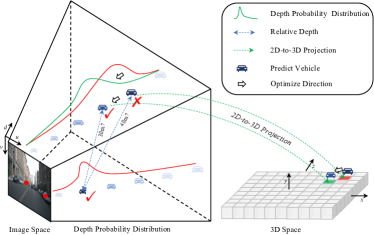
近年来,基于相机的3D目标检测受到从图像到3D特征空间转换精度及目标在3D空间中定位准确性的限制。本文旨在解决这一根本问题:如何有效学习深度信息以实现准确的特征提升和目标定位。与以往直接预测深度分布的方法不同,我们提出了一个由两个深度感知学习范式组成的级联框架。首先,深度估计方案利用相对深度信息实现从2D到3D空间的有效特征提升;其次,深度校准方案引入深度重建以进一步调整沿深度轴的3D目标定位扰动。实验结果表明,我们的方法在NuScenes基准上取得了+2.2%/+2.7%的NDS/mAP提升,且在多个检测器上展示了良好的通用性。
🔬 方法详解
问题定义:本文解决的是基于相机的3D目标检测中,如何有效学习深度信息以提高特征提升和目标定位的准确性。现有方法往往直接预测深度分布,导致精度不足。
核心思路:我们提出的级联框架包含深度估计和深度校准两个模块,前者通过相对深度信息提升特征,后者通过深度重建调整3D定位,旨在提高整体检测精度。
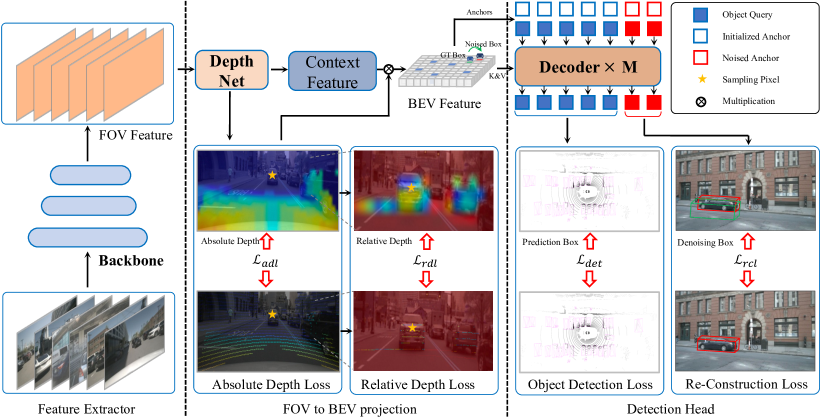
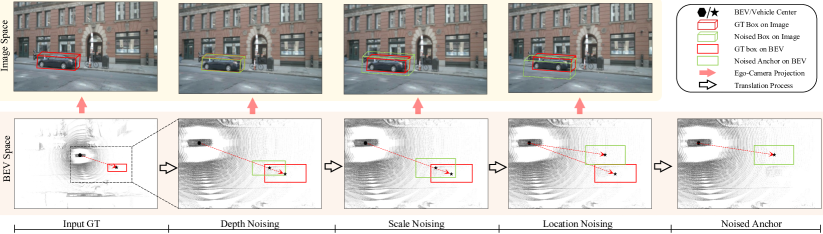
技术框架:整体架构包括两个主要模块:深度估计(DE)和深度校准(DC)。DE模块通过优化绝对和相对深度损失实现深度预测,DC模块则通过深度去噪机制嵌入到检测Transformer中,提升3D定位的准确性。
关键创新:最重要的创新在于将深度估计与深度校准结合,通过级联方式提升3D目标检测的精度。这种方法与传统的直接深度预测方法有本质区别,能够更好地处理深度信息。
关键设计:在DE模块中,我们设计了绝对和相对深度优化损失函数,以促进深度预测的精度;在DC模块中,深度去噪机制被嵌入到检测Transformer中,增强了模型的鲁棒性。整个模型采用端到端的训练方式。
🖼️ 关键图片
📊 实验亮点
在NuScenes基准测试中,我们的方法在NDS和mAP指标上分别提升了+2.2%和+2.7%,达到了55.9%和45.7%的性能。此外,我们在多种检测器上进行了广泛实验,展示了约+2%的NDS提升,验证了方法的通用性和有效性。
🎯 应用场景
该研究在自动驾驶、机器人视觉和增强现实等领域具有广泛的应用潜力。通过提高3D目标检测的精度,可以显著提升这些系统的环境感知能力,从而增强其安全性和可靠性。未来,该方法有望推动更复杂场景下的3D理解与交互。
📄 摘要(原文)
Recent camera-based 3D object detection is limited by the precision of transforming from image to 3D feature spaces, as well as the accuracy of object localization within the 3D space. This paper aims to address such a fundamental problem of camera-based 3D object detection: How to effectively learn depth information for accurate feature lifting and object localization. Different from previous methods which directly predict depth distributions by using a supervised estimation model, we propose a cascade framework consisting of two depth-aware learning paradigms. First, a depth estimation (DE) scheme leverages relative depth information to realize the effective feature lifting from 2D to 3D spaces. Furthermore, a depth calibration (DC) scheme introduces depth reconstruction to further adjust the 3D object localization perturbation along the depth axis. In practice, the DE is explicitly realized by using both the absolute and relative depth optimization loss to promote the precision of depth prediction, while the capability of DC is implicitly embedded into the detection Transformer through a depth denoising mechanism in the training phase. The entire model training is accomplished through an end-to-end manner. We propose a baseline detector and evaluate the effectiveness of our proposal with +2.2%/+2.7% NDS/mAP improvements on NuScenes benchmark, and gain a comparable performance with 55.9%/45.7% NDS/mAP. Furthermore, we conduct extensive experiments to demonstrate its generality based on various detectors with about +2% NDS improvements.