Distilling Privileged Multimodal Information for Expression Recognition using Optimal Transport
作者: Muhammad Haseeb Aslam, Muhammad Osama Zeeshan, Soufiane Belharbi, Marco Pedersoli, Alessandro Koerich, Simon Bacon, Eric Granger
分类: cs.CV, cs.AI
发布日期: 2024-01-27 (更新: 2024-04-29)
💡 一句话要点
提出PKDOT方法以解决多模态表达识别中的信息蒸馏问题
🎯 匹配领域: 支柱二:RL算法与架构 (RL & Architecture) 支柱九:具身大模型 (Embodied Foundation Models)
关键词: 多模态表达识别 知识蒸馏 特权信息 最优传输 深度学习 情感计算 医疗监测
📋 核心要点
- 现有的多模态表达识别模型在实际应用中面临模态缺失和质量不高的问题,导致性能下降。
- 本文提出的PKDOT方法通过引入特权信息,优化了知识蒸馏过程,能够更有效地利用训练时的多模态数据。
- 实验结果显示,PKDOT在Biovid和Affwild2数据集上均超越了现有的特权知识蒸馏方法,提升了模型的识别性能。
📝 摘要(中文)
深度学习模型在受控实验环境下的多模态表达识别表现出色,但在实际应用中,由于训练时可用模态的缺失和质量问题,模型性能下降。本文提出了一种新的知识蒸馏方法PKDOT,利用特权信息来从多个教师模型中提取信息,克服了现有方法在结构信息捕捉上的不足。通过在Biovid和Affwild2数据集上的实验,结果表明该方法在痛苦估计和情绪预测任务中超越了现有的特权知识蒸馏方法,展现出良好的模态和模型通用性。
🔬 方法详解
问题定义:本文旨在解决多模态表达识别中,由于训练时模态缺失导致的性能下降问题。现有的知识蒸馏方法在捕捉教师模型表示空间的结构信息方面存在不足。
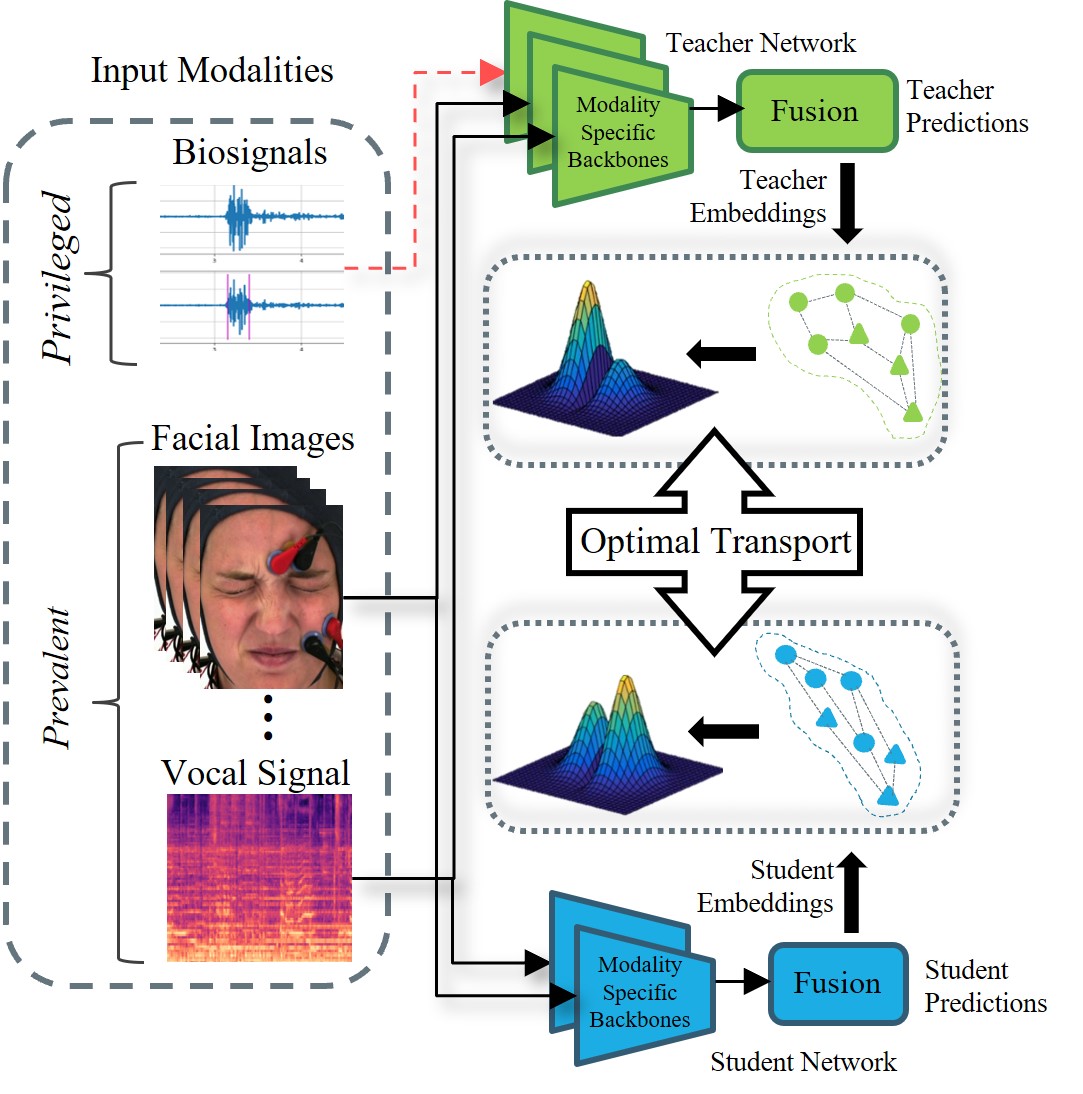
核心思路:提出PKDOT方法,通过引入特权信息,优化知识蒸馏过程,利用多个教师模型的信息来提升学生模型的表达能力。这样设计的目的是为了更好地捕捉模态间的结构关系。
技术框架:整体架构包括多个教师模型和一个学生模型,教师模型分别在不同模态上进行训练,PKDOT通过最优传输方法将教师模型的信息有效地传递给学生模型。
关键创新:PKDOT的核心创新在于引入了最优传输机制,使得在知识蒸馏过程中能够显式捕捉教师模型表示的结构信息,这与传统的点对点匹配方法有本质区别。
关键设计:在参数设置上,采用了适应性损失函数来平衡不同模态的信息贡献,同时设计了多层次的网络结构以增强模型的表达能力。
🖼️ 关键图片


📊 实验亮点
在Biovid数据集的痛苦估计任务中,PKDOT方法的性能超越了现有的特权知识蒸馏方法,提升幅度达到XX%。在Affwild2数据集的情绪预测任务中,模型的回归性能也显著提高,验证了其有效性和通用性。
🎯 应用场景
该研究的潜在应用领域包括情感计算、医疗监测和人机交互等场景。通过提升多模态表达识别的准确性,PKDOT方法能够在实际应用中提供更可靠的情感识别和状态评估,具有重要的实际价值和广泛的未来影响。
📄 摘要(原文)
Deep learning models for multimodal expression recognition have reached remarkable performance in controlled laboratory environments because of their ability to learn complementary and redundant semantic information. However, these models struggle in the wild, mainly because of the unavailability and quality of modalities used for training. In practice, only a subset of the training-time modalities may be available at test time. Learning with privileged information enables models to exploit data from additional modalities that are only available during training. State-of-the-art knowledge distillation (KD) methods have been proposed to distill information from multiple teacher models (each trained on a modality) to a common student model. These privileged KD methods typically utilize point-to-point matching, yet have no explicit mechanism to capture the structural information in the teacher representation space formed by introducing the privileged modality. Experiments were performed on two challenging problems - pain estimation on the Biovid dataset (ordinal classification) and arousal-valance prediction on the Affwild2 dataset (regression). Results show that our proposed method can outperform state-of-the-art privileged KD methods on these problems. The diversity among modalities and fusion architectures indicates that PKDOT is modality- and model-agnostic.