Full-Body Motion Reconstruction with Sparse Sensing from Graph Perspective
作者: Feiyu Yao, Zongkai Wu, Li Yi
分类: cs.CV
发布日期: 2024-01-22
💡 一句话要点
提出基于图的全身运动重建方法以解决稀疏传感器数据问题
🎯 匹配领域: 支柱六:视频提取与匹配 (Video Extraction) 支柱七:动作重定向 (Motion Retargeting) 支柱八:物理动画 (Physics-based Animation)
关键词: 全身运动重建 稀疏传感器 人体姿态图 图神经网络 增强现实 虚拟现实 运动捕捉
📋 核心要点
- 现有方法在稀疏传感器数据下难以全面捕捉全身运动,导致重建效果不佳。
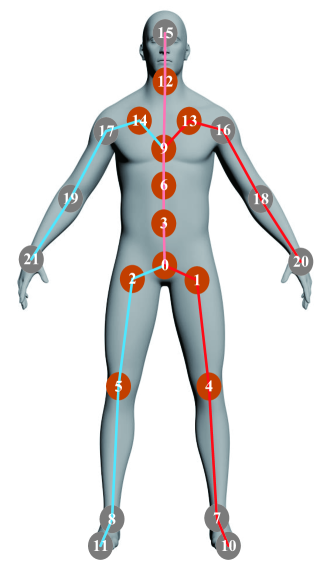
- 论文提出通过人体姿态图(BPG)将运动重建问题转化为图缺失节点的预测问题,利用图神经网络进行节点特征更新。
- 实验结果表明,所提方法在下肢运动重建上达到了最先进的性能,相较于基线方法有显著提升。
📝 摘要(中文)
从稀疏传感器数据中估计3D全身姿态是增强现实和虚拟现实中重建真实人类运动的关键技术。然而,常见VR系统中稀疏分布的传感器无法捕捉全身运动,导致这一挑战。本文提出了一种基于人体姿态图(BPG)的全身运动重建框架,将该问题转化为图缺失节点的预测问题。通过时间金字塔结构捕捉时间动态,并结合空间关系,最终实现了在下肢运动方面的最先进性能,超越了其他基线方法。
🔬 方法详解
问题定义:本文旨在解决从稀疏传感器数据中重建全身运动的具体问题。现有方法由于传感器分布稀疏,无法全面捕捉人体运动,导致重建效果不理想。
核心思路:论文的核心思路是利用人体姿态图(BPG)将运动重建问题转化为图缺失节点的预测问题。通过将传感器信号提取的特征与时间和空间动态结合,增强了对全身运动的捕捉能力。
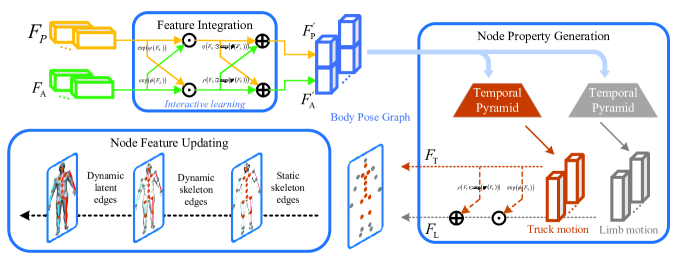
技术框架:整体架构包括特征提取、BPG构建和图神经网络更新三个主要模块。首先,从稀疏传感器信号中提取特征,然后构建BPG,最后通过图神经网络更新节点特征以反映关节间的关系。
关键创新:最重要的技术创新在于提出了基于BPG的全身运动重建框架,并通过图神经网络有效更新节点特征,显著提升了重建精度。与现有方法相比,该方法在处理稀疏数据时表现出更好的适应性和准确性。
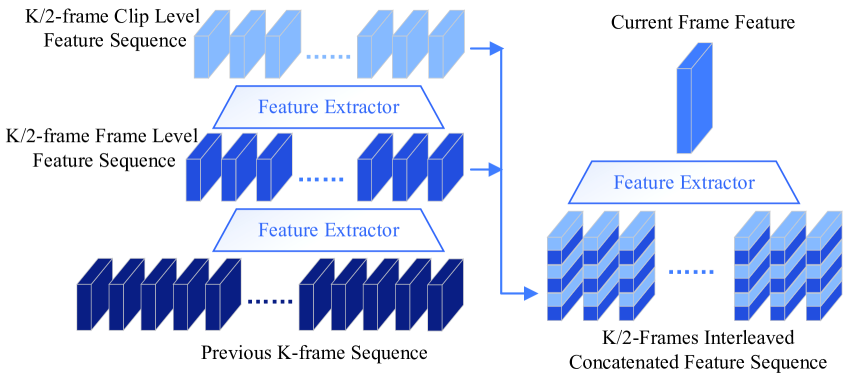
关键设计:在设计中,节点特征通过时间金字塔结构捕捉时间动态,并结合关节运动的空间属性。损失函数的选择和网络结构的设计均旨在优化节点间的关系,确保重建效果的准确性。
🖼️ 关键图片
📊 实验亮点
实验结果显示,所提方法在下肢运动重建上达到了最先进的性能,相较于其他基线方法,提升幅度显著,具体性能数据未提供,但表明在处理稀疏数据时具有明显优势。
🎯 应用场景
该研究具有广泛的应用潜力,尤其在增强现实和虚拟现实领域。通过精确重建人类运动,可以提升虚拟环境中的交互体验,推动游戏、医疗康复、运动训练等多个行业的发展。未来,该技术有望与其他传感器技术结合,进一步提升运动捕捉的精度和实时性。
📄 摘要(原文)
Estimating 3D full-body pose from sparse sensor data is a pivotal technique employed for the reconstruction of realistic human motions in Augmented Reality and Virtual Reality. However, translating sparse sensor signals into comprehensive human motion remains a challenge since the sparsely distributed sensors in common VR systems fail to capture the motion of full human body. In this paper, we use well-designed Body Pose Graph (BPG) to represent the human body and translate the challenge into a prediction problem of graph missing nodes. Then, we propose a novel full-body motion reconstruction framework based on BPG. To establish BPG, nodes are initially endowed with features extracted from sparse sensor signals. Features from identifiable joint nodes across diverse sensors are amalgamated and processed from both temporal and spatial perspectives. Temporal dynamics are captured using the Temporal Pyramid Structure, while spatial relations in joint movements inform the spatial attributes. The resultant features serve as the foundational elements of the BPG nodes. To further refine the BPG, node features are updated through a graph neural network that incorporates edge reflecting varying joint relations. Our method's effectiveness is evidenced by the attained state-of-the-art performance, particularly in lower body motion, outperforming other baseline methods. Additionally, an ablation study validates the efficacy of each module in our proposed framework.