The State of Computer Vision Research in Africa
作者: Abdul-Hakeem Omotayo, Ashery Mbilinyi, Lukman Ismaila, Houcemeddine Turki, Mahmoud Abdien, Karim Gamal, Idriss Tondji, Yvan Pimi, Naome A. Etori, Marwa M. Matar, Clifford Broni-Bediako, Abigail Oppong, Mai Gamal, Eman Ehab, Gbetondji Dovonon, Zainab Akinjobi, Daniel Ajisafe, Oluwabukola G. Adegboro, Mennatullah Siam
分类: cs.CV
发布日期: 2024-01-21 (更新: 2024-09-13)
备注: Community Work of Ro'ya Grassroots, https://ro-ya-cv4africa.github.io/homepage/. Published in JAIR,. arXiv admin note: text overlap with arXiv:2305.06773
期刊: JAIR 2024
DOI: 10.1613/jair.1.16653
💡 一句话要点
分析非洲计算机视觉研究现状以促进资源共享与合作
🎯 匹配领域: 支柱九:具身大模型 (Embodied Foundation Models)
关键词: 计算机视觉 人工智能 数据集 合作研究 资源共享 非洲研究 结构性障碍
📋 核心要点
- 非洲在计算机视觉领域的研究贡献极其有限,主要受制于计算资源和数据集的缺乏。
- 本研究通过分析63,000篇出版物,利用大型语言模型自动解析摘要,识别主题和数据集。
- 研究结果列出了超过100个非洲数据集,并分析了研究者的合作趋势,识别出结构性障碍。
📝 摘要(中文)
尽管在人工智能领域取得了显著进展,计算机视觉作为其子领域在非洲仍然滞后。造成这一现状的主要因素包括计算资源、数据集和合作的有限获取。过去十年,非洲在该领域的顶级出版物贡献仅为0.06%。本研究分析了63,000篇来自非洲的计算机视觉出版物,利用大型语言模型自动解析其摘要,以识别和分类主题及数据集,列出了超过100个非洲数据集。我们的目标是提供一个全面的数据集分类法,以促进对这些资源的更好理解和利用,同时分析了研究者的合作趋势,并通过问卷调查识别出需要紧急关注的结构性障碍。最终,本研究为非洲计算机视觉研究的现状提供了全面的概述,旨在赋能边缘化社区参与计算机视觉系统的设计与开发。
🔬 方法详解
问题定义:本研究旨在解决非洲计算机视觉研究的低贡献率及资源获取困难的问题。现有方法在数据集和合作方面存在明显不足,限制了研究的进展。
核心思路:通过分析大量的计算机视觉出版物,利用大型语言模型自动解析摘要,识别和分类主题及数据集,从而提高资源的可访问性和利用率。
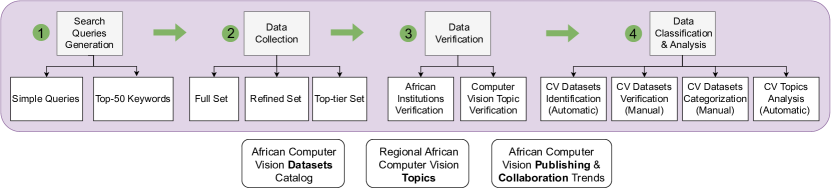
技术框架:研究首先收集63,000篇Scopus索引的计算机视觉出版物,然后使用大型语言模型对其摘要进行解析,接着对识别出的主题和数据集进行分类,最后总结出数据集的分类法和合作趋势。
关键创新:本研究的创新点在于首次系统性地分析了非洲的计算机视觉研究,利用自动化技术识别和分类数据集,填补了该领域的知识空白。
关键设计:在数据集分类中,研究设计了全面的分类法,并通过问卷调查收集了研究者对结构性障碍的看法,确保了研究的实用性和针对性。
🖼️ 关键图片
📊 实验亮点
研究结果显示,非洲在计算机视觉领域的出版物贡献仅为0.06%,而通过本研究识别出的100多个数据集将为未来的研究提供重要资源,促进研究者之间的合作与交流。
🎯 应用场景
该研究的潜在应用领域包括推动非洲地区的计算机视觉研究与开发,促进数据集的共享与合作,提升当地研究者的能力与参与度。通过改善资源获取,能够激发更多创新应用,推动社会经济发展。
📄 摘要(原文)
Despite significant efforts to democratize artificial intelligence (AI), computer vision which is a sub-field of AI, still lags in Africa. A significant factor to this, is the limited access to computing resources, datasets, and collaborations. As a result, Africa's contribution to top-tier publications in this field has only been 0.06% over the past decade. Towards improving the computer vision field and making it more accessible and inclusive, this study analyzes 63,000 Scopus-indexed computer vision publications from Africa. We utilize large language models to automatically parse their abstracts, to identify and categorize topics and datasets. This resulted in listing more than 100 African datasets. Our objective is to provide a comprehensive taxonomy of dataset categories to facilitate better understanding and utilization of these resources. We also analyze collaboration trends of researchers within and outside the continent. Additionally, we conduct a large-scale questionnaire among African computer vision researchers to identify the structural barriers they believe require urgent attention. In conclusion, our study offers a comprehensive overview of the current state of computer vision research in Africa, to empower marginalized communities to participate in the design and development of computer vision systems.