DynMF: Neural Motion Factorization for Real-time Dynamic View Synthesis with 3D Gaussian Splatting
作者: Agelos Kratimenos, Jiahui Lei, Kostas Daniilidis
分类: cs.CV, cs.GR
发布日期: 2023-11-30 (更新: 2024-12-05)
备注: Project page: https://agelosk.github.io/dynmf/
💡 一句话要点
提出DynMF以解决动态场景合成中的运动建模问题
🎯 匹配领域: 支柱三:空间感知与语义 (Perception & Semantics)
关键词: 动态场景建模 神经网络 实时合成 运动解耦 高效渲染 3D高斯点云 稀疏损失函数
📋 核心要点
- 动态场景的建模面临时间动态和运动复杂性等挑战,现有方法难以高效处理。
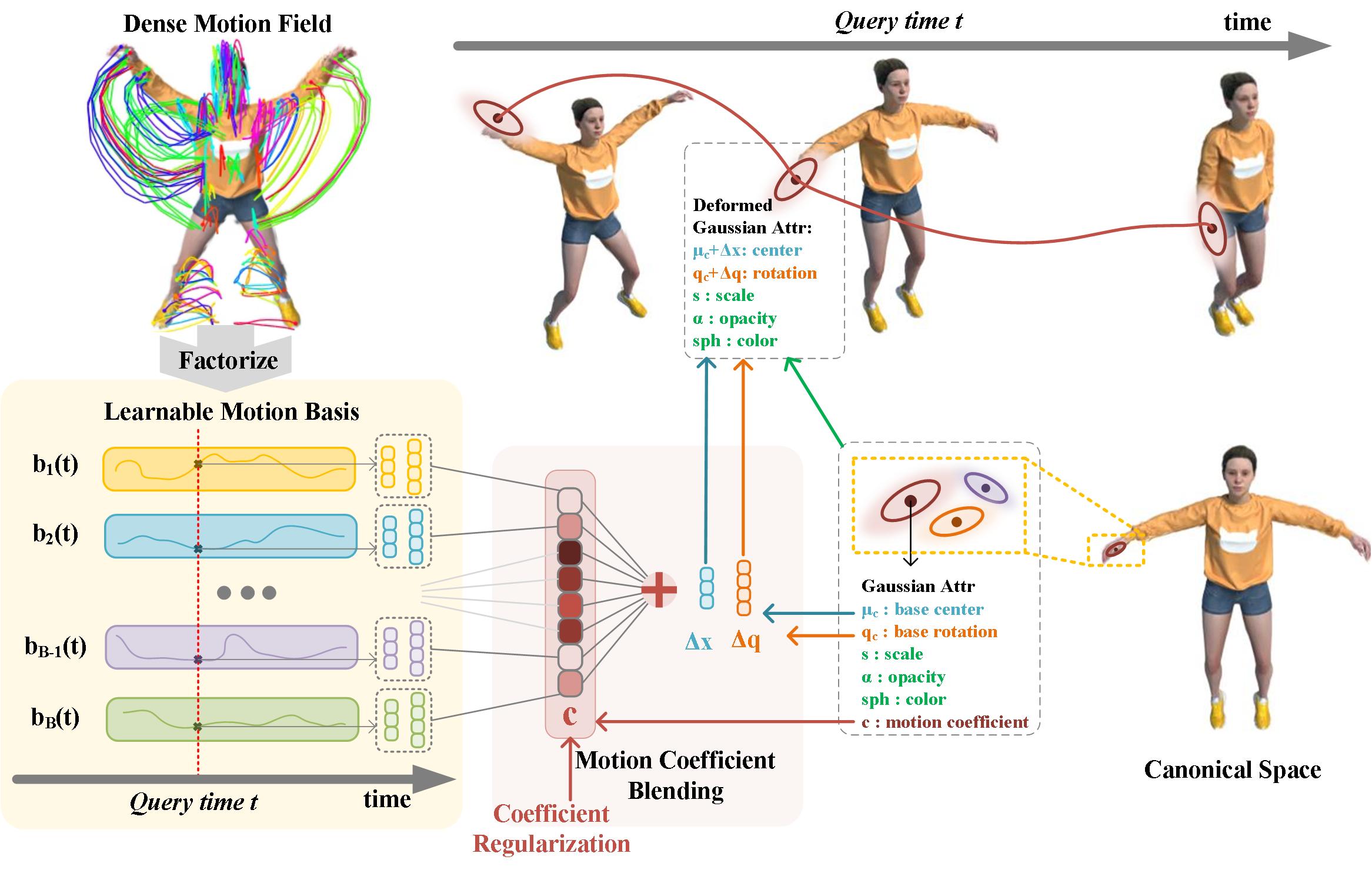
- DynMF通过将动态场景分解为少量神经轨迹,提供了一种紧凑高效的表示,允许快速渲染。
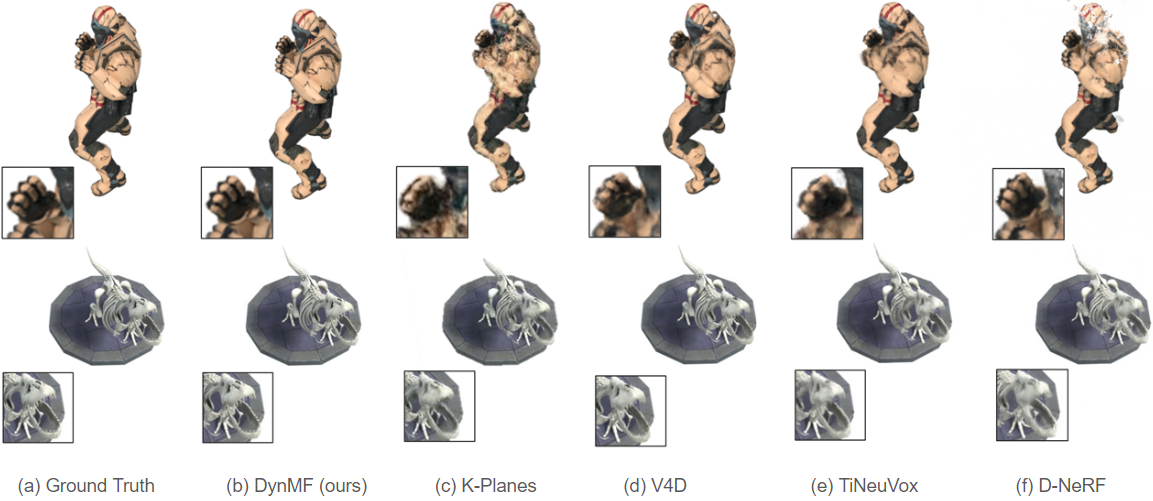
- 实验表明,DynMF在5分钟内达到最先进的渲染质量,且合成新视图的速度超过120 FPS。
📝 摘要(中文)
准确高效地建模动态场景和运动是一项具有挑战性的任务。为了解决这些挑战,本文提出了DynMF,一种紧凑高效的表示方法,将动态场景分解为少量神经轨迹。我们认为动态场景的每个点的运动可以分解为一小组显式或学习的轨迹。我们的神经框架通过仅在时间上查询一小组学习的基底,实现了与3D高斯点云相似的渲染速度,超过120 FPS,同时仅需比静态场景多双倍的存储。该表示方法有效约束了动态场景的运动场,促进了快速优化,并通过稀疏损失函数解耦场景中的运动,独立控制并生成前所未见的新运动组合。我们在仅5分钟的训练时间内达到了最先进的渲染质量,并在不到半小时内合成了具有优越光照真实感的新视图。
🔬 方法详解
问题定义:本文旨在解决动态场景中运动建模的复杂性和效率问题。现有方法在处理动态场景时,往往面临时间动态和运动复杂性带来的挑战,导致渲染速度慢和存储需求高。
核心思路:DynMF的核心思路是将动态场景的每个点的运动分解为少量的显式或学习的轨迹。通过这种方式,能够有效约束运动场并实现快速优化。
技术框架:DynMF的整体架构包括一个神经网络框架,该框架仅在时间上查询一小组学习的基底。通过将每个点绑定到运动系数,确保了轨迹的共享,从而实现了高效的渲染和优化。
关键创新:本文的关键创新在于提出了一种新的神经表示方法,能够在动态场景中有效解耦运动,并生成前所未见的运动组合。这种方法与现有的静态场景处理方式有本质区别。
关键设计:在设计中,采用了稀疏损失函数来优化运动系数,并通过小型网络结构实现高效的存储和快速的渲染速度。
🖼️ 关键图片
📊 实验亮点
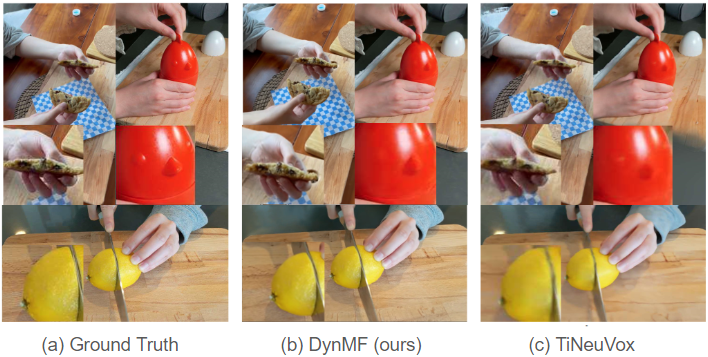
实验结果显示,DynMF在渲染质量上达到了最先进水平,且在训练仅5分钟后即可实现高质量合成。在动态场景合成中,渲染速度超过120 FPS,存储需求仅为静态场景的双倍,展现了显著的性能提升。
🎯 应用场景
该研究的潜在应用领域包括虚拟现实、游戏开发和电影制作等需要实时动态场景合成的领域。通过提供高效且高质量的动态视图合成,DynMF能够显著提升用户体验和视觉效果,具有广泛的实际价值和未来影响。
📄 摘要(原文)
Accurately and efficiently modeling dynamic scenes and motions is considered so challenging a task due to temporal dynamics and motion complexity. To address these challenges, we propose DynMF, a compact and efficient representation that decomposes a dynamic scene into a few neural trajectories. We argue that the per-point motions of a dynamic scene can be decomposed into a small set of explicit or learned trajectories. Our carefully designed neural framework consisting of a tiny set of learned basis queried only in time allows for rendering speed similar to 3D Gaussian Splatting, surpassing 120 FPS, while at the same time, requiring only double the storage compared to static scenes. Our neural representation adequately constrains the inherently underconstrained motion field of a dynamic scene leading to effective and fast optimization. This is done by biding each point to motion coefficients that enforce the per-point sharing of basis trajectories. By carefully applying a sparsity loss to the motion coefficients, we are able to disentangle the motions that comprise the scene, independently control them, and generate novel motion combinations that have never been seen before. We can reach state-of-the-art render quality within just 5 minutes of training and in less than half an hour, we can synthesize novel views of dynamic scenes with superior photorealistic quality. Our representation is interpretable, efficient, and expressive enough to offer real-time view synthesis of complex dynamic scene motions, in monocular and multi-view scenarios.