BioCLIP: A Vision Foundation Model for the Tree of Life
作者: Samuel Stevens, Jiaman Wu, Matthew J Thompson, Elizabeth G Campolongo, Chan Hee Song, David Edward Carlyn, Li Dong, Wasila M Dahdul, Charles Stewart, Tanya Berger-Wolf, Wei-Lun Chao, Yu Su
分类: cs.CV, cs.CL, cs.LG
发布日期: 2023-11-30 (更新: 2024-05-14)
备注: CVPR 2024 (oral) camera-ready version; data released
🔗 代码/项目: PROJECT_PAGE
💡 一句话要点
提出BioCLIP以解决生物图像分类的通用性问题
🎯 匹配领域: 支柱九:具身大模型 (Embodied Foundation Models)
关键词: 生物图像分类 计算机视觉 多样性监测 生态保护 深度学习
📋 核心要点
- 现有的生物图像处理方法多为定制化,难以适应新的研究问题和数据集,限制了其应用范围。
- 本文提出BioCLIP模型,利用TreeOfLife-10M数据集的丰富性和多样性,旨在为生物图像提供通用的分类解决方案。
- 实验结果表明,BioCLIP在多个细粒度生物分类任务中显著优于现有方法,提升幅度达到16%至17%。
📝 摘要(中文)
随着自然界图像的激增,尤其是来自无人机和手机的生物信息,计算方法在提取生物相关信息方面的需求日益增加。然而,现有方法多为特定任务定制,缺乏适应性。为此,本文发布了TreeOfLife-10M数据集,并开发了BioCLIP模型,旨在解决生物图像的通用分类问题。通过严格的基准测试,BioCLIP在细粒度生物分类任务中表现出色,超越了现有基线16%至17%。
🔬 方法详解
问题定义:本文旨在解决生物图像分类的通用性问题,现有方法往往针对特定任务设计,缺乏灵活性和适应性。
核心思路:通过构建BioCLIP模型,利用TreeOfLife-10M数据集的多样性和丰富的生物知识,提供一个通用的生物图像分类框架。
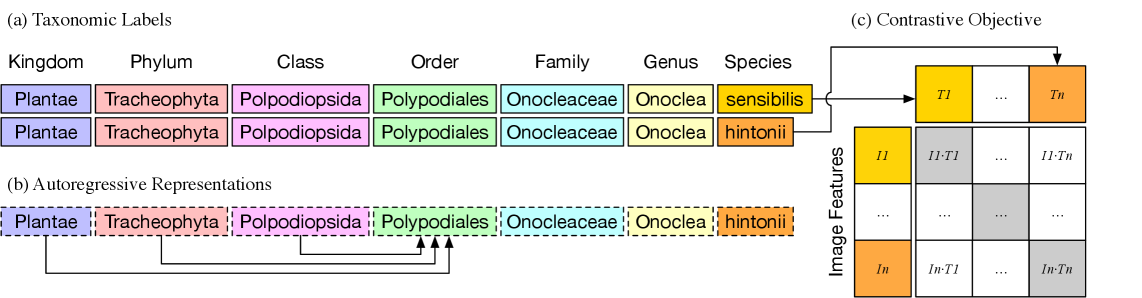
技术框架:BioCLIP的整体架构包括数据预处理、特征提取、模型训练和评估等主要模块,确保模型能够有效学习生物图像的层次化表示。
关键创新:BioCLIP的核心创新在于其能够学习符合生命树的层次化表示,显著提升了模型的泛化能力,与现有方法相比具有更强的适应性。
关键设计:在模型设计中,采用了特定的损失函数和网络结构,确保模型在多样化数据集上的表现,同时优化了训练过程中的参数设置,以提升学习效率。
🖼️ 关键图片
📊 实验亮点
BioCLIP在细粒度生物分类任务中表现优异,较现有基线提升了16%至17%的绝对准确率,验证了其强大的分类能力和泛化能力。实验结果显示,BioCLIP能够有效学习生物图像的层次化表示,进一步推动了生物图像处理技术的发展。
🎯 应用场景
BioCLIP模型的潜在应用领域包括生物多样性监测、生态保护、物种识别等。其通用性和高效性使其能够在不同的生物图像数据集上应用,推动生物科学研究和保护工作的进展。未来,BioCLIP有望成为生物图像分析的标准工具,促进科学研究与实际应用的结合。
📄 摘要(原文)
Images of the natural world, collected by a variety of cameras, from drones to individual phones, are increasingly abundant sources of biological information. There is an explosion of computational methods and tools, particularly computer vision, for extracting biologically relevant information from images for science and conservation. Yet most of these are bespoke approaches designed for a specific task and are not easily adaptable or extendable to new questions, contexts, and datasets. A vision model for general organismal biology questions on images is of timely need. To approach this, we curate and release TreeOfLife-10M, the largest and most diverse ML-ready dataset of biology images. We then develop BioCLIP, a foundation model for the tree of life, leveraging the unique properties of biology captured by TreeOfLife-10M, namely the abundance and variety of images of plants, animals, and fungi, together with the availability of rich structured biological knowledge. We rigorously benchmark our approach on diverse fine-grained biology classification tasks and find that BioCLIP consistently and substantially outperforms existing baselines (by 16% to 17% absolute). Intrinsic evaluation reveals that BioCLIP has learned a hierarchical representation conforming to the tree of life, shedding light on its strong generalizability. https://imageomics.github.io/bioclip has models, data and code.