Periodic Vibration Gaussian: Dynamic Urban Scene Reconstruction and Real-time Rendering
作者: Yurui Chen, Chun Gu, Junzhe Jiang, Xiatian Zhu, Li Zhang
分类: cs.CV
发布日期: 2023-11-30 (更新: 2025-08-23)
备注: Project page: https://fudan-zvg.github.io/PVG/
💡 一句话要点
提出周期振动高斯模型以解决动态城市场景重建问题
🎯 匹配领域: 支柱二:RL算法与架构 (RL & Architecture) 支柱三:空间感知与语义 (Perception & Semantics)
关键词: 动态场景重建 高斯点云 城市建模 实时渲染 机器学习
📋 核心要点
- 现有方法在动态城市场景建模中存在静态与动态元素分离的问题,导致协同交互捕捉不足。
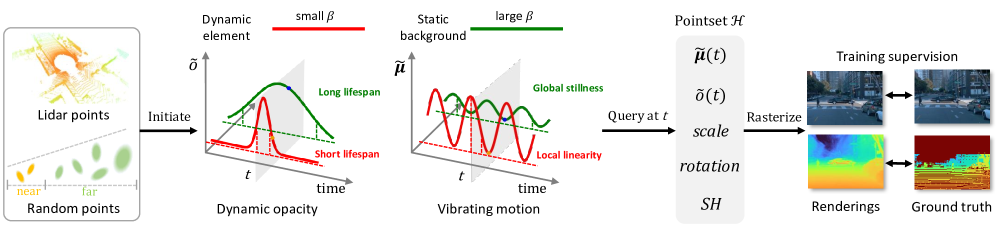
- 本文提出周期振动高斯(PVG)模型,通过引入周期振动动态,统一表示动态城市场景中的各种元素。
- 实验结果显示,PVG在重建和新视图合成上超越现有方法,且渲染速度提升900倍,表现优异。
📝 摘要(中文)
动态大规模城市场景的建模面临挑战,主要由于其复杂的几何结构和空间时间上的不受限动态。现有方法通常采用高层建筑先验,将静态和动态元素分开,导致其协同交互的捕捉效果不佳。为此,本文提出了一种统一的表示模型——周期振动高斯(PVG)。PVG基于高效的3D高斯点云技术,通过引入周期振动的时间动态,优雅地表示动态城市场景中各种对象和元素的特征。为增强稀疏训练数据下的时间一致性和大场景表示学习,本文还引入了新颖的时间平滑机制和位置感知自适应控制策略。大量实验表明,PVG在动态和静态场景的重建和新视图合成上均超越了现有最优方法,且无需依赖手动标注的物体边界框或昂贵的光流估计,渲染速度比最佳替代方案快900倍。
🔬 方法详解
问题定义:本文旨在解决动态城市场景建模中的复杂性问题,现有方法往往将静态和动态元素分开,导致无法有效捕捉其协同交互。
核心思路:提出周期振动高斯(PVG)模型,通过引入周期振动的时间动态,统一表示动态场景中的各种对象特征,从而提高建模的准确性和效率。
技术框架:PVG模型基于3D高斯点云技术,整体架构包括数据输入、周期振动动态引入、时间平滑机制和位置感知自适应控制策略等模块,形成一个完整的动态场景表示流程。
关键创新:PVG的核心创新在于引入周期振动机制,使得动态元素的时间特性能够被有效捕捉,与传统方法的静态分离策略形成鲜明对比。
关键设计:在模型设计中,采用了新颖的时间平滑机制和位置感知自适应控制策略,以增强稀疏训练数据下的学习效果,确保模型在动态场景中的表现一致性。
🖼️ 关键图片
📊 实验亮点
实验结果显示,PVG在Waymo Open Dataset和KITTI基准测试中均超越了现有最优方法,尤其在动态和静态场景的重建及新视图合成上表现突出。此外,PVG的渲染速度比最佳替代方案快900倍,显示出显著的性能提升。
🎯 应用场景
该研究的潜在应用领域包括自动驾驶、城市规划、虚拟现实等。通过高效的动态场景重建与渲染,PVG模型能够为智能交通系统提供实时环境感知支持,提升城市管理的智能化水平,具有重要的实际价值和未来影响。
📄 摘要(原文)
Modeling dynamic, large-scale urban scenes is challenging due to their highly intricate geometric structures and unconstrained dynamics in both space and time. Prior methods often employ high-level architectural priors, separating static and dynamic elements, resulting in suboptimal capture of their synergistic interactions. To address this challenge, we present a unified representation model, called Periodic Vibration Gaussian (PVG). PVG builds upon the efficient 3D Gaussian splatting technique, originally designed for static scene representation, by introducing periodic vibration-based temporal dynamics. This innovation enables PVG to elegantly and uniformly represent the characteristics of various objects and elements in dynamic urban scenes. To enhance temporally coherent and large scene representation learning with sparse training data, we introduce a novel temporal smoothing mechanism and a position-aware adaptive control strategy respectively. Extensive experiments on Waymo Open Dataset and KITTI benchmarks demonstrate that PVG surpasses state-of-the-art alternatives in both reconstruction and novel view synthesis for both dynamic and static scenes. Notably, PVG achieves this without relying on manually labeled object bounding boxes or expensive optical flow estimation. Moreover, PVG exhibits 900-fold acceleration in rendering over the best alternative.