ALSTER: A Local Spatio-Temporal Expert for Online 3D Semantic Reconstruction
作者: Silvan Weder, Francis Engelmann, Johannes L. Schönberger, Akihito Seki, Marc Pollefeys, Martin R. Oswald
分类: cs.CV
发布日期: 2023-11-29 (更新: 2023-12-03)
💡 一句话要点
提出ALSTER以解决在线3D语义重建问题
🎯 匹配领域: 支柱三:空间感知与语义 (Perception & Semantics)
关键词: 在线3D重建 语义分割 RGB-D处理 实时系统 增量更新 深度学习 机器人技术
📋 核心要点
- 现有的在线3D语义重建方法在实时性和信息提取方面存在挑战,难以处理无限输入流。
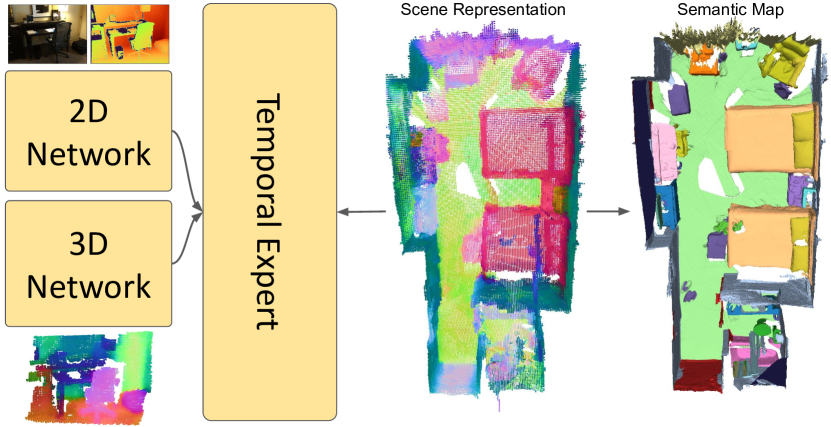
- 本研究提出了一种联合估计几何和语义标签的在线方法,并通过时间专家网络处理增量更新。
- 实验结果显示,该方法在多个基准数据集上优于现有方法,证明了信息互补的有效性。
📝 摘要(中文)
我们提出了一种在线3D语义分割方法,能够从RGB-D帧流中逐步重建3D语义地图。与离线方法不同,该方法适用于实时约束场景,如机器人和混合现实。为克服在线方法的固有挑战,我们的主要贡献包括:首先,联合估计每帧的几何信息和语义标签,以有效提取输入RGB-D视频流中的信息;其次,设计了一个时间专家网络,利用2D、3D和过去的信息,预测增量场景更新并将其整合到全局场景表示中。实验结果表明,该方法在ScanNet基准和SceneNN数据集上表现优异,超越了现有的在线方法。
🔬 方法详解
问题定义:本论文旨在解决在线3D语义重建中的实时性和信息提取问题。现有方法往往无法有效处理来自RGB-D帧流的无限输入,导致性能下降。
核心思路:我们的方法通过联合估计每帧的几何信息和语义标签,充分利用2D和3D信息的空间上下文,提升了语义实体的推理能力。
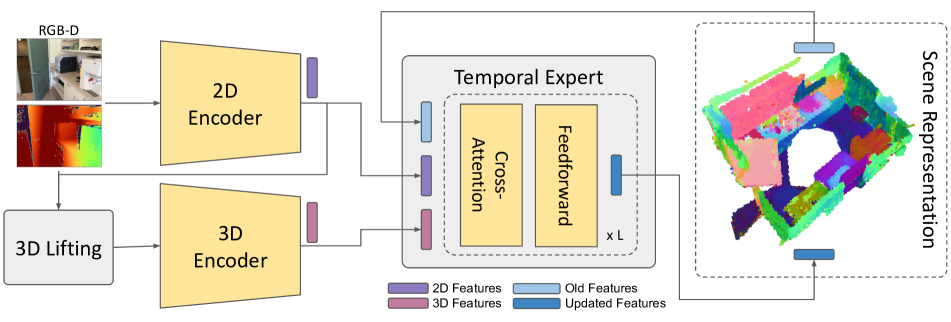
技术框架:整体架构包括两个主要模块:首先是用于提取2D特征的轻量级分割网络,其次是处理3D结构的网络,最后通过时间专家网络进行增量更新。
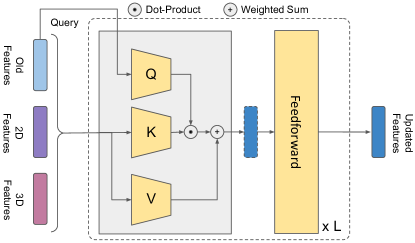
关键创新:最重要的创新在于设计了一个时间专家网络,能够在处理无限输入流的同时,利用历史信息进行场景更新,这与现有方法的局限性形成鲜明对比。
关键设计:我们在网络结构上采用了轻量级设计,确保实时性,同时在损失函数中引入了多模态信息融合,以提升模型的整体性能。通过一系列消融实验验证了不同设计选择的有效性。
🖼️ 关键图片
📊 实验亮点
我们的实验结果在ScanNet基准和SceneNN数据集上显示,ALSTER方法在处理增量更新时,相较于现有在线方法,性能提升显著,尤其在局部区域的语义理解上,表现出更高的准确性和效率。
🎯 应用场景
该研究的潜在应用领域包括机器人导航、增强现实和虚拟现实等实时场景。通过提供高效的3D语义重建能力,ALSTER能够在动态环境中实现更智能的交互和决策,具有重要的实际价值和未来影响。
📄 摘要(原文)
We propose an online 3D semantic segmentation method that incrementally reconstructs a 3D semantic map from a stream of RGB-D frames. Unlike offline methods, ours is directly applicable to scenarios with real-time constraints, such as robotics or mixed reality. To overcome the inherent challenges of online methods, we make two main contributions. First, to effectively extract information from the input RGB-D video stream, we jointly estimate geometry and semantic labels per frame in 3D. A key focus of our approach is to reason about semantic entities both in the 2D input and the local 3D domain to leverage differences in spatial context and network architectures. Our method predicts 2D features using an off-the-shelf segmentation network. The extracted 2D features are refined by a lightweight 3D network to enable reasoning about the local 3D structure. Second, to efficiently deal with an infinite stream of input RGB-D frames, a subsequent network serves as a temporal expert predicting the incremental scene updates by leveraging 2D, 3D, and past information in a learned manner. These updates are then integrated into a global scene representation. Using these main contributions, our method can enable scenarios with real-time constraints and can scale to arbitrary scene sizes by processing and updating the scene only in a local region defined by the new measurement. Our experiments demonstrate improved results compared to existing online methods that purely operate in local regions and show that complementary sources of information can boost the performance. We provide a thorough ablation study on the benefits of different architectural as well as algorithmic design decisions. Our method yields competitive results on the popular ScanNet benchmark and SceneNN dataset.