DifFlow3D: Toward Robust Uncertainty-Aware Scene Flow Estimation with Diffusion Model
作者: Jiuming Liu, Guangming Wang, Weicai Ye, Chaokang Jiang, Jinru Han, Zhe Liu, Guofeng Zhang, Dalong Du, Hesheng Wang
分类: cs.CV
发布日期: 2023-11-29 (更新: 2024-05-10)
备注: Accepted by CVPR 2024. Codes are released at https://github.com/IRMVLab/DifFlow3D
🔗 代码/项目: GITHUB
💡 一句话要点
提出DifFlow3D以解决动态场景流估计中的不确定性问题
🎯 匹配领域: 支柱三:空间感知与语义 (Perception & Semantics)
关键词: 场景流估计 扩散模型 不确定性感知 动态场景 计算机视觉 深度学习 鲁棒性 精度提升
📋 核心要点
- 现有场景流估计方法在动态场景中面临相关性不可靠和累积不准确性的问题。
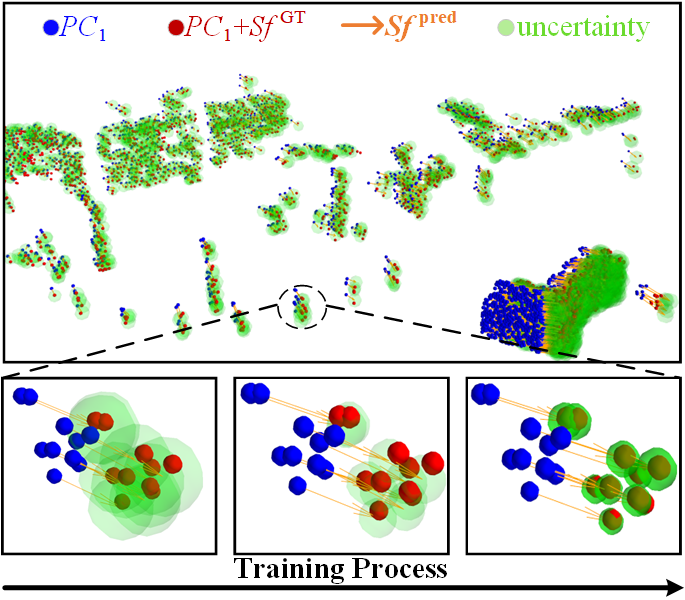
- 本文提出的DifFlow3D网络利用扩散模型进行不确定性感知的场景流估计,增强了对复杂情况的鲁棒性。
- 实验结果表明,DifFlow3D在多个数据集上显著提高了估计精度,尤其在KITTI数据集上达到了毫米级精度。
📝 摘要(中文)
场景流估计旨在预测动态场景中每个点的三维位移,是计算机视觉领域的基础任务。然而,现有方法常因局部约束搜索范围导致的相关性不可靠,以及粗到细结构引起的累积不准确性而面临挑战。为此,本文提出了一种新颖的不确定性感知场景流估计网络DifFlow3D,结合扩散概率模型。通过迭代的扩散基础精炼,增强了对动态、噪声输入和重复模式等挑战性情况的相关性鲁棒性。此外,论文还开发了不确定性估计模块,以评估估计场景流的可靠性。DifFlow3D在FlyingThings3D和KITTI 2015数据集上分别实现了24.0%和29.1%的EPE3D降低,且在KITTI数据集上达到了前所未有的毫米级精度(0.0078m)。
🔬 方法详解
问题定义:本文旨在解决动态场景流估计中的不确定性问题,现有方法因局部搜索范围限制而导致相关性不可靠,同时粗到细的结构引起的累积不准确性也是主要痛点。
核心思路:DifFlow3D通过引入扩散概率模型,采用迭代的扩散基础精炼来增强场景流估计的鲁棒性,并通过不确定性估计模块评估估计结果的可靠性。
技术框架:整体架构包括三个主要模块:扩散模型模块、流特征条件模块和不确定性估计模块。扩散模型负责生成和精炼场景流,流特征模块提供条件信息以限制生成多样性,不确定性模块则评估估计的可靠性。
关键创新:最重要的创新在于将扩散模型应用于场景流估计中,并通过不确定性感知来提高估计的准确性和鲁棒性,这与传统方法的直接回归方式有本质区别。
关键设计:在设计中,选择了三种关键流相关特征作为扩散模型的条件,以限制生成的多样性。此外,损失函数的设计也考虑了不确定性评估,以确保最终输出的可靠性。
🖼️ 关键图片


📊 实验亮点
DifFlow3D在FlyingThings3D和KITTI 2015数据集上分别实现了24.0%和29.1%的EPE3D降低,且在KITTI数据集上达到了前所未有的毫米级精度(0.0078m)。该方法的扩散基础精炼可以作为即插即用模块集成到现有场景流网络中,显著提高其估计准确性。
🎯 应用场景
该研究的潜在应用领域包括自动驾驶、机器人导航和增强现实等动态场景理解任务。通过提高场景流估计的准确性和鲁棒性,DifFlow3D能够为这些领域提供更可靠的基础技术支持,推动相关应用的发展。未来,该方法还可以与其他计算机视觉任务结合,进一步提升整体系统性能。
📄 摘要(原文)
Scene flow estimation, which aims to predict per-point 3D displacements of dynamic scenes, is a fundamental task in the computer vision field. However, previous works commonly suffer from unreliable correlation caused by locally constrained searching ranges, and struggle with accumulated inaccuracy arising from the coarse-to-fine structure. To alleviate these problems, we propose a novel uncertainty-aware scene flow estimation network (DifFlow3D) with the diffusion probabilistic model. Iterative diffusion-based refinement is designed to enhance the correlation robustness and resilience to challenging cases, e.g. dynamics, noisy inputs, repetitive patterns, etc. To restrain the generation diversity, three key flow-related features are leveraged as conditions in our diffusion model. Furthermore, we also develop an uncertainty estimation module within diffusion to evaluate the reliability of estimated scene flow. Our DifFlow3D achieves state-of-the-art performance, with 24.0% and 29.1% EPE3D reduction respectively on FlyingThings3D and KITTI 2015 datasets. Notably, our method achieves an unprecedented millimeter-level accuracy (0.0078m in EPE3D) on the KITTI dataset. Additionally, our diffusion-based refinement paradigm can be readily integrated as a plug-and-play module into existing scene flow networks, significantly increasing their estimation accuracy. Codes are released at https://github.com/IRMVLab/DifFlow3D.