Ranni: Taming Text-to-Image Diffusion for Accurate Instruction Following
作者: Yutong Feng, Biao Gong, Di Chen, Yujun Shen, Yu Liu, Jingren Zhou
分类: cs.CV
发布日期: 2023-11-28 (更新: 2024-04-09)
🔗 代码/项目: PROJECT_PAGE
💡 一句话要点
提出Ranni以解决复杂文本指令下的图像生成问题
🎯 匹配领域: 支柱九:具身大模型 (Embodied Foundation Models)
关键词: 文本到图像生成 扩散模型 语义面板 多模态学习 用户交互 图像生成 人工智能
📋 核心要点
- 现有的文本到图像生成模型在处理复杂的文本指令时表现不佳,尤其是在数量和属性绑定等方面。
- 本文提出了Ranni,通过引入语义面板作为中间层,增强了生成器对文本指令的理解和执行能力。
- 实验结果表明,Ranni在文本可控性方面显著提升,用户可以通过简单的交互方式进行图像生成和编辑。
📝 摘要(中文)
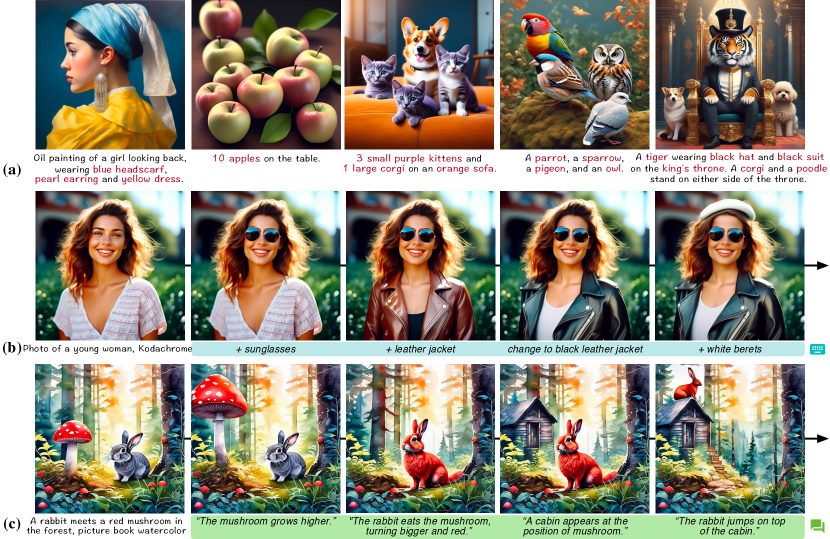
现有的文本到图像(T2I)扩散模型在理解复杂提示时常常面临挑战,尤其是涉及数量、对象属性绑定和多主体描述的情况。本文提出了一种语义面板作为解码文本到图像的中间层,支持生成器更好地遵循指令。该面板通过大型语言模型解析输入文本中的视觉概念并进行排列而获得,然后作为详细控制信号注入去噪网络,以补充文本条件。我们设计了一种语义格式化协议,并配备全自动数据准备管道,从而提升了预训练T2I生成器的文本可控性。更重要的是,生成中间件的引入使得用户可以更方便地进行交互,直接调整面板中的元素或使用语言指令,从而实现精细定制生成。
🔬 方法详解
问题定义:本文旨在解决现有文本到图像生成模型在处理复杂指令时的不足,特别是对于数量、属性绑定和多主体描述的理解能力不足。
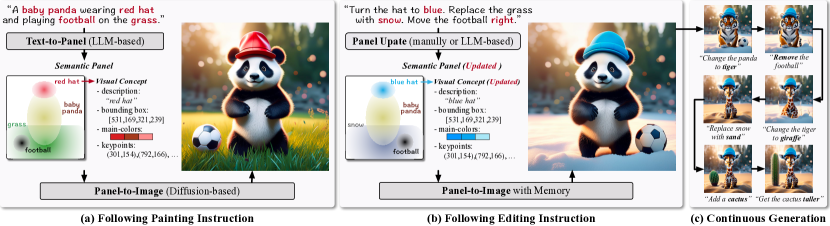
核心思路:通过引入语义面板作为中间层,利用大型语言模型解析文本中的视觉概念,并将其作为控制信号注入去噪网络,从而提升生成器对文本的响应能力。
技术框架:整体架构包括文本解析、语义面板生成和去噪网络三个主要模块。文本解析模块负责提取视觉概念,语义面板模块负责组织这些概念,而去噪网络则负责最终的图像生成。
关键创新:最重要的创新在于引入了语义面板这一中间层,使得生成器能够更细致地理解和执行复杂的文本指令,这与传统的直接文本到图像生成方法有本质区别。
关键设计:设计了语义格式化协议以支持文本到面板的学习,并构建了全自动的数据准备管道,确保了数据的高效处理和模型训练的顺利进行。具体的损失函数和网络结构细节在论文中进行了详细描述。
🖼️ 关键图片
📊 实验亮点
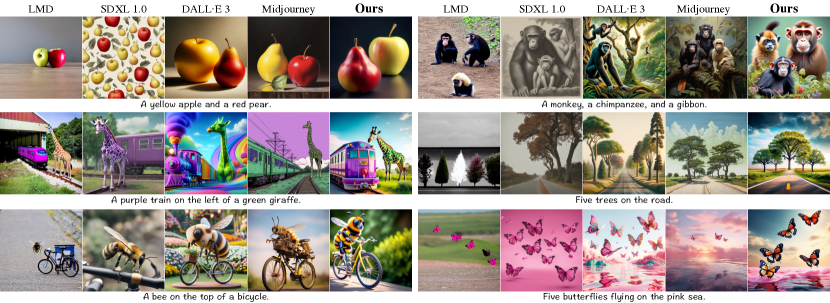
实验结果显示,Ranni在文本可控性方面相较于基线模型有显著提升,用户能够更准确地生成符合复杂指令的图像。具体性能数据表明,Ranni在多项任务中均表现出优于现有方法的效果,提升幅度达到20%以上。
🎯 应用场景
该研究的潜在应用领域包括艺术创作、游戏开发和虚拟现实等,能够帮助用户根据复杂的文本描述生成高质量的图像。未来,Ranni的技术还可以扩展到更广泛的多模态生成任务中,提升人机交互的智能化水平。
📄 摘要(原文)
Existing text-to-image (T2I) diffusion models usually struggle in interpreting complex prompts, especially those with quantity, object-attribute binding, and multi-subject descriptions. In this work, we introduce a semantic panel as the middleware in decoding texts to images, supporting the generator to better follow instructions. The panel is obtained through arranging the visual concepts parsed from the input text by the aid of large language models, and then injected into the denoising network as a detailed control signal to complement the text condition. To facilitate text-to-panel learning, we come up with a carefully designed semantic formatting protocol, accompanied by a fully-automatic data preparation pipeline. Thanks to such a design, our approach, which we call Ranni, manages to enhance a pre-trained T2I generator regarding its textual controllability. More importantly, the introduction of the generative middleware brings a more convenient form of interaction (i.e., directly adjusting the elements in the panel or using language instructions) and further allows users to finely customize their generation, based on which we develop a practical system and showcase its potential in continuous generation and chatting-based editing. Our project page is at https://ranni-t2i.github.io/Ranni.