Compact 3D Gaussian Representation for Radiance Field
作者: Joo Chan Lee, Daniel Rho, Xiangyu Sun, Jong Hwan Ko, Eunbyung Park
分类: cs.CV, cs.GR
发布日期: 2023-11-22 (更新: 2024-02-15)
备注: Project page: http://maincold2.github.io/c3dgs/
🔗 代码/项目: PROJECT_PAGE
💡 一句话要点
提出紧凑的3D高斯表示以解决NeRF渲染瓶颈问题
🎯 匹配领域: 支柱三:空间感知与语义 (Perception & Semantics)
关键词: 神经辐射场 3D高斯表示 渲染优化 模型压缩 实时渲染
📋 核心要点
- 现有的NeRF方法在高保真度渲染复杂3D场景时面临计算瓶颈,限制了其应用。
- 本文提出通过可学习的掩码策略和网格神经场来减少高斯点数量和压缩属性,从而提升渲染效率。
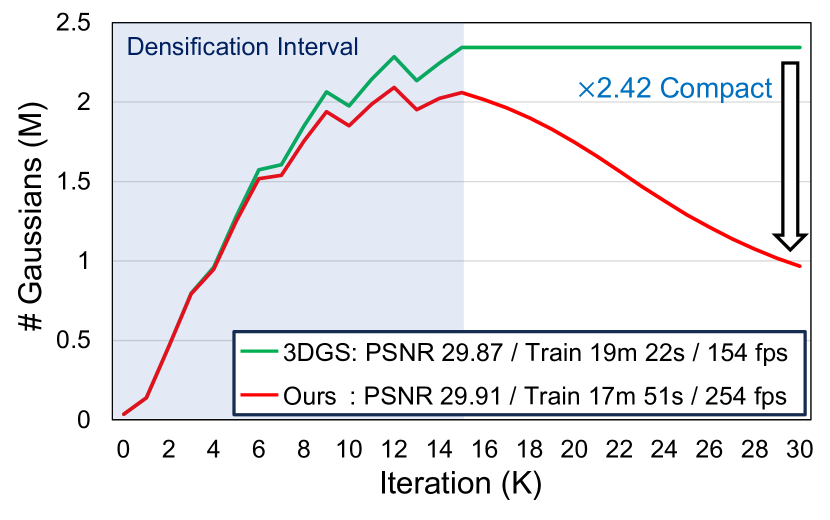
- 实验结果显示,所提方法在存储和渲染速度上均有显著提升,存储减少超过25倍,同时保持了高质量的场景表示。
📝 摘要(中文)
神经辐射场(NeRF)在高保真度捕捉复杂3D场景方面展现了显著潜力,但由于体积渲染导致的计算瓶颈限制了其广泛应用。3D高斯点云(3DGS)作为一种新兴的表示方法,通过光栅化管道实现快速渲染,但需要大量3D高斯点以保持图像质量,导致内存和存储需求高。为了解决这一问题,本文提出了一种可学习的掩码策略,显著减少高斯点数量,同时保持高性能,并通过网格神经场有效表示视角依赖的颜色,最后利用向量量化学习代码本以紧凑表示高斯的几何属性。通过模型压缩技术,本文实现了超过25倍的存储减少和渲染速度提升,同时保持场景表示质量。
🔬 方法详解
问题定义:本文旨在解决NeRF在渲染复杂3D场景时的计算瓶颈问题,现有的3D高斯点云方法需要大量高斯点以维持图像质量,导致内存和存储需求过高。
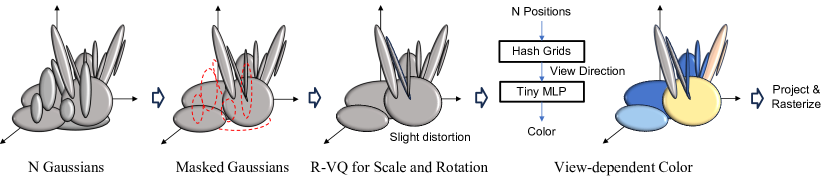
核心思路:通过引入可学习的掩码策略来减少高斯点数量,同时采用网格神经场来有效表示视角依赖的颜色,以此提高渲染速度和降低存储需求。
技术框架:整体架构包括三个主要模块:可学习掩码生成模块、网格神经场模块和高斯几何属性的向量量化模块。首先,通过掩码策略筛选出重要的高斯点;其次,使用网格神经场表示颜色信息;最后,利用向量量化压缩几何属性。
关键创新:最重要的技术创新在于提出了可学习的掩码策略和网格神经场的结合,显著减少了高斯点的数量,同时保持了渲染质量,与传统的3DGS方法相比,内存和存储需求大幅降低。
关键设计:在参数设置上,掩码策略通过深度学习模型进行训练,损失函数设计为综合考虑渲染质量和存储效率,网络结构采用了适合处理高维数据的卷积神经网络,以提高学习效果。
🖼️ 关键图片

📊 实验亮点
实验结果表明,所提方法在存储和渲染速度上均有显著提升,存储需求减少超过25倍,同时渲染速度显著提高,且保持了高质量的场景表示,优于传统的3D高斯点云方法。
🎯 应用场景
该研究的潜在应用领域包括虚拟现实、游戏开发、电影制作等需要高质量3D场景渲染的行业。通过提升渲染速度和降低存储需求,能够使得实时3D场景生成和交互成为可能,具有重要的实际价值和未来影响。
📄 摘要(原文)
Neural Radiance Fields (NeRFs) have demonstrated remarkable potential in capturing complex 3D scenes with high fidelity. However, one persistent challenge that hinders the widespread adoption of NeRFs is the computational bottleneck due to the volumetric rendering. On the other hand, 3D Gaussian splatting (3DGS) has recently emerged as an alternative representation that leverages a 3D Gaussisan-based representation and adopts the rasterization pipeline to render the images rather than volumetric rendering, achieving very fast rendering speed and promising image quality. However, a significant drawback arises as 3DGS entails a substantial number of 3D Gaussians to maintain the high fidelity of the rendered images, which requires a large amount of memory and storage. To address this critical issue, we place a specific emphasis on two key objectives: reducing the number of Gaussian points without sacrificing performance and compressing the Gaussian attributes, such as view-dependent color and covariance. To this end, we propose a learnable mask strategy that significantly reduces the number of Gaussians while preserving high performance. In addition, we propose a compact but effective representation of view-dependent color by employing a grid-based neural field rather than relying on spherical harmonics. Finally, we learn codebooks to compactly represent the geometric attributes of Gaussian by vector quantization. With model compression techniques such as quantization and entropy coding, we consistently show over 25$\times$ reduced storage and enhanced rendering speed, while maintaining the quality of the scene representation, compared to 3DGS. Our work provides a comprehensive framework for 3D scene representation, achieving high performance, fast training, compactness, and real-time rendering. Our project page is available at https://maincold2.github.io/c3dgs/.