Meta-Adapter: An Online Few-shot Learner for Vision-Language Model
作者: Cheng Cheng, Lin Song, Ruoyi Xue, Hang Wang, Hongbin Sun, Yixiao Ge, Ying Shan
分类: cs.CV
发布日期: 2023-11-07 (更新: 2024-01-11)
备注: Accepted by NeurIPS 2023
💡 一句话要点
提出Meta-Adapter以解决CLIP在少样本学习中的在线适应问题
🎯 匹配领域: 支柱三:空间感知与语义 (Perception & Semantics)
关键词: 少样本学习 视觉-语言模型 在线学习 特征精炼 CLIP 目标检测 图像分类 深度学习
📋 核心要点
- 现有基于CLIP的少样本学习方法需要离线微调,导致推理时间长和过拟合风险。
- 本文提出Meta-Adapter,通过在线方式根据少样本精炼CLIP特征,避免了离线微调的缺陷。
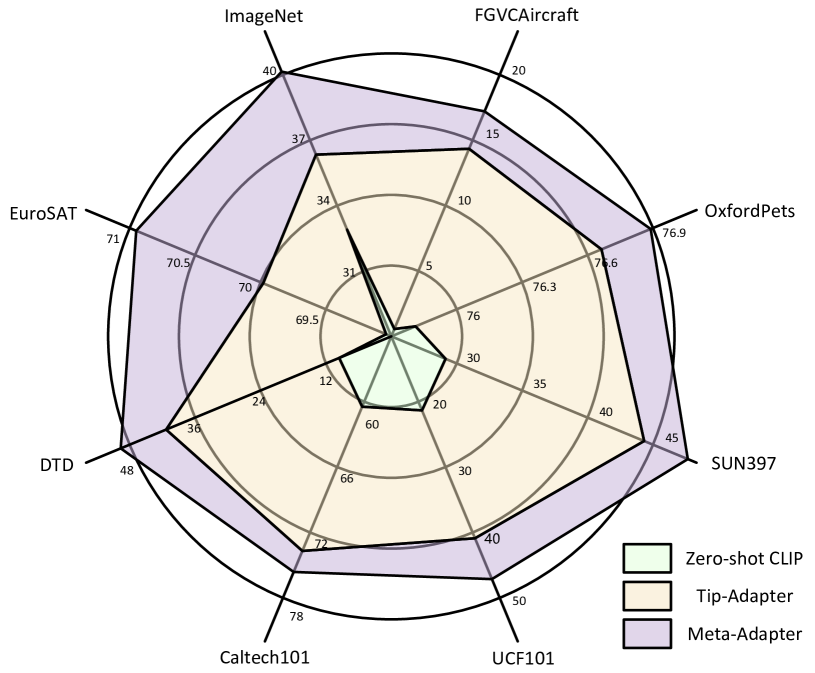
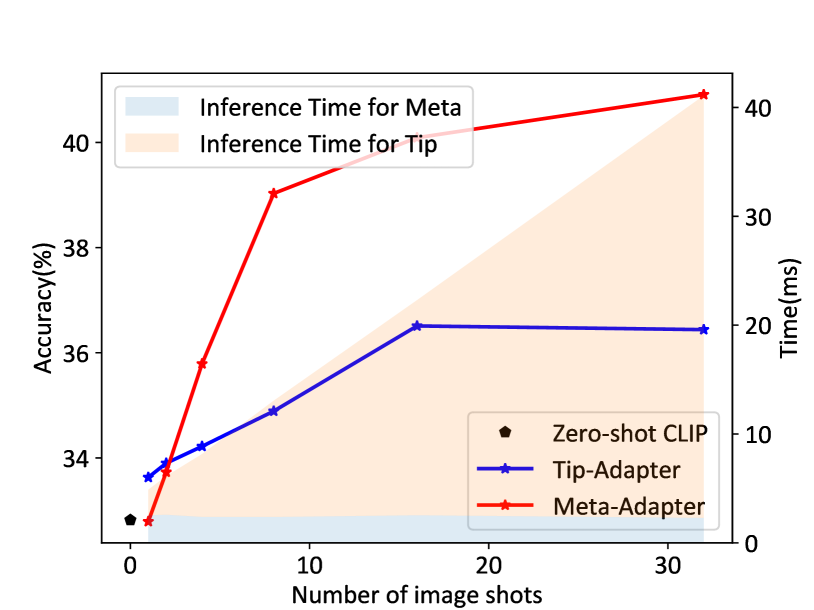
- 实验结果表明,Meta-Adapter在多个数据集上平均提升3.6%,且推理速度更快,适用于多种下游任务。
📝 摘要(中文)
对比视觉-语言预训练模型CLIP展现出在开放世界视觉概念感知中的潜力,但基于CLIP的少样本学习方法通常需要对少样本进行离线微调,导致推理时间较长且在某些领域存在过拟合风险。为了解决这些挑战,本文提出了Meta-Adapter,这是一种轻量级的残差风格适配器,能够在线地根据少样本精炼CLIP特征。通过少量训练样本,我们的方法能够实现有效的少样本学习能力,并在无需额外微调的情况下对未见数据或任务进行泛化,取得了竞争力的性能和高效性。我们的模型在八个图像分类数据集上平均超越了最先进的在线少样本学习方法3.6%,且推理速度更快。此外,Meta-Adapter作为一个简单灵活的插件模块,能够直接应用于下游任务,在开放词汇目标检测和分割任务中获得显著性能提升。
🔬 方法详解
问题定义:本文旨在解决基于CLIP的少样本学习方法在推理时需要离线微调的问题,这种方法导致了推理时间延长和过拟合风险。
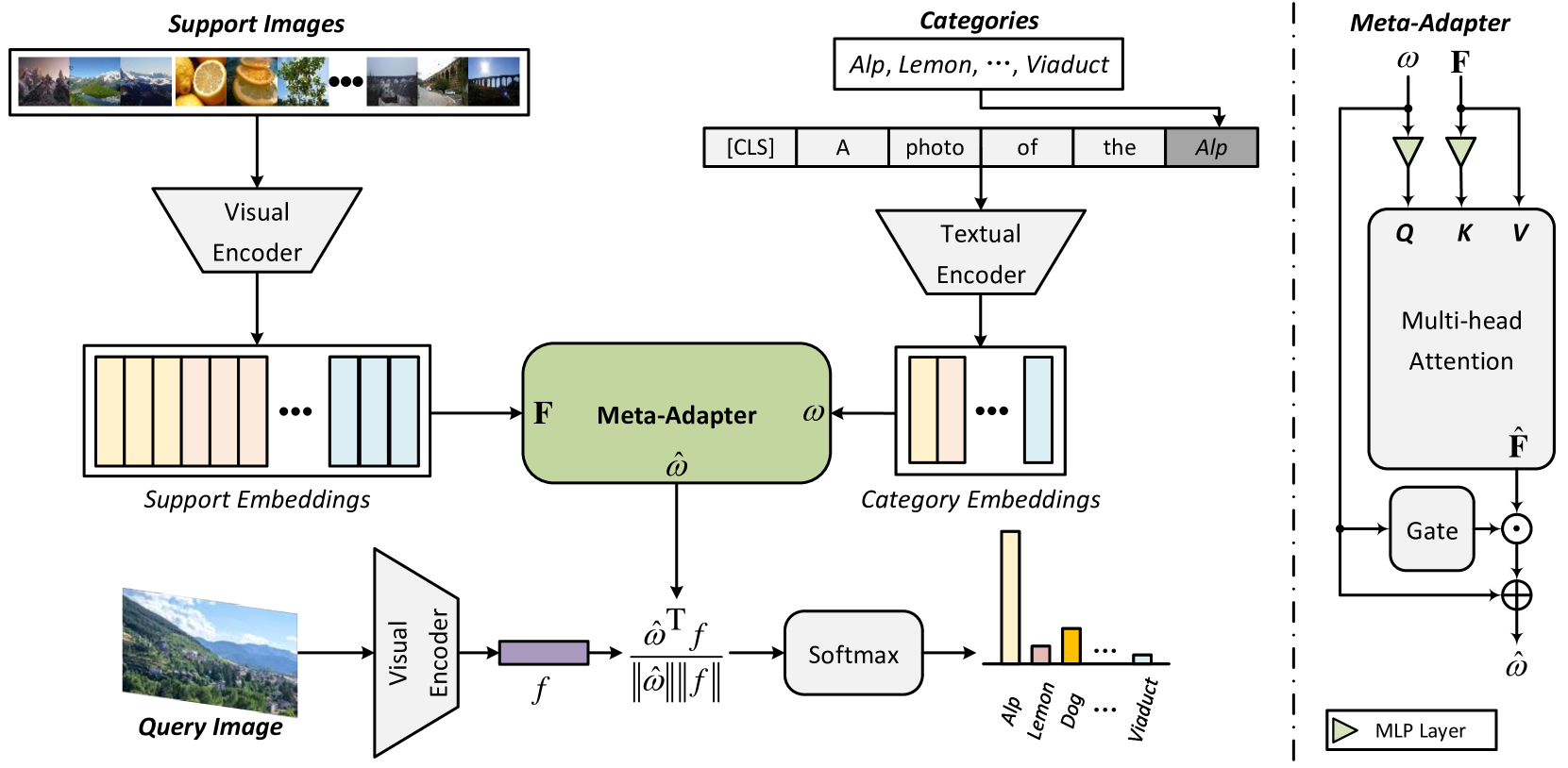
核心思路:Meta-Adapter通过轻量级的残差风格适配器在线地根据少样本进行特征精炼,避免了传统方法的离线微调过程,从而提高了学习效率和泛化能力。
技术框架:该方法的整体架构包括特征提取模块(基于CLIP)、适配器模块(Meta-Adapter)和在线学习机制。特征提取模块负责从输入图像中提取视觉特征,适配器模块则根据少样本进行特征调整,最后通过在线学习机制实现快速适应。
关键创新:Meta-Adapter的最大创新在于其轻量级设计和在线适应能力,使得模型在少样本情况下能够快速调整特征,而不需要额外的微调步骤,这与现有方法形成了鲜明对比。
关键设计:在设计上,Meta-Adapter采用了残差连接以保持信息流动,同时使用了特定的损失函数来优化特征调整过程,确保模型在少样本学习中的有效性。
🖼️ 关键图片
📊 实验亮点
在实验中,Meta-Adapter在八个图像分类数据集上平均提升了3.6%,超越了最先进的在线少样本学习方法,且推理速度显著提高。这表明该方法在效率和性能上的双重优势,具有较强的竞争力。
🎯 应用场景
Meta-Adapter的研究成果在多个领域具有广泛的应用潜力,尤其是在需要快速适应新任务的计算机视觉应用中,如图像分类、目标检测和分割等。其高效的在线学习能力使得模型能够在动态环境中快速响应,具有重要的实际价值和未来影响。
📄 摘要(原文)
The contrastive vision-language pre-training, known as CLIP, demonstrates remarkable potential in perceiving open-world visual concepts, enabling effective zero-shot image recognition. Nevertheless, few-shot learning methods based on CLIP typically require offline fine-tuning of the parameters on few-shot samples, resulting in longer inference time and the risk of over-fitting in certain domains. To tackle these challenges, we propose the Meta-Adapter, a lightweight residual-style adapter, to refine the CLIP features guided by the few-shot samples in an online manner. With a few training samples, our method can enable effective few-shot learning capabilities and generalize to unseen data or tasks without additional fine-tuning, achieving competitive performance and high efficiency. Without bells and whistles, our approach outperforms the state-of-the-art online few-shot learning method by an average of 3.6\% on eight image classification datasets with higher inference speed. Furthermore, our model is simple and flexible, serving as a plug-and-play module directly applicable to downstream tasks. Without further fine-tuning, Meta-Adapter obtains notable performance improvements in open-vocabulary object detection and segmentation tasks.