Exploitation-Guided Exploration for Semantic Embodied Navigation
作者: Justin Wasserman, Girish Chowdhary, Abhinav Gupta, Unnat Jain
分类: cs.CV, cs.AI, cs.LG, cs.RO
发布日期: 2023-11-06
备注: Code and results available at http://xgxvisnav.github.io
💡 一句话要点
提出基于利用引导的探索方法以提升语义体导航性能
🎯 匹配领域: 支柱一:机器人控制 (Robot Control)
关键词: 体导航 模块化策略 探索与利用 仿真到现实 机器人技术 策略优化
📋 核心要点
- 现有的模块化策略在体导航任务中存在组合性不足的问题,难以有效整合探索与利用。
- 本文提出的利用引导的探索(XGX)方法,通过将探索和利用模块结合,优化了导航过程中的策略选择。
- 实验结果表明,XGX在物体导航任务中的表现从70%提升至73%,并在目标条件探索中展现出更高的效率。
📝 摘要(中文)
在近年来的体导航和仿真到机器人转移的进展中,模块化策略已成为一种事实上的框架。然而,组合性不仅仅是将学习负载分解为模块组件。本文探讨了一种有原则的方式来语法上组合这些组件。特别地,我们提出了利用引导的探索(XGX),将探索和利用的独立模块以新颖且直观的方式结合在一起。我们配置利用模块在导航的确定性最后步骤中接管,即当目标变得可见时。关键是,利用模块强制探索模块,并继续推动被覆盖的策略优化。XGX通过有效的分解和新颖的引导,将在具有挑战性的物体导航任务上的性能从70%提升至73%。通过针对性分析,我们还表明XGX在目标条件探索方面更为高效。最后,我们展示了仿真到现实的转移,XGX在机器人硬件上表现超过最佳基线的两倍。
🔬 方法详解
问题定义:本文旨在解决现有体导航方法中模块化策略的组合性不足,导致探索与利用的有效整合困难。
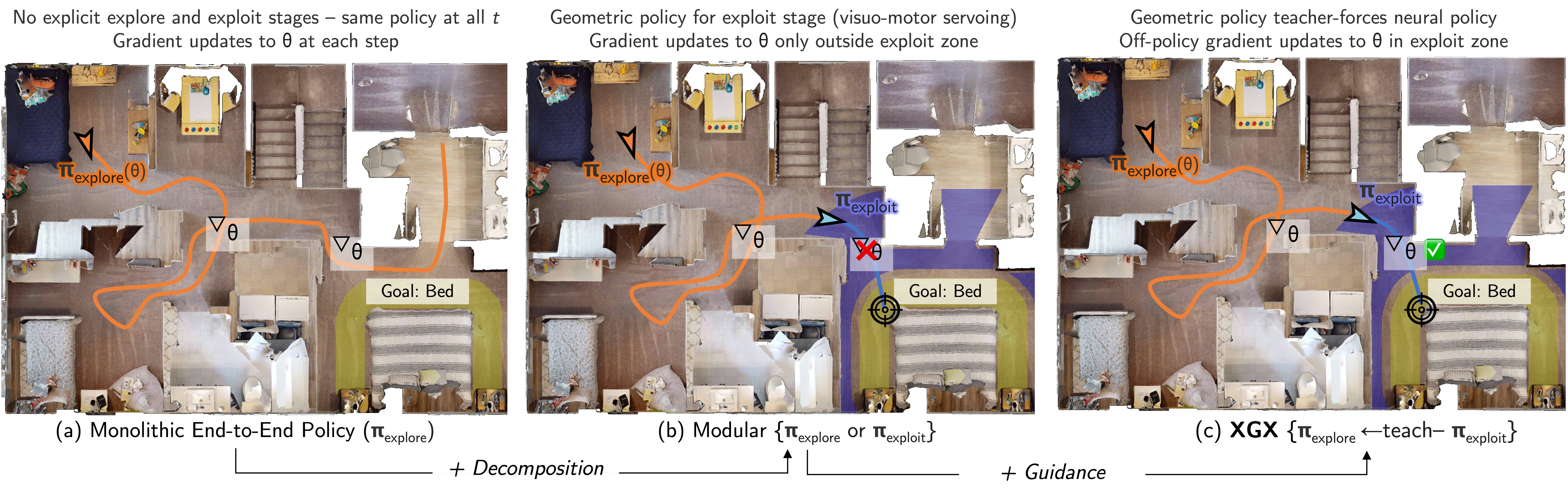
核心思路:提出利用引导的探索(XGX),通过将独立的探索和利用模块结合,优化导航过程中的决策,使得在目标可见时能够更有效地进行导航。
技术框架:XGX的整体架构包括两个主要模块:探索模块和利用模块。在导航过程中,探索模块负责初步的环境探索,而利用模块在目标可见时接管,确保导航的准确性和效率。
关键创新:XGX的核心创新在于利用模块对探索模块的强制引导,这种设计使得策略优化过程更加高效,克服了传统方法中探索与利用分离的局限性。
关键设计:在参数设置上,XGX采用了特定的损失函数来平衡探索与利用的权重,同时在网络结构上,探索模块与利用模块之间的交互设计确保了信息的有效传递。
🖼️ 关键图片
📊 实验亮点
在实验中,XGX方法在物体导航任务中的性能从70%提升至73%,显示出显著的改进。此外,在目标条件探索方面,XGX展现出更高的效率,且在仿真到现实的转移中,其性能超过最佳基线的两倍,证明了其在实际应用中的潜力。
🎯 应用场景
该研究的潜在应用领域包括自主机器人导航、智能家居系统以及增强现实等场景。通过提升导航的准确性和效率,XGX方法能够在复杂环境中实现更为智能的决策,具有重要的实际价值和未来影响。
📄 摘要(原文)
In the recent progress in embodied navigation and sim-to-robot transfer, modular policies have emerged as a de facto framework. However, there is more to compositionality beyond the decomposition of the learning load into modular components. In this work, we investigate a principled way to syntactically combine these components. Particularly, we propose Exploitation-Guided Exploration (XGX) where separate modules for exploration and exploitation come together in a novel and intuitive manner. We configure the exploitation module to take over in the deterministic final steps of navigation i.e. when the goal becomes visible. Crucially, an exploitation module teacher-forces the exploration module and continues driving an overridden policy optimization. XGX, with effective decomposition and novel guidance, improves the state-of-the-art performance on the challenging object navigation task from 70% to 73%. Along with better accuracy, through targeted analysis, we show that XGX is also more efficient at goal-conditioned exploration. Finally, we show sim-to-real transfer to robot hardware and XGX performs over two-fold better than the best baseline from simulation benchmarking. Project page: xgxvisnav.github.io