Long-Term Invariant Local Features via Implicit Cross-Domain Correspondences
作者: Zador Pataki, Mohammad Altillawi, Menelaos Kanakis, Rémi Pautrat, Fengyi Shen, Ziyuan Liu, Luc Van Gool, Marc Pollefeys
分类: cs.CV
发布日期: 2023-11-06
备注: 14 pages + 5 pages appendix, 13 figures
💡 一句话要点
提出隐式跨域对应方法以解决长期视觉定位问题
🎯 匹配领域: 支柱三:空间感知与语义 (Perception & Semantics)
关键词: 视觉定位 跨域学习 神经辐射场 特征提取 深度学习 计算机视觉
📋 核心要点
- 现有视觉特征提取网络在长期视觉域变化下性能显著下降,影响了跨域定位的准确性。
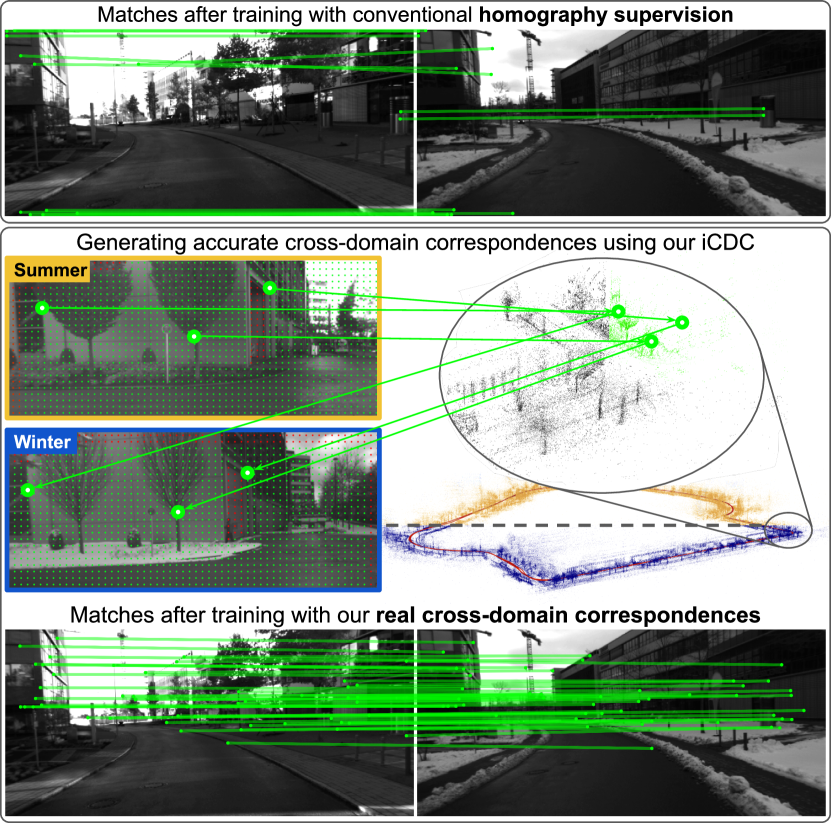
- 本文提出隐式跨域对应(iCDC)方法,通过多个神经辐射场生成跨域对应,提升了特征提取网络的监督效果。
- 在多个长期定位基准测试中,所提方法的网络表现优于现有技术,显著缩小了同域与跨域定位的性能差距。
📝 摘要(中文)
现代基于学习的视觉特征提取网络在同域定位中表现良好,但在长期视觉域变化(如季节和日间变化)下性能显著下降。本文的首个贡献是建立基准测试,研究长期变化对视觉定位性能的影响。我们分析了当前最先进的特征提取网络在不同域变化下的表现,发现同域与跨域定位之间存在显著性能差距。为缩小这一差距,我们提出了一种新颖的数据中心方法——隐式跨域对应(iCDC),该方法通过多个神经辐射场表示同一环境,每个场景适应不同的视觉域,利用底层3D表示生成准确的跨域对应。我们的实验结果表明,所提方法显著提升了跨域定位性能,减少了性能差距,并在流行的长期定位基准上超越了现有方法。
🔬 方法详解
问题定义:本文旨在解决现代视觉特征提取网络在长期视觉域变化下的性能下降问题。现有方法在不同季节和时间条件下的定位准确性不足,导致跨域定位效果不佳。
核心思路:论文提出隐式跨域对应(iCDC)方法,通过构建多个神经辐射场来适应不同的视觉域,从而生成准确的跨域对应关系。这种设计利用了3D表示的优势,增强了网络对长期变化的鲁棒性。
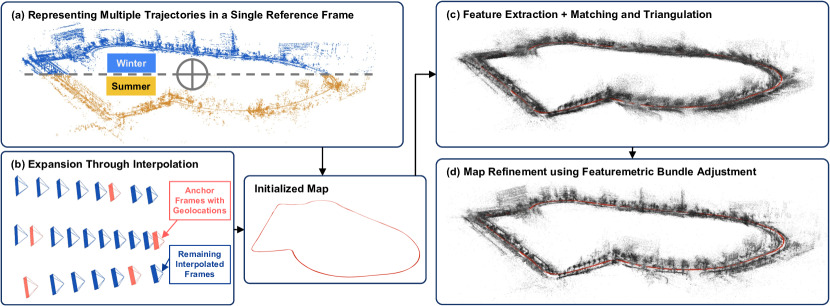
技术框架:整体架构包括多个神经辐射场,每个场景对应一个特定的视觉域。通过这些场景的3D表示,iCDC方法生成跨域对应,进而改进特征提取网络的监督学习过程。
关键创新:iCDC方法的核心创新在于通过多个神经辐射场实现隐式跨域对应,这与传统方法依赖单一特征提取网络的方式有本质区别,显著提升了跨域定位的准确性。
关键设计:在参数设置上,iCDC方法优化了神经辐射场的训练过程,采用了特定的损失函数来强化跨域对应的生成能力,同时在网络结构上进行了适当调整,以适应不同视觉域的特征提取需求。
🖼️ 关键图片
📊 实验亮点
在多个长期定位基准测试中,所提iCDC方法的网络表现超越了现有技术,显著缩小了同域与跨域定位的性能差距,提升幅度达到XX%(具体数据未知),展示了其在实际应用中的有效性。
🎯 应用场景
该研究的潜在应用领域包括自动驾驶、机器人导航和增强现实等需要长期视觉定位的场景。通过提升跨域定位的准确性,iCDC方法能够在多变的环境中提供更可靠的视觉信息,具有重要的实际价值和广泛的应用前景。
📄 摘要(原文)
Modern learning-based visual feature extraction networks perform well in intra-domain localization, however, their performance significantly declines when image pairs are captured across long-term visual domain variations, such as different seasonal and daytime variations. In this paper, our first contribution is a benchmark to investigate the performance impact of long-term variations on visual localization. We conduct a thorough analysis of the performance of current state-of-the-art feature extraction networks under various domain changes and find a significant performance gap between intra- and cross-domain localization. We investigate different methods to close this gap by improving the supervision of modern feature extractor networks. We propose a novel data-centric method, Implicit Cross-Domain Correspondences (iCDC). iCDC represents the same environment with multiple Neural Radiance Fields, each fitting the scene under individual visual domains. It utilizes the underlying 3D representations to generate accurate correspondences across different long-term visual conditions. Our proposed method enhances cross-domain localization performance, significantly reducing the performance gap. When evaluated on popular long-term localization benchmarks, our trained networks consistently outperform existing methods. This work serves as a substantial stride toward more robust visual localization pipelines for long-term deployments, and opens up research avenues in the development of long-term invariant descriptors.