Unified Multi-modal Unsupervised Representation Learning for Skeleton-based Action Understanding
作者: Shengkai Sun, Daizong Liu, Jianfeng Dong, Xiaoye Qu, Junyu Gao, Xun Yang, Xun Wang, Meng Wang
分类: cs.CV
发布日期: 2023-11-06
备注: Accepted by ACM MM 2023. The code is available at https://github.com/HuiGuanLab/UmURL
💡 一句话要点
提出UmURL框架以解决骨骼动作理解中的多模态冗余问题
🎯 匹配领域: 支柱二:RL算法与架构 (RL & Architecture) 支柱九:具身大模型 (Embodied Foundation Models)
关键词: 骨骼动作理解 无监督学习 多模态融合 深度学习 特征学习
📋 核心要点
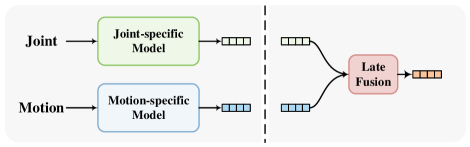
- 现有方法通常采用分离的模态特定模型,导致多流模型复杂且冗余,且固定输入模态限制了灵活性。
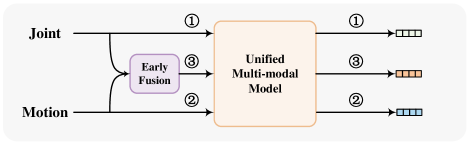
- 本文提出UmURL框架,通过早期融合策略在单流中共同编码多模态特征,简化模型复杂度。
- 在NTU-60、NTU-120和PKU-MMD II等大型数据集上,UmURL展现出接近单模态方法的复杂度,同时在多个下游任务中实现了新的最优性能。
📝 摘要(中文)
无监督预训练在骨骼动作理解中取得了显著成功。现有方法通常采用分离的模态特定模型,并通过后期融合策略整合多模态信息,尽管取得了良好性能,但面临复杂且冗余的多流模型设计及固定输入模态的限制。为此,本文提出了统一多模态无监督表示学习框架UmURL,采用高效的早期融合策略以单流方式共同编码多模态特征。通过内部和外部模态一致性学习,确保融合特征不受单一模态主导。大量实验表明,UmURL在多个数据集上表现出色,复杂度接近单模态方法,同时在骨骼动作表示学习的多个下游任务中实现了新的最优性能。
🔬 方法详解
问题定义:本文旨在解决骨骼动作理解中多模态模型的复杂性与冗余性问题。现有方法通常依赖于分离的模态特定模型,导致模型设计复杂且灵活性不足。
核心思路:UmURL框架通过早期融合策略,将不同模态输入共同输入到同一流中,简化了模型结构并减少了冗余。通过这种方式,模型能够有效学习多模态特征,避免模态偏见。
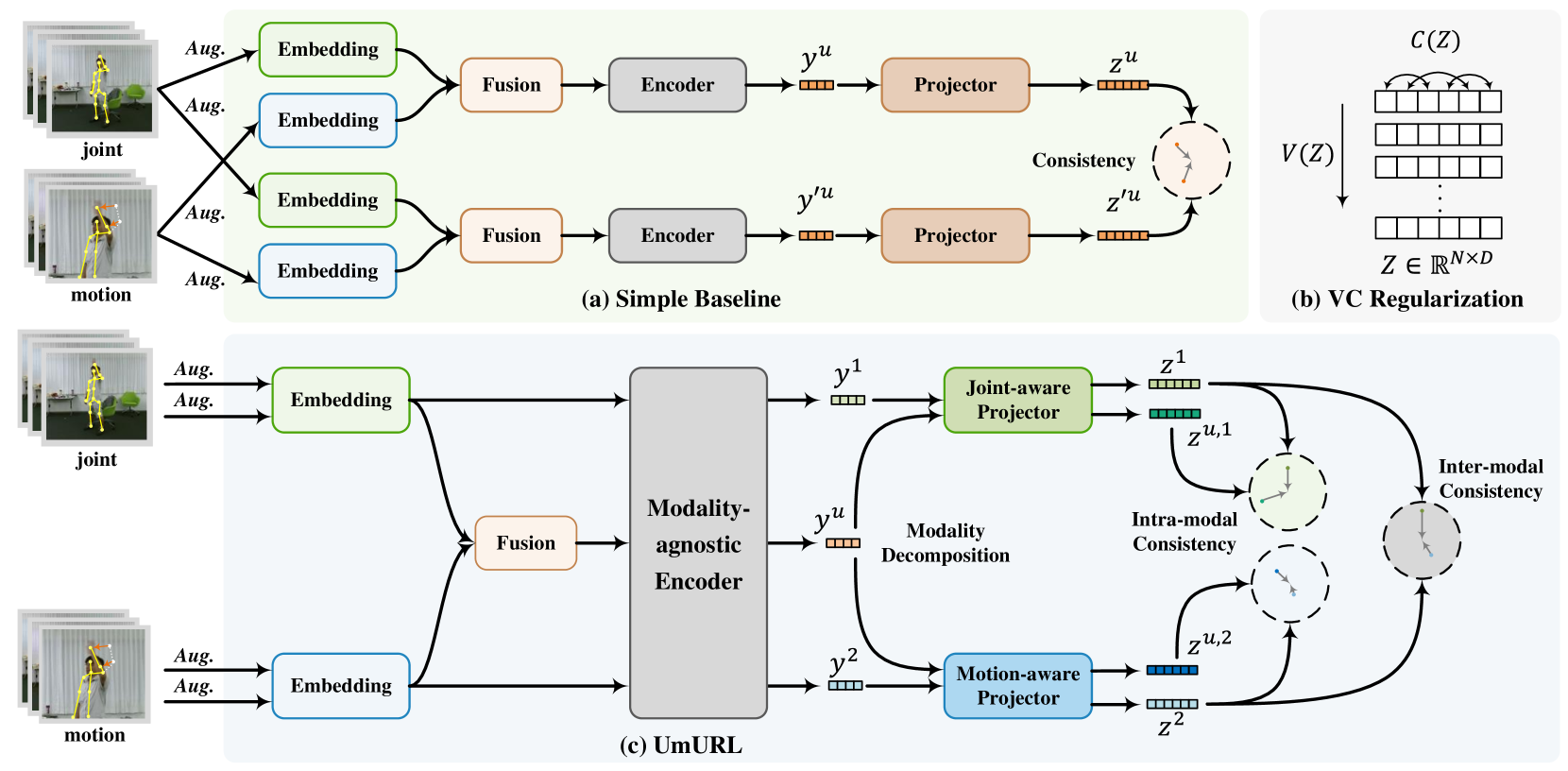
技术框架:UmURL的整体架构包括输入层、早期融合模块、特征学习模块以及一致性学习模块。输入层接收不同模态的数据,早期融合模块将其合并,特征学习模块负责提取多模态特征,一致性学习模块确保特征的模态一致性。
关键创新:UmURL的主要创新在于采用早期融合策略和一致性学习机制,确保融合特征不受单一模态的影响,从而实现更全面的语义表示。这一设计与传统的后期融合方法本质上不同。
关键设计:在模型设计中,采用了特征分解和对齐技术,以保证多模态特征的完整性。此外,损失函数的设计也考虑了模态间的一致性,确保模型在训练过程中能够有效学习到各模态的特征。
🖼️ 关键图片
📊 实验亮点
UmURL在NTU-60、NTU-120和PKU-MMD II数据集上表现优异,达到了新的最优性能,复杂度接近单模态方法,展示了在骨骼动作表示学习中的显著提升,具体性能数据未详细列出。
🎯 应用场景
该研究的潜在应用领域包括智能监控、虚拟现实、运动分析等,能够为这些领域提供更加灵活和高效的动作理解解决方案。未来,UmURL框架有望推动多模态学习在实际场景中的应用,提升人机交互和自动化系统的智能化水平。
📄 摘要(原文)
Unsupervised pre-training has shown great success in skeleton-based action understanding recently. Existing works typically train separate modality-specific models, then integrate the multi-modal information for action understanding by a late-fusion strategy. Although these approaches have achieved significant performance, they suffer from the complex yet redundant multi-stream model designs, each of which is also limited to the fixed input skeleton modality. To alleviate these issues, in this paper, we propose a Unified Multimodal Unsupervised Representation Learning framework, called UmURL, which exploits an efficient early-fusion strategy to jointly encode the multi-modal features in a single-stream manner. Specifically, instead of designing separate modality-specific optimization processes for uni-modal unsupervised learning, we feed different modality inputs into the same stream with an early-fusion strategy to learn their multi-modal features for reducing model complexity. To ensure that the fused multi-modal features do not exhibit modality bias, i.e., being dominated by a certain modality input, we further propose both intra- and inter-modal consistency learning to guarantee that the multi-modal features contain the complete semantics of each modal via feature decomposition and distinct alignment. In this manner, our framework is able to learn the unified representations of uni-modal or multi-modal skeleton input, which is flexible to different kinds of modality input for robust action understanding in practical cases. Extensive experiments conducted on three large-scale datasets, i.e., NTU-60, NTU-120, and PKU-MMD II, demonstrate that UmURL is highly efficient, possessing the approximate complexity with the uni-modal methods, while achieving new state-of-the-art performance across various downstream task scenarios in skeleton-based action representation learning.