ChEF: A Comprehensive Evaluation Framework for Standardized Assessment of Multimodal Large Language Models
作者: Zhelun Shi, Zhipin Wang, Hongxing Fan, Zhenfei Yin, Lu Sheng, Yu Qiao, Jing Shao
分类: cs.CV
发布日期: 2023-11-05
备注: 39 pages, 26 figures
💡 一句话要点
提出ChEF框架以标准化评估多模态大语言模型
🎯 匹配领域: 支柱九:具身大模型 (Embodied Foundation Models)
关键词: 多模态大语言模型 评估框架 标准化评估 模型比较 能力量化 数据集构建 问答策略
📋 核心要点
- 现有的多模态大语言模型评估缺乏标准化框架,导致其能力和局限性难以全面理解。
- 本文提出的ChEF框架通过四个模块化组件,提供了一个全面的评估方法,支持灵活的评估设计。
- 通过对9个主流MLLM的评估,发现了MLLM在不同场景下的泛化能力和复合能力的20多条观察结果。
📝 摘要(中文)
多模态大语言模型(MLLMs)在与视觉内容交互方面展现了令人印象深刻的能力,然而由于缺乏标准化的评估框架,其能力和局限性仍未得到全面理解。为此,本文提出了首个综合评估框架ChEF,能够全面描述每个MLLM并公平比较不同模型。ChEF由四个模块组成:场景、指令、推理器和指标,支持灵活的评估和新评估的构建。我们还引入了6个新评估方案,以量化MLLM在真实世界多模态交互中的能力。通过对9个主流MLLM在9个场景和6个能力指标上的大规模评估,我们总结了20多条关于MLLM泛化能力的有价值观察,并将公开所有实现细节和易用的模块化工具包,以促进MLLM社区的发展。
🔬 方法详解
问题定义:当前多模态大语言模型(MLLMs)的评估缺乏统一标准,导致其能力和局限性难以全面理解,现有基准无法全面反映模型性能。
核心思路:本文提出的ChEF框架通过四个模块(场景、指令、推理器和指标)构建一个标准化的评估体系,允许灵活组合以适应不同评估需求。
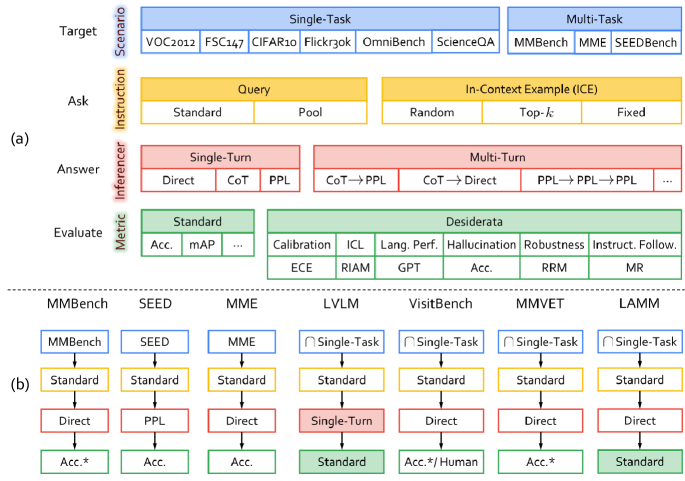
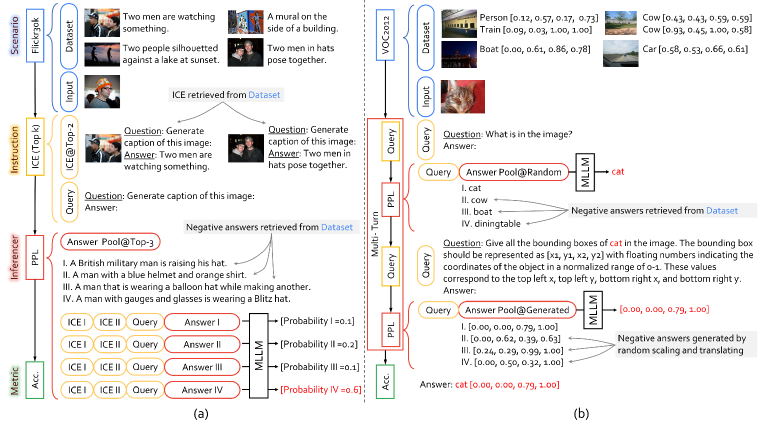
技术框架:ChEF框架由四个主要模块组成:场景模块提供可扩展的多模态数据集,指令模块提供灵活的指令检索公式,推理器模块实现可靠的问答策略,指标模块则提供任务特定的评分函数。
关键创新:ChEF是首个综合评估框架,能够全面描述和比较不同的MLLM,且现有基准可以被视为ChEF的评估方案。
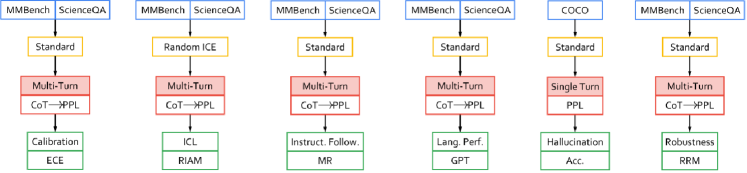
关键设计:在设计中,ChEF引入了6个新评估方案,量化MLLM的能力指标,包括校准、上下文学习、指令遵循、语言表现、幻觉和鲁棒性等。
🖼️ 关键图片
📊 实验亮点
在对9个主流MLLM的评估中,ChEF框架揭示了模型在不同场景下的泛化能力和复合能力,提供了超过20条有价值的观察结果,显著提升了对MLLM性能的理解和比较。
🎯 应用场景
ChEF框架的潜在应用领域包括多模态交互系统、智能助手和自动内容生成等。通过提供标准化的评估工具,研究人员和开发者可以更有效地比较和优化多模态大语言模型,推动相关技术的发展和应用。
📄 摘要(原文)
Multimodal Large Language Models (MLLMs) have shown impressive abilities in interacting with visual content with myriad potential downstream tasks. However, even though a list of benchmarks has been proposed, the capabilities and limitations of MLLMs are still not comprehensively understood, due to a lack of a standardized and holistic evaluation framework. To this end, we present the first Comprehensive Evaluation Framework (ChEF) that can holistically profile each MLLM and fairly compare different MLLMs. First, we structure ChEF as four modular components, i.e., Scenario as scalable multimodal datasets, Instruction as flexible instruction retrieving formulae, Inferencer as reliable question answering strategies, and Metric as indicative task-specific score functions. Based on them, ChEF facilitates versatile evaluations in a standardized framework, and new evaluations can be built by designing new Recipes (systematic selection of these four components). Notably, current MLLM benchmarks can be readily summarized as recipes of ChEF. Second, we introduce 6 new recipes to quantify competent MLLMs' desired capabilities (or called desiderata, i.e., calibration, in-context learning, instruction following, language performance, hallucination, and robustness) as reliable agents that can perform real-world multimodal interactions. Third, we conduct a large-scale evaluation of 9 prominent MLLMs on 9 scenarios and 6 desiderata. Our evaluation summarized over 20 valuable observations concerning the generalizability of MLLMs across various scenarios and the composite capability of MLLMs required for multimodal interactions. We will publicly release all the detailed implementations for further analysis, as well as an easy-to-use modular toolkit for the integration of new recipes and models, so that ChEF can be a growing evaluation framework for the MLLM community.