What Makes Pre-Trained Visual Representations Successful for Robust Manipulation?
作者: Kaylee Burns, Zach Witzel, Jubayer Ibn Hamid, Tianhe Yu, Chelsea Finn, Karol Hausman
分类: cs.CV, cs.AI, cs.RO
发布日期: 2023-11-03
备注: 20 pages, 12 figures
💡 一句话要点
提出视觉表示评估方法以提升机器人操作的鲁棒性
🎯 匹配领域: 支柱一:机器人控制 (Robot Control) 支柱二:RL算法与架构 (RL & Architecture) 支柱九:具身大模型 (Embodied Foundation Models)
关键词: 视觉表示 机器人操作 分割能力 泛化能力 迁移学习 性能评估 视觉模型
📋 核心要点
- 现有的视觉预训练方法在面对光照变化和干扰物体时,表现出较差的泛化能力,影响机器人操作的可靠性。
- 论文通过比较15个预训练视觉模型的性能,提出了分割能力作为评估视觉表示鲁棒性的关键指标。
- 实验结果显示,分割得分能够有效预测在真实世界中的操作性能,尤其是在经过离线训练后。
📝 摘要(中文)
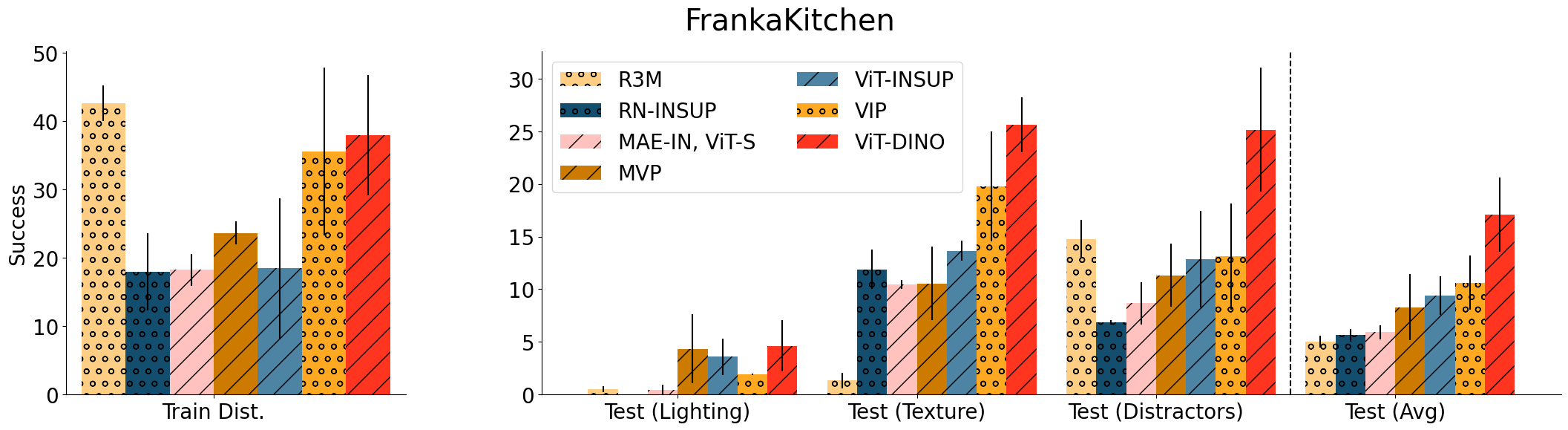
受计算机视觉中迁移学习成功的启发,机器人研究者探索视觉预训练以提高从像素学习策略的效率和泛化能力。尽管以大型物体交互数据集为基础的预训练方法提高了策略学习的效率,但在分布变化下,这些表示的可靠性仍不明确。研究发现,针对操作和控制任务设计的视觉表示在光照、场景纹理微小变化或干扰物体引入时并不一定具有良好的泛化能力。通过对15个预训练视觉模型在不同视觉外观下的性能比较,发现新兴的分割能力是ViT模型在分布外泛化的强预测因子。该指标的排名顺序比以往指导泛化研究的指标更具预测性。实验在两个模拟操作环境中的十个任务上进行了广泛测试,结果表明,分割得分能够预测经过50次演示的真实世界性能。
🔬 方法详解
问题定义:本论文旨在解决现有视觉表示在机器人操作中面对分布变化时的泛化能力不足的问题。现有方法主要依赖于大型数据集,但在实际应用中,环境变化会导致性能下降。
核心思路:论文提出通过评估视觉模型的分割能力来预测其在不同视觉条件下的泛化性能。通过对比多种预训练模型,发现分割能力与操作任务的成功率有显著相关性。
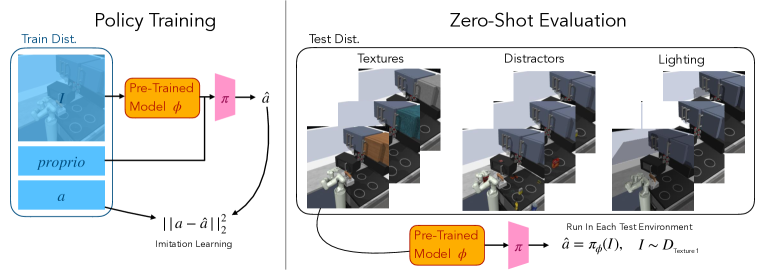
技术框架:研究首先选择15个预训练视觉模型,然后在不同的视觉外观下进行性能测试,最后分析分割能力与模型泛化性能之间的关系。主要模块包括模型选择、性能评估和结果分析。
关键创新:最重要的创新在于提出了分割能力作为新的评估指标,这一指标在预测模型的泛化能力方面优于传统的准确率和形状偏差等指标。
关键设计:在实验中,使用了多种视觉外观变化,包括光照和场景纹理的变化,并通过分割得分来评估模型的鲁棒性。模型的训练和测试均在两个模拟环境中进行,确保了结果的可靠性。
🖼️ 关键图片

📊 实验亮点
实验结果表明,基于分割得分的评估方法在ALOHA设置中能够有效预测经过50次演示后的真实世界性能,且其预测能力优于传统的准确率指标。这一发现为机器人操作中的视觉表示选择提供了新的方向。
🎯 应用场景
该研究的潜在应用领域包括机器人操作、自动化生产和智能家居等。通过提升视觉表示的鲁棒性,机器人能够更好地适应复杂和动态的环境,从而提高操作的成功率和安全性。未来,该方法可能会推动更广泛的智能系统在现实世界中的应用。
📄 摘要(原文)
Inspired by the success of transfer learning in computer vision, roboticists have investigated visual pre-training as a means to improve the learning efficiency and generalization ability of policies learned from pixels. To that end, past work has favored large object interaction datasets, such as first-person videos of humans completing diverse tasks, in pursuit of manipulation-relevant features. Although this approach improves the efficiency of policy learning, it remains unclear how reliable these representations are in the presence of distribution shifts that arise commonly in robotic applications. Surprisingly, we find that visual representations designed for manipulation and control tasks do not necessarily generalize under subtle changes in lighting and scene texture or the introduction of distractor objects. To understand what properties do lead to robust representations, we compare the performance of 15 pre-trained vision models under different visual appearances. We find that emergent segmentation ability is a strong predictor of out-of-distribution generalization among ViT models. The rank order induced by this metric is more predictive than metrics that have previously guided generalization research within computer vision and machine learning, such as downstream ImageNet accuracy, in-domain accuracy, or shape-bias as evaluated by cue-conflict performance. We test this finding extensively on a suite of distribution shifts in ten tasks across two simulated manipulation environments. On the ALOHA setup, segmentation score predicts real-world performance after offline training with 50 demonstrations.