Recognize Any Regions
作者: Haosen Yang, Chuofan Ma, Bin Wen, Yi Jiang, Zehuan Yuan, Xiatian Zhu
分类: cs.CV, cs.AI
发布日期: 2023-11-02 (更新: 2025-04-19)
备注: NeurIPS 2024. Github: https://github.com/Surrey-UPLab/Recognize-Any-Regions
💡 一句话要点
提出RegionSpot以解决开放世界物体检测中的区域识别问题
🎯 匹配领域: 支柱九:具身大模型 (Embodied Foundation Models)
关键词: 开放世界检测 区域识别 视觉-语言模型 知识集成 计算机视觉 深度学习 模型优化
📋 核心要点
- 现有方法在开放世界物体检测中面临计算开销大、对数据噪声敏感和上下文信息不足等挑战。
- 本文提出RegionSpot架构,通过结合定位模型和视觉-语言模型的优势,实现高效的区域识别。
- 实验结果显示,RegionSpot在多个基准数据集上显著超越了现有方法,提升幅度可达13.1 AP。
📝 摘要(中文)
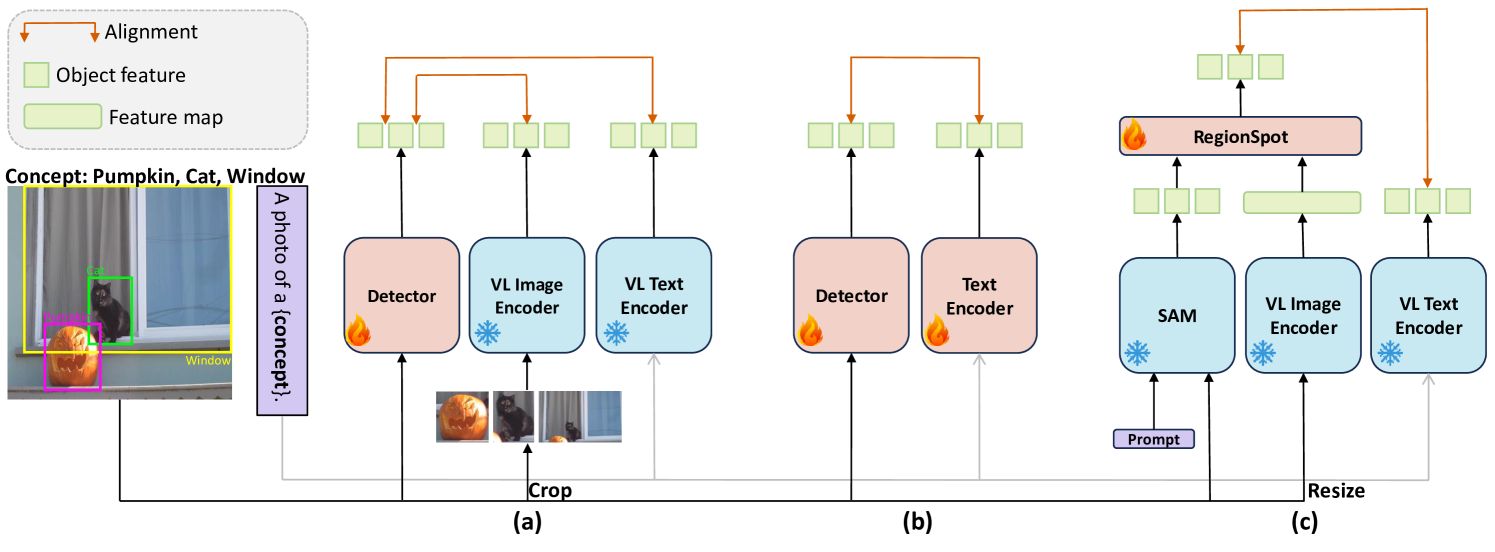
理解无约束图像中各个区域或补丁的语义,如开放世界物体检测,仍然是计算机视觉中的一项关键且具有挑战性的任务。基于强大的图像级视觉-语言基础模型(如CLIP)的成功,近期的研究尝试通过从头训练对比模型或将检测模型的输出与图像级表示对齐来利用其能力。然而,这些方法存在计算开销大、对数据噪声敏感和上下文信息不足等问题。为了解决这些局限性,本文探索了现成基础模型的协同潜力,提出了一种新颖、通用且高效的架构RegionSpot,旨在将定位基础模型(如SAM)的位置信息与视觉-语言模型(如CLIP)的语义信息结合。通过保持基础模型不变,优化轻量级的知识集成模块,RegionSpot在开放世界物体识别中表现出显著的性能提升和计算节省。
🔬 方法详解
问题定义:本文旨在解决开放世界物体检测中对各个区域语义理解的挑战。现有方法在训练过程中计算开销大,且对数据噪声和上下文信息的处理能力不足。
核心思路:论文的核心思路是利用现成的基础模型,结合定位和语义信息的优势,提出RegionSpot架构,以实现高效的区域识别。通过冻结基础模型,仅优化轻量级的知识集成模块,降低了训练成本。
技术框架:RegionSpot的整体架构包括两个主要模块:定位基础模型(如SAM)和视觉-语言模型(如CLIP)。通过集成这两个模型的输出,RegionSpot能够实现更准确的区域识别。
关键创新:最重要的技术创新在于提出了一种新的知识集成模块,能够有效结合定位信息和语义信息,显著提高了模型的性能。这一方法与传统的从头训练对比模型的方式有本质区别。
关键设计:在设计中,保持了基础模型的参数不变,采用轻量级的注意力机制进行知识集成,优化过程中仅关注这一模块的参数调整,从而实现了高效的训练和推理。具体的损失函数和网络结构细节在论文中进行了详细描述。
🖼️ 关键图片


📊 实验亮点
实验结果表明,RegionSpot在LVIS验证集上相较于GLIP-L提升了2.9 mAP,在更具挑战性和稀有类别上提升幅度达到13.1 AP。同时,在ODinW数据集上也实现了2.5 AP的提升,超越GroundingDINO-L在稀有类别上的表现达11.0 AP。
🎯 应用场景
该研究的潜在应用领域包括自动驾驶、智能监控和机器人视觉等场景,能够在复杂环境中实现更准确的物体识别和理解。RegionSpot的高效性和准确性将推动这些领域的技术进步,提升系统的智能化水平。
📄 摘要(原文)
Understanding the semantics of individual regions or patches of unconstrained images, such as open-world object detection, remains a critical yet challenging task in computer vision. Building on the success of powerful image-level vision-language (ViL) foundation models like CLIP, recent efforts have sought to harness their capabilities by either training a contrastive model from scratch with an extensive collection of region-label pairs or aligning the outputs of a detection model with image-level representations of region proposals. Despite notable progress, these approaches are plagued by computationally intensive training requirements, susceptibility to data noise, and deficiency in contextual information. To address these limitations, we explore the synergistic potential of off-the-shelf foundation models, leveraging their respective strengths in localization and semantics. We introduce a novel, generic, and efficient architecture, named RegionSpot, designed to integrate position-aware localization knowledge from a localization foundation model (e.g., SAM) with semantic information from a ViL model (e.g., CLIP). To fully exploit pretrained knowledge while minimizing training overhead, we keep both foundation models frozen, focusing optimization efforts solely on a lightweight attention-based knowledge integration module. Extensive experiments in open-world object recognition show that our RegionSpot achieves significant performance gain over prior alternatives, along with substantial computational savings (e.g., training our model with 3 million data in a single day using 8 V100 GPUs). RegionSpot outperforms GLIP-L by 2.9 in mAP on LVIS val set, with an even larger margin of 13.1 AP for more challenging and rare categories, and a 2.5 AP increase on ODinW. Furthermore, it exceeds GroundingDINO-L by 11.0 AP for rare categories on the LVIS minival set.