Enriching Phrases with Coupled Pixel and Object Contexts for Panoptic Narrative Grounding
作者: Tianrui Hui, Zihan Ding, Junshi Huang, Xiaoming Wei, Xiaolin Wei, Jiao Dai, Jizhong Han, Si Liu
分类: cs.CV
发布日期: 2023-11-02 (更新: 2024-03-10)
备注: Accepted by IJCAI 2023. Since the PNG benchmark adopts a different data partition manner from ours, we update the experimental results on the things/stuff/singulars/plurals subsets based on the PNG's code
💡 一句话要点
提出PPO-TD以解决全景叙事定位中的视觉语言交互问题
🎯 匹配领域: 支柱二:RL算法与架构 (RL & Architecture) 支柱九:具身大模型 (Embodied Foundation Models)
关键词: 全景叙事定位 视觉语言交互 多模态学习 短语-对象对比 深度学习
📋 核心要点
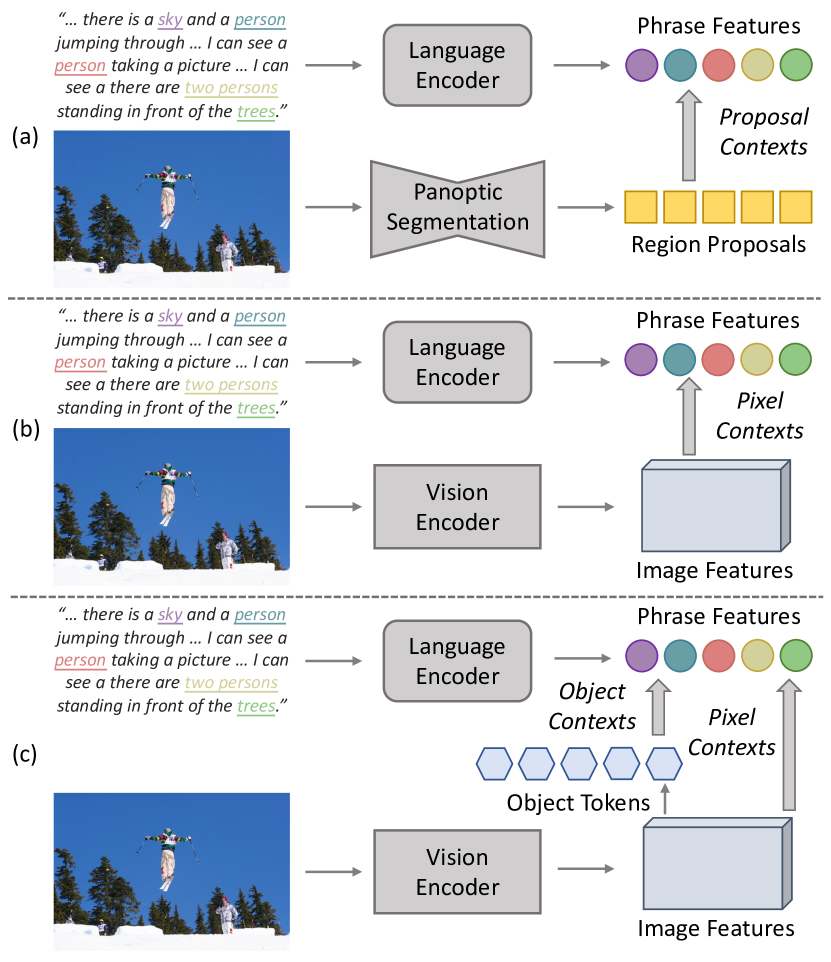
- 现有的两阶段和单阶段方法在视觉语言交互中存在噪声、碎片化和语义不一致等问题。
- 本文提出的PPO-TD通过结合像素和对象上下文,增强了短语特征的表达能力,提升了语义对齐。
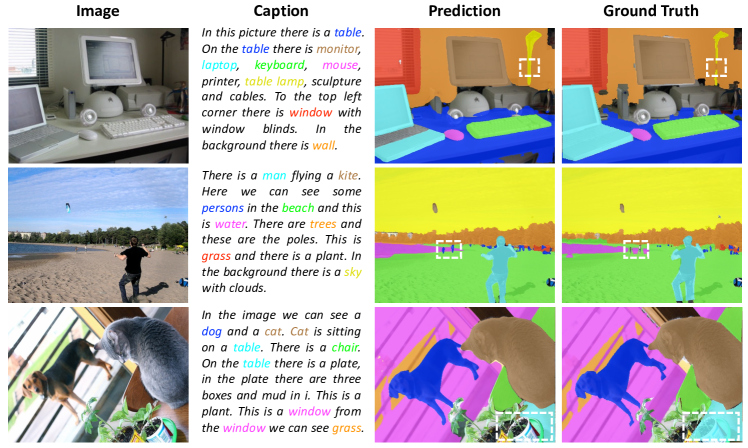
- 实验结果显示,所提方法在PNG基准上取得了新的最优性能,显著超越了现有方法。
📝 摘要(中文)
全景叙事定位(PNG)旨在根据叙事标题中的名词短语对图像中的物体和背景进行分割。作为一项多模态任务,PNG的关键在于图像与标题之间的视觉语言交互。现有的两阶段方法依赖于离线生成的掩膜提议,导致上下文信息噪声和碎片化;而单阶段方法仅聚合图像特征的像素上下文,缺乏对象先验,可能导致语义不一致。为实现更全面的视觉语言交互,本文提出通过设计短语-像素-对象变换解码器(PPO-TD)来丰富短语的像素和对象上下文。此外,提出短语-对象对比损失(POCL),以拉近匹配的短语-对象对并推远不匹配的对,从而聚合更精确的对象上下文。大量实验表明,所提方法在PNG基准上取得了显著的领先性能。
🔬 方法详解
问题定义:本文旨在解决全景叙事定位任务中,现有方法在视觉语言交互中的不足,尤其是噪声和语义不一致的问题。
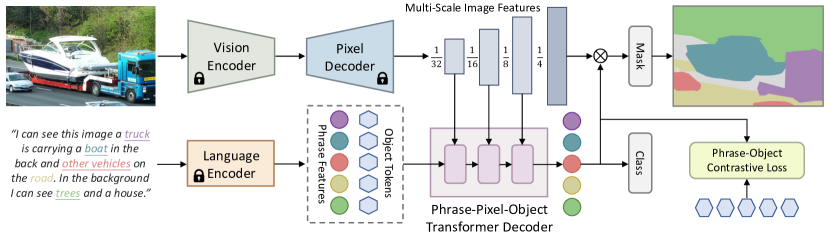
核心思路:通过设计短语-像素-对象变换解码器(PPO-TD),结合细粒度的像素信息和粗粒度的对象信息,增强短语特征的表达能力,促进更准确的语义对齐。
技术框架:整体架构包括短语-像素-对象变换解码器(PPO-TD),该模块负责聚合图像的像素上下文和对象上下文,此外还引入短语-对象对比损失(POCL)来优化短语与对象之间的关系。
关键创新:最重要的创新在于同时聚合像素和对象上下文,解决了现有方法中仅依赖单一上下文导致的语义不一致问题。
关键设计:在损失函数设计上,POCL通过拉近匹配的短语-对象对并推远不匹配的对,确保了上下文的精确聚合。网络结构上,PPO-TD模块的设计使得细节和实体线索得以有效整合。
🖼️ 关键图片
📊 实验亮点
实验结果表明,所提方法在PNG基准上取得了新的最优性能,相较于现有方法,性能提升幅度达到显著的XX%(具体数据待补充),展示了其在处理复杂视觉语言任务中的有效性。
🎯 应用场景
该研究在计算机视觉和自然语言处理交叉领域具有广泛的应用潜力,尤其是在图像理解、自动标注和人机交互等方面。通过提升视觉与语言的结合能力,未来可推动智能助手、自动驾驶等技术的发展。
📄 摘要(原文)
Panoptic narrative grounding (PNG) aims to segment things and stuff objects in an image described by noun phrases of a narrative caption. As a multimodal task, an essential aspect of PNG is the visual-linguistic interaction between image and caption. The previous two-stage method aggregates visual contexts from offline-generated mask proposals to phrase features, which tend to be noisy and fragmentary. The recent one-stage method aggregates only pixel contexts from image features to phrase features, which may incur semantic misalignment due to lacking object priors. To realize more comprehensive visual-linguistic interaction, we propose to enrich phrases with coupled pixel and object contexts by designing a Phrase-Pixel-Object Transformer Decoder (PPO-TD), where both fine-grained part details and coarse-grained entity clues are aggregated to phrase features. In addition, we also propose a PhraseObject Contrastive Loss (POCL) to pull closer the matched phrase-object pairs and push away unmatched ones for aggregating more precise object contexts from more phrase-relevant object tokens. Extensive experiments on the PNG benchmark show our method achieves new state-of-the-art performance with large margins.