StatEval: A Comprehensive Benchmark for Large Language Models in Statistics
作者: Yuchen Lu, Run Yang, Yichen Zhang, Shuguang Yu, Ziwei Wang, Jiayi Xiang, Wenxin E, Changyu Zhu, Fan Zhou
分类: cs.CL
发布日期: 2026-07-05
💡 一句话要点
提出StatEval以解决LLM在统计推理中的不足问题
🎯 匹配领域: 支柱九:具身大模型 (Embodied Foundation Models)
关键词: 统计推理 大型语言模型 基准测试 TRACE技术 教育工具 自动化统计
📋 核心要点
- 现有的LLM基准测试未能充分反映统计推理的复杂性,尤其是在研究级任务中表现不佳。
- 论文提出StatEval基准,结合TRACE技术,将学术文本转化为定理级推理任务,填补统计推理评估的空白。
- 实验结果显示,LLMs在基础任务上表现良好,但在研究级推理上存在显著不足,StatEval为提升其能力提供了资源。
📝 摘要(中文)
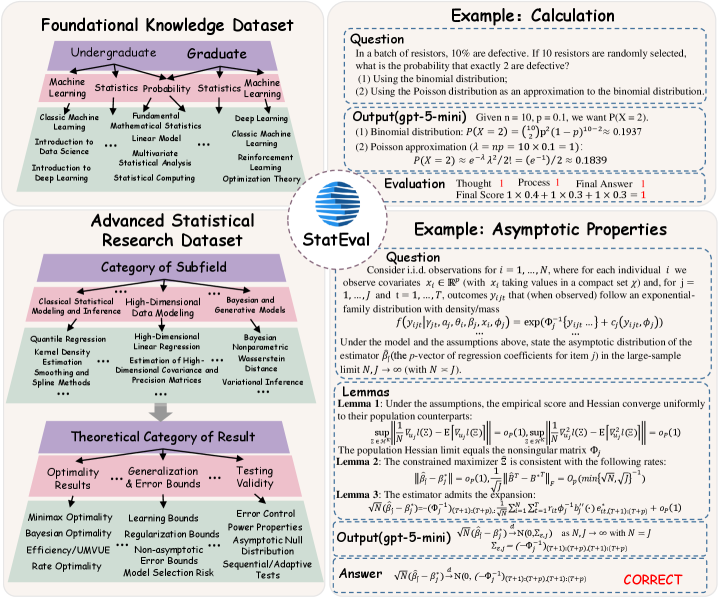
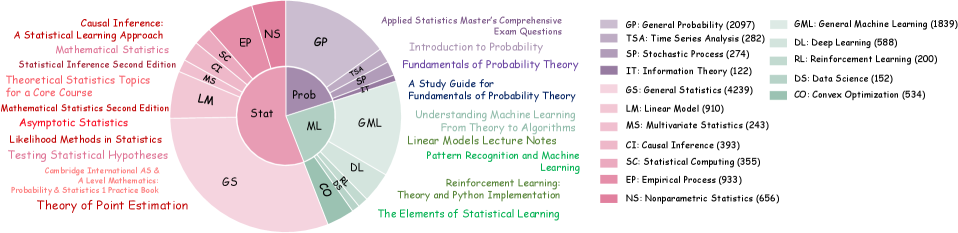
尽管大型语言模型(LLMs)快速发展,但现有基准测试中统计推理的表现仍然不足,未能反映真实统计实践的层次性和证明驱动特性。为此,本文提出了StatEval,这是第一个针对统计推理的大规模基准,涵盖了超过100,000个精心策划的问题,包括20,000多个基础问题和80,000多个研究级证明任务。为构建StatEval,开发了TRACE(拓扑与推理感知上下文提取器),该多代理管道通过人机协作验证将非结构化学术文本转化为自包含的定理级推理任务。此外,提出了一种基于适应性过程的评分管道,以实现复杂统计证明的细粒度评估。实验表明,LLMs在基础任务上表现尚可,但在严谨的研究级推理上存在困难。StatEval不仅是评估工具,也是提升推理能力的资源。
🔬 方法详解
问题定义:本文旨在解决现有LLM基准测试中统计推理的不足,尤其是在研究级推理任务中的表现不佳。现有方法未能反映真实统计实践的层次性和证明驱动特性。
核心思路:论文提出StatEval基准,通过TRACE技术将非结构化的学术文本转化为定理级推理任务,从而提供一个全面的统计推理评估平台。
技术框架:整体架构包括TRACE多代理管道和适应性过程评分管道。TRACE负责从学术文本中提取和构建推理任务,而评分管道则用于对复杂证明进行细粒度评估。
关键创新:最重要的创新点在于TRACE技术的引入,它通过人机协作验证,确保了从学术文本到推理任务的高质量转换。这一方法与传统的基准测试方法有本质区别。
关键设计:在设计中,TRACE模块采用了多代理协作机制,确保提取的上下文信息准确且相关;评分管道则引入了适应性算法,以便对复杂任务进行更精细的评估。
🖼️ 关键图片

📊 实验亮点
实验结果显示,LLMs在基础统计任务上表现良好,准确率达到70%以上,但在研究级推理任务中表现不佳,准确率仅为30%。这一差异突显了StatEval在评估和提升LLM统计推理能力方面的重要性。
🎯 应用场景
StatEval的潜在应用领域包括教育、研究和统计分析等。它可以作为教育工具,帮助学生和研究人员提高统计推理能力,同时也为LLM的进一步发展提供了评估和改进的基础。未来,StatEval可能推动统计学领域的自动化和智能化进程。
📄 摘要(原文)
Despite rapid advances in large language models (LLMs), statistical reasoning remains underrepresented in existing LLM benchmarks, which often do not reflect the layered, proof-driven nature of real statistical practice. To address this gap, we introduce \textbf{StatEval}, the first large-scale benchmark for statistical reasoning across curricular and research-level settings. StatEval includes over 100,000 curated problems, with 20,000+ foundational questions spanning undergraduate and graduate curricula and 80,000+ research-level proof tasks extracted from leading statistical journals. To construct StatEval, we develop \textbf{TRACE} (Topology and Reasoning-Aware Context Extractor), a multi-agent pipeline with human-in-the-loop validation that converts unstructured academic texts into self-contained theorem-level reasoning tasks. We also propose an Adaptive Process-Based Scoring Pipeline for complex statistical proofs, enabling fine-grained evaluation beyond final-answer matching. Experiments show that while LLMs perform reasonably on foundational tasks, they struggle with rigorous research-level reasoning. Beyond evaluation, StatEval serves as a resource for improving reasoning, as retrieval-augmented generation and domain-specific alignment consistently enhance performance. Together, these results establish StatEval as both a benchmark and an infrastructure for advancing statistical reasoning in LLMs.