Large Language Model Agent for Fake News Detection
作者: Xinyi Li, Yongfeng Zhang, Edward C. Malthouse
分类: cs.CL, cs.AI, cs.IR
发布日期: 2024-04-30
💡 一句话要点
提出FactAgent以解决假新闻检测中的效率问题
🎯 匹配领域: 支柱九:具身大模型 (Embodied Foundation Models)
关键词: 假新闻检测 大型语言模型 自动化验证 信息传播 透明性 结构化流程 用户信任
📋 核心要点
- 现有的假新闻检测方法往往依赖人工验证,效率低下且难以扩展,无法满足快速变化的信息环境。
- 本文提出FactAgent,通过将假新闻检测任务分解为多个简单步骤,利用大型语言模型模拟人类专家的验证行为,提升检测效率。
- 实验结果显示,FactAgent在无需训练的情况下有效验证新闻声明,且在每个步骤提供透明的解释,增强了用户对检测过程的理解。
📝 摘要(中文)
在当前数字时代,在线平台上虚假信息的快速传播对社会福祉、公众信任和民主进程构成了重大挑战。为应对这些挑战,自动化的假新闻检测机制需求日益增长。本文提出FactAgent,这是一种利用预训练的大型语言模型(LLMs)进行假新闻检测的代理方法。FactAgent通过结构化工作流程将新闻真实性检查的复杂任务分解为多个子步骤,允许LLMs在不进行模型训练的情况下模拟人类专家的行为。实验结果表明,FactAgent在验证新闻声明的有效性方面表现出色,并提供透明的推理过程,增强了用户的理解。该方法具有高度适应性,能够轻松更新工具和工作流程,适用于多个领域的新闻验证。
🔬 方法详解
问题定义:本文旨在解决假新闻检测中效率低下的问题,现有方法往往依赖人工验证,难以快速响应信息传播的速度。
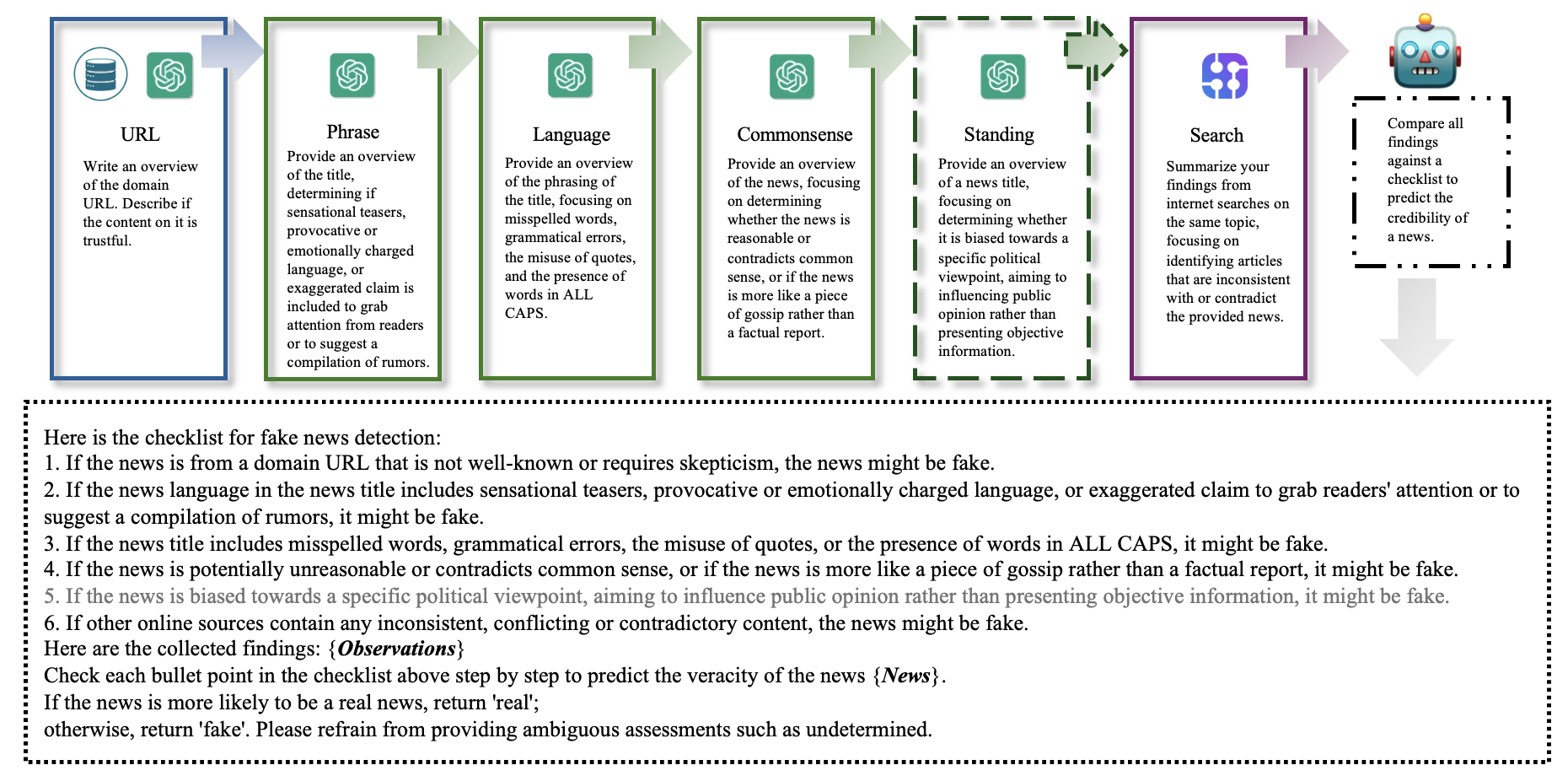
核心思路:FactAgent通过结构化的工作流程,将复杂的新闻真实性检查任务分解为多个简单的子任务,利用大型语言模型的内在知识和外部工具进行验证,从而模拟人类专家的行为。
技术框架:FactAgent的整体架构包括多个阶段:首先是信息收集阶段,接着是信息分析阶段,最后是结果整合与决策阶段。在每个阶段,LLMs执行特定的子任务,逐步构建对新闻声明的验证。
关键创新:FactAgent的主要创新在于其代理性方法,允许LLMs在不进行额外训练的情况下,通过结构化流程进行有效的假新闻检测。这一方法与传统的直接生成响应的方式有本质区别。
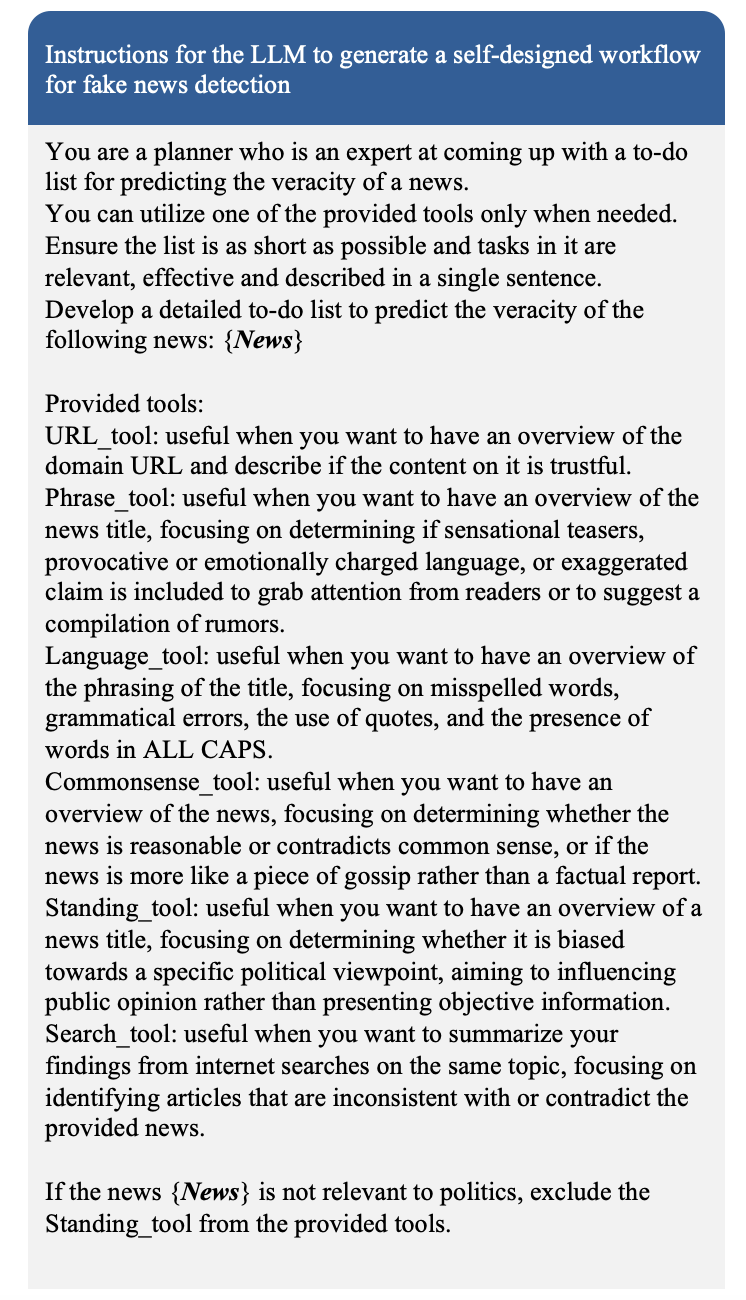
关键设计:在设计上,FactAgent强调透明性和可解释性,确保每个步骤的推理过程对用户可见。此外,系统允许对工具和工作流程进行灵活更新,以适应不同领域的需求。
🖼️ 关键图片
📊 实验亮点
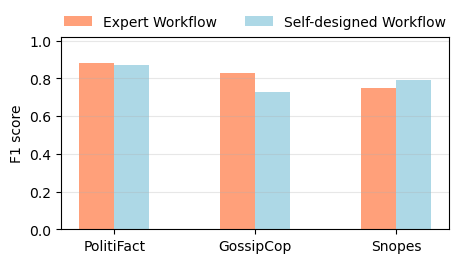
实验结果表明,FactAgent在假新闻检测任务中表现出色,能够在不进行任何训练的情况下,准确验证新闻声明。与传统人工验证相比,FactAgent的效率显著提升,且在每个步骤提供透明的推理过程,增强了用户的理解和信任。
🎯 应用场景
FactAgent的潜在应用领域包括新闻媒体、社交网络和信息验证平台等。其高效的假新闻检测能力能够帮助用户快速识别虚假信息,维护公众信任和社会稳定。未来,FactAgent还可以扩展到其他领域的信息验证,如科学研究和政策分析,具有广泛的实际价值。
📄 摘要(原文)
In the current digital era, the rapid spread of misinformation on online platforms presents significant challenges to societal well-being, public trust, and democratic processes, influencing critical decision making and public opinion. To address these challenges, there is a growing need for automated fake news detection mechanisms. Pre-trained large language models (LLMs) have demonstrated exceptional capabilities across various natural language processing (NLP) tasks, prompting exploration into their potential for verifying news claims. Instead of employing LLMs in a non-agentic way, where LLMs generate responses based on direct prompts in a single shot, our work introduces FactAgent, an agentic approach of utilizing LLMs for fake news detection. FactAgent enables LLMs to emulate human expert behavior in verifying news claims without any model training, following a structured workflow. This workflow breaks down the complex task of news veracity checking into multiple sub-steps, where LLMs complete simple tasks using their internal knowledge or external tools. At the final step of the workflow, LLMs integrate all findings throughout the workflow to determine the news claim's veracity. Compared to manual human verification, FactAgent offers enhanced efficiency. Experimental studies demonstrate the effectiveness of FactAgent in verifying claims without the need for any training process. Moreover, FactAgent provides transparent explanations at each step of the workflow and during final decision-making, offering insights into the reasoning process of fake news detection for end users. FactAgent is highly adaptable, allowing for straightforward updates to its tools that LLMs can leverage within the workflow, as well as updates to the workflow itself using domain knowledge. This adaptability enables FactAgent's application to news verification across various domains.