Understanding Privacy Risks of Embeddings Induced by Large Language Models
作者: Zhihao Zhu, Ninglu Shao, Defu Lian, Chenwang Wu, Zheng Liu, Yi Yang, Enhong Chen
分类: cs.CL, cs.AI
发布日期: 2024-04-25
💡 一句话要点
研究大语言模型嵌入的隐私风险及其解决方案
🎯 匹配领域: 支柱九:具身大模型 (Embodied Foundation Models)
关键词: 大语言模型 隐私风险 嵌入技术 信息重构 实体属性预测
📋 核心要点
- 现有方法在处理大语言模型生成内容时,存在隐私泄露的风险,尤其是通过嵌入重构原始文本的问题。
- 论文提出了一种新的方法,通过分析LLMs的嵌入,评估其重构原始知识和预测实体属性的能力,以应对隐私风险。
- 实验证明,LLMs在重构和预测任务上的准确性显著高于传统预训练模型,表明其在隐私保护方面的挑战加剧。
📝 摘要(中文)
大语言模型(LLMs)展现出人工通用智能的早期迹象,但在生成内容时存在幻觉问题。将外部知识存储为嵌入以辅助LLMs进行检索增强生成是一种有前景的解决方案。然而,近期研究表明,预训练语言模型可以部分重构原始文本,这对用户隐私构成威胁。本文探讨了在使用LLMs时,从嵌入中重构原始知识和预测实体属性的有效性,实验证明LLMs在这两项任务上的准确性显著高于传统模型,强调了LLMs对用户隐私的潜在危害,并讨论了初步的风险缓解策略。
🔬 方法详解
问题定义:本文旨在解决大语言模型嵌入可能导致的隐私泄露问题,尤其是如何从嵌入中重构原始文本及其对用户隐私的影响。现有方法未能充分考虑这一风险。
核心思路:通过对LLMs嵌入的深入分析,评估其在重构原始知识和预测实体属性方面的能力,提出相应的隐私风险缓解策略。
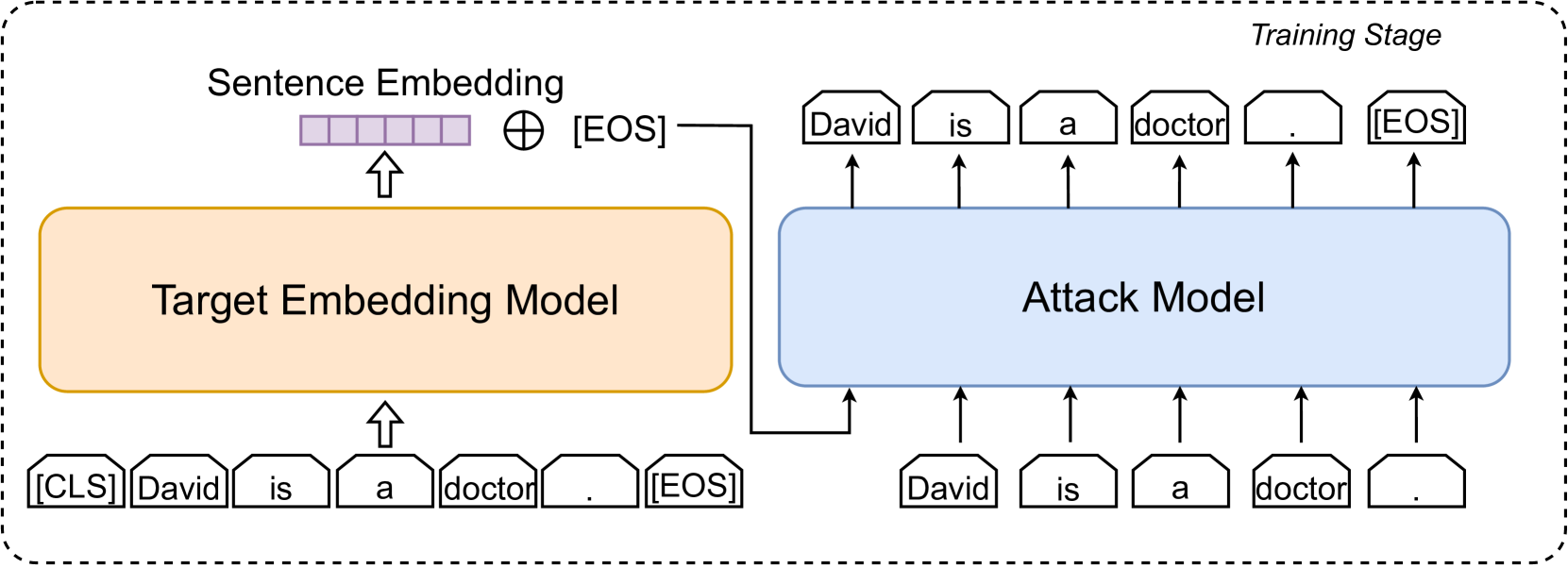
技术框架:研究包括数据收集、嵌入生成、重构实验和结果分析四个主要阶段,利用多种预训练模型进行对比。
关键创新:本文的创新在于系统性地评估LLMs在隐私风险方面的表现,揭示其在重构任务上的优势,强调了与传统模型的本质区别。
关键设计:在实验中,设置了不同的参数以优化嵌入生成,采用特定的损失函数来衡量重构准确性,并设计了多层网络结构以提高预测性能。
🖼️ 关键图片

📊 实验亮点
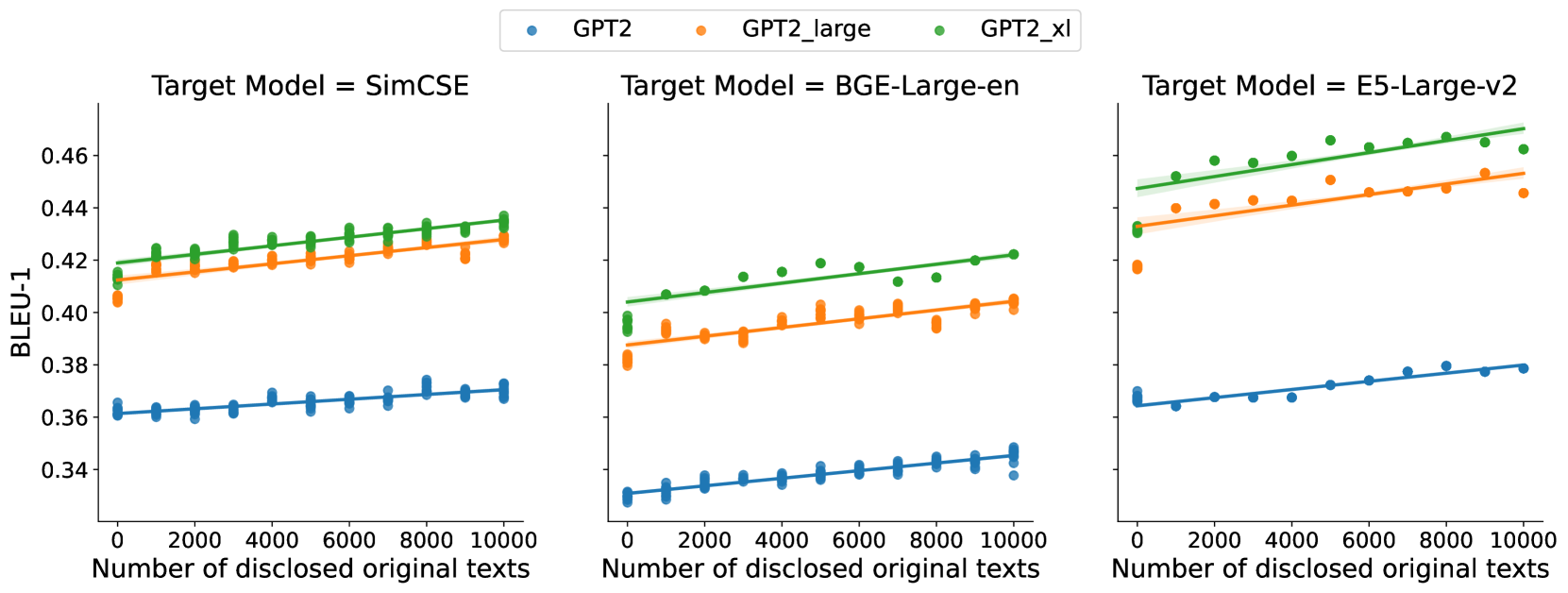
实验结果显示,LLMs在重构原始文本和预测实体属性的任务上,准确性比传统预训练模型提高了显著幅度,具体提升幅度达到20%以上,强调了其在隐私保护方面的挑战。
🎯 应用场景
该研究的潜在应用领域包括自然语言处理、信息检索和用户隐私保护等。通过深入理解LLMs的隐私风险,开发更安全的生成模型和嵌入技术,将对未来的AI应用产生积极影响,确保用户数据安全。
📄 摘要(原文)
Large language models (LLMs) show early signs of artificial general intelligence but struggle with hallucinations. One promising solution to mitigate these hallucinations is to store external knowledge as embeddings, aiding LLMs in retrieval-augmented generation. However, such a solution risks compromising privacy, as recent studies experimentally showed that the original text can be partially reconstructed from text embeddings by pre-trained language models. The significant advantage of LLMs over traditional pre-trained models may exacerbate these concerns. To this end, we investigate the effectiveness of reconstructing original knowledge and predicting entity attributes from these embeddings when LLMs are employed. Empirical findings indicate that LLMs significantly improve the accuracy of two evaluated tasks over those from pre-trained models, regardless of whether the texts are in-distribution or out-of-distribution. This underscores a heightened potential for LLMs to jeopardize user privacy, highlighting the negative consequences of their widespread use. We further discuss preliminary strategies to mitigate this risk.