Student Data Paradox and Curious Case of Single Student-Tutor Model: Regressive Side Effects of Training LLMs for Personalized Learning
作者: Shashank Sonkar, Naiming Liu, Richard G. Baraniuk
分类: cs.CL
发布日期: 2024-04-23 (更新: 2024-10-05)
备注: Accepted at EMNLP 2024 Findings Track
💡 一句话要点
揭示学生数据悖论以优化个性化学习模型
🎯 匹配领域: 支柱九:具身大模型 (Embodied Foundation Models)
关键词: 个性化学习 大规模语言模型 学生数据悖论 智能辅导系统 幻觉标记 模型训练 教育技术
📋 核心要点
- 现有方法在个性化学习中面临学生数据悖论,训练模型时可能损害其推理和知识能力。
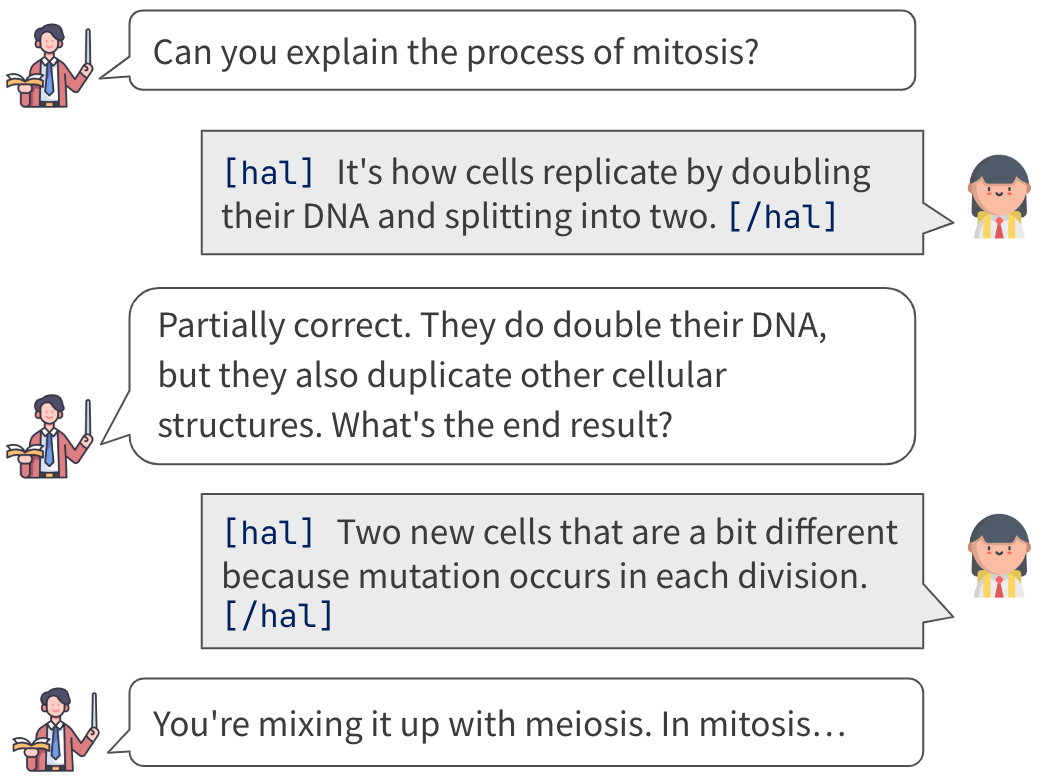
- 论文提出通过引入幻觉标记来缓解学生数据悖论,旨在平衡学生行为建模与模型准确性。
- 实验结果显示,模型在多个基准测试中的表现显著下降,强调了该问题的广泛影响。
📝 摘要(中文)
个性化教育的追求促使大规模语言模型(LLMs)在智能辅导系统中的应用。为了更好地理解和适应学生的个体需求,LLMs需要在大量的学生-辅导对话数据上进行训练。然而,我们的研究揭示了一个基本挑战:'学生数据悖论'。当LLMs在学生数据上训练以理解学习者行为时,反而可能损害其事实知识和推理能力。通过对学生-辅导对话数据集进行训练并在多个基准上评估模型性能,我们发现模型在推理、真实性和常识理解等方面的表现显著下降。我们的研究提出了两个主要贡献:通过定量分析实证展示学生数据悖论,以及引入'幻觉标记'作为缓解策略,尽管提升了性能,但也突显了在准确建模学生行为与保持LLM作为教育工具的完整性之间的挑战。
🔬 方法详解
问题定义:本研究旨在解决在个性化学习中训练大规模语言模型(LLMs)时出现的学生数据悖论。现有方法依赖于学生对话数据,导致模型的事实知识和推理能力下降。
核心思路:论文的核心思路是通过引入幻觉标记来缓解学生数据悖论。这种设计旨在在建模学生行为的同时,保持模型的知识完整性。
技术框架:整体架构包括数据收集、模型训练和性能评估三个主要模块。首先,收集大量学生-辅导对话数据;其次,使用这些数据训练LLMs;最后,通过多个基准测试评估模型的推理、真实性和常识理解能力。
关键创新:最重要的技术创新点是引入幻觉标记作为缓解策略。这一策略与现有方法的本质区别在于,它不仅关注模型的行为建模,还强调保持模型的知识准确性。
关键设计:在模型训练中,设置了特定的损失函数以平衡学生行为建模与知识保持,网络结构经过优化以适应幻觉标记的引入。
🖼️ 关键图片
📊 实验亮点
实验结果显示,模型在推理、真实性和常识理解等多个基准测试中的表现显著下降,具体表现为性能下降幅度超过20%。这一发现强调了学生数据悖论对模型能力的广泛影响。
🎯 应用场景
该研究的潜在应用领域包括智能教育系统、个性化学习平台和在线辅导工具。通过优化LLMs的训练方法,可以更好地满足学生的个体需求,提高学习效果,未来可能对教育技术的发展产生深远影响。
📄 摘要(原文)
The pursuit of personalized education has led to the integration of Large Language Models (LLMs) in developing intelligent tutoring systems. To better understand and adapt to individual student needs, including their misconceptions, LLMs need to be trained on extensive datasets of student-tutor dialogues. Our research uncovers a fundamental challenge in this approach: the
Student Data Paradox.'' This paradox emerges when LLMs, trained on student data to understand learner behavior, inadvertently compromise their own factual knowledge and reasoning abilities. We investigate this paradox by training state-of-the-art language models on student-tutor dialogue datasets and evaluating their performance across multiple benchmarks. These benchmarks assess various aspects of language model capabilities, including reasoning, truthfulness, and common sense understanding. Our findings reveal significant declines in the models' performance across these diverse benchmarks, indicating a broad impact on their capabilities when trained to model student behavior. Our research makes two primary contributions: (1) empirical demonstration of the Student Data Paradox through quantitative analysis of model performance, and (2) introduction ofhallucination tokens'' as a mitigation strategy. These tokens, while improving performance, highlight the persistent challenge of balancing accurate student behavior modeling with maintaining the LLM's integrity as an educational tool. This study emphasizes the need for innovative solutions to reconcile the conflicting goals of faithfully understanding diverse student cognition while preserving the model's ability to provide accurate information and guidance.