MDAgents: An Adaptive Collaboration of LLMs for Medical Decision-Making
作者: Yubin Kim, Chanwoo Park, Hyewon Jeong, Yik Siu Chan, Xuhai Xu, Daniel McDuff, Hyeonhoon Lee, Marzyeh Ghassemi, Cynthia Breazeal, Hae Won Park
分类: cs.CL, cs.AI, cs.LG
发布日期: 2024-04-22 (更新: 2024-10-30)
🔗 代码/项目: GITHUB
💡 一句话要点
提出MDAgents框架以优化医疗决策中的LLMs协作
🎯 匹配领域: 支柱九:具身大模型 (Embodied Foundation Models)
关键词: 医疗决策 大型语言模型 多代理系统 自动化协作 医学知识
📋 核心要点
- 现有方法在复杂医疗任务中如何有效利用大型语言模型(LLMs)仍然存在挑战,缺乏自动化的协作结构分配。
- 本文提出的MDAgents框架能够根据具体医疗任务自动分配LLMs的协作结构,模拟真实的医疗决策过程。
- 实验结果显示,MDAgents在七个基准测试中表现最佳,较之前方法提高了4.2%的性能,且组合协作的准确性平均提高了11.8%。
📝 摘要(中文)
基础模型在医学领域的应用日益重要,但如何有效利用大型语言模型(LLMs)进行复杂医疗任务仍然是一个未解的问题。本文提出了一种名为医疗决策代理(MDAgents)的多代理框架,自动为LLMs团队分配协作结构,模拟真实的医疗决策过程。通过在多个医学知识和诊断基准上进行评估,MDAgents在七个基准测试中表现最佳,较之前方法提高了4.2%的性能。消融研究表明,MDAgents能够有效判断医疗复杂性,从而在多样化的医疗任务中优化效率和准确性。
🔬 方法详解
问题定义:本文旨在解决如何在复杂医疗任务中有效利用大型语言模型(LLMs)的协作问题。现有方法缺乏针对具体任务的自动化协作结构分配,导致效率和准确性不足。
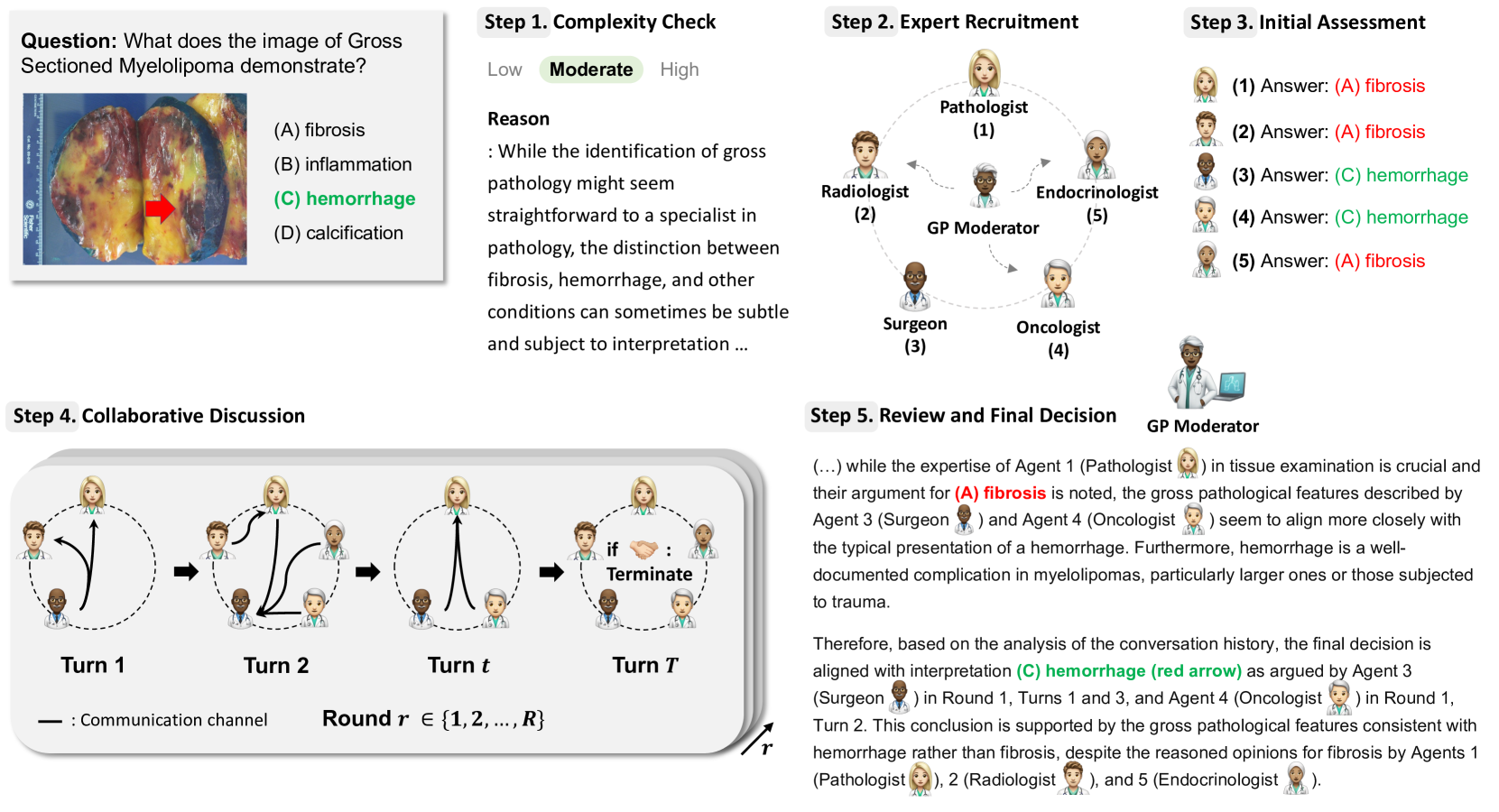
核心思路:MDAgents框架通过自动分配LLMs的协作结构(单独或小组)来适应不同复杂性的医疗任务,模拟真实的医疗决策过程,从而提高决策的效率和准确性。
技术框架:MDAgents的整体架构包括多个LLMs代理,这些代理根据任务复杂性进行协作。框架首先评估任务的复杂性,然后动态调整代理的协作方式,确保最佳的决策支持。
关键创新:MDAgents的主要创新在于其自动化的协作结构分配机制,能够根据医疗任务的复杂性进行优化,这与现有方法的静态协作方式形成了鲜明对比。
关键设计:在设计中,MDAgents结合了调解人审查和外部医学知识,以增强小组协作的效果。此外,框架中使用的损失函数和参数设置经过精心调整,以确保在多模态推理任务中的高效性和准确性。
🖼️ 关键图片


📊 实验亮点
MDAgents在七个医学基准测试中表现最佳,较之前方法提高了4.2%的性能(p < 0.05)。此外,结合调解人审查和外部医学知识的小组协作平均准确性提高了11.8%,显示出显著的效果提升。
🎯 应用场景
MDAgents框架在医疗决策支持系统中具有广泛的应用潜力,能够帮助医生在复杂情况下做出更准确的决策。未来,该框架还可以扩展到其他领域,如法律、金融等需要多方协作的决策场景,推动智能决策系统的发展。
📄 摘要(原文)
Foundation models are becoming valuable tools in medicine. Yet despite their promise, the best way to leverage Large Language Models (LLMs) in complex medical tasks remains an open question. We introduce a novel multi-agent framework, named Medical Decision-making Agents (MDAgents) that helps address this gap by automatically assigning a collaboration structure to a team of LLMs. The assigned solo or group collaboration structure is tailored to the medical task at hand, emulating real-world medical decision-making processes adapted to tasks of varying complexities. We evaluate our framework and baseline methods using state-of-the-art LLMs across a suite of real-world medical knowledge and medical diagnosis benchmarks, including a comparison of LLMs' medical complexity classification against human physicians. MDAgents achieved the best performance in seven out of ten benchmarks on tasks requiring an understanding of medical knowledge and multi-modal reasoning, showing a significant improvement of up to 4.2% (p < 0.05) compared to previous methods' best performances. Ablation studies reveal that MDAgents effectively determines medical complexity to optimize for efficiency and accuracy across diverse medical tasks. Notably, the combination of moderator review and external medical knowledge in group collaboration resulted in an average accuracy improvement of 11.8%. Our code can be found at https://github.com/mitmedialab/MDAgents.