Automated Long Answer Grading with RiceChem Dataset
作者: Shashank Sonkar, Kangqi Ni, Lesa Tran Lu, Kristi Kincaid, John S. Hutchinson, Richard G. Baraniuk
分类: cs.CL
发布日期: 2024-04-22
🔗 代码/项目: GITHUB
💡 一句话要点
提出自动化长答案评分方法以解决教育领域评估挑战
🎯 匹配领域: 支柱九:具身大模型 (Embodied Foundation Models)
关键词: 自动化评分 长答案评估 自然语言处理 教育技术 迁移学习 评分标准 数据集
📋 核心要点
- 现有的自动化评分方法在处理复杂的长答案时面临挑战,尤其是在评估多维度的学生回答时。
- 本文提出将ALAG视为评分标准蕴含问题,利用自然语言推理模型来验证学生回答的完整性。
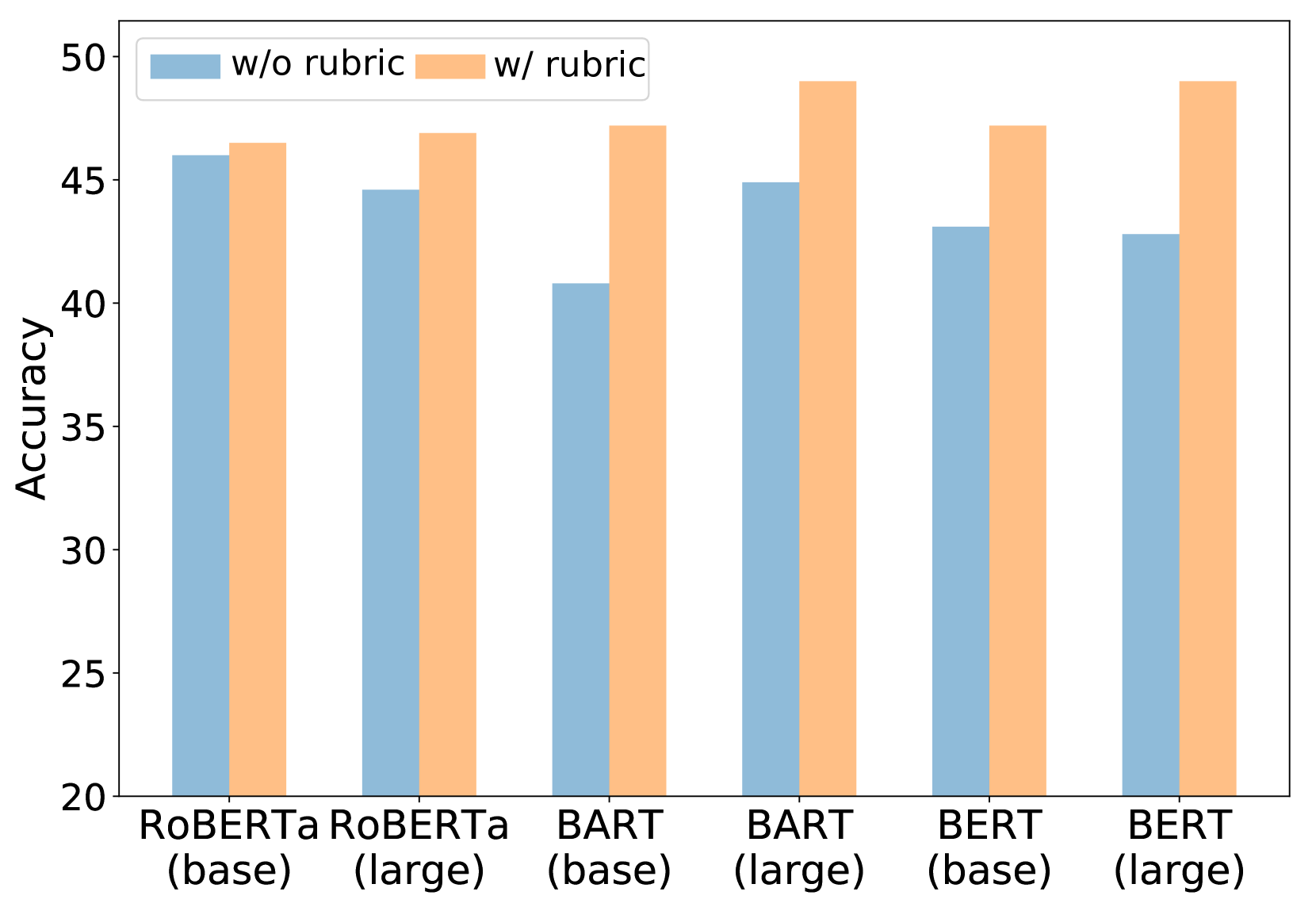
- 通过在RiceChem数据集上的实验,模型性能显著提升,展示了基于评分标准的方法在捕捉学生回答细节方面的优势。
📝 摘要(中文)
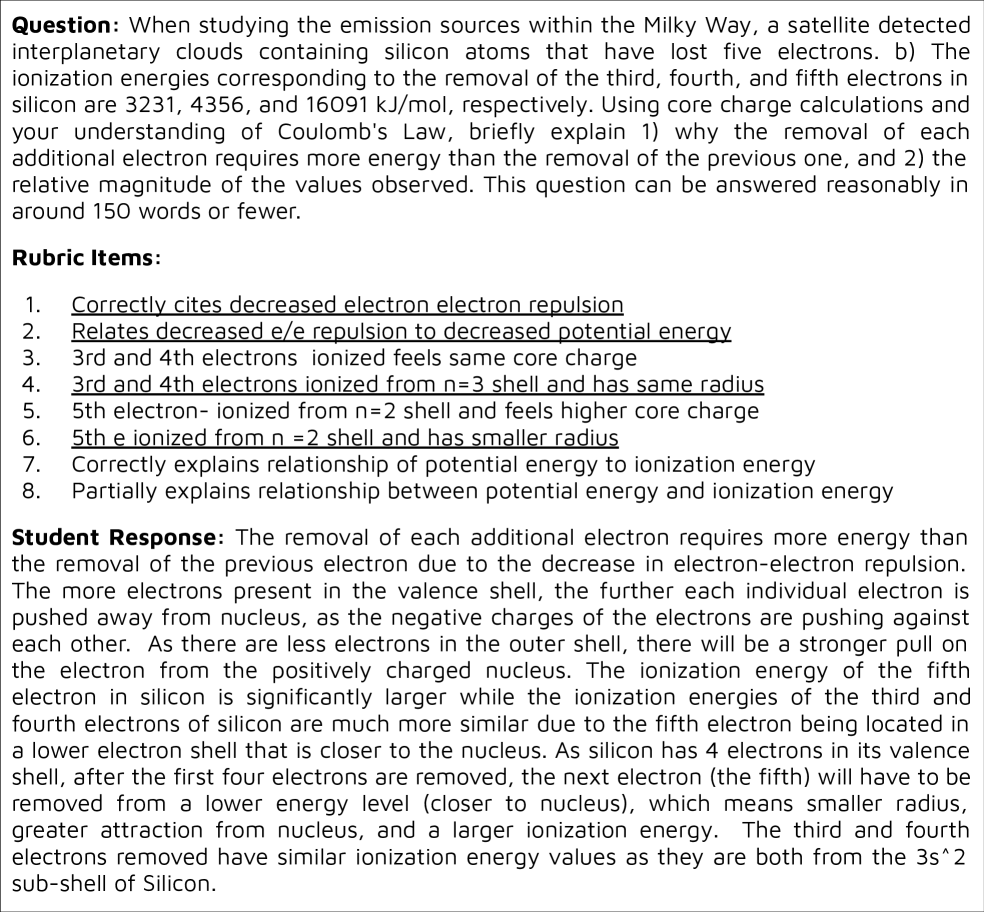
本文介绍了教育自然语言处理领域的新研究方向:自动化长答案评分(ALAG)。与自动化短答案评分(ASAG)和自动化论文评分(AEG)不同,ALAG面临着基于事实的长答案的复杂性和多面性挑战。为研究ALAG,本文引入了RiceChem数据集,该数据集源自大学化学课程,包含真实学生对长答案问题的回答,平均字数显著高于典型的ASAG数据集。我们提出了一种新颖的ALAG方法,将其表述为评分标准蕴含问题,利用自然语言推理模型验证学生回答中是否涵盖了评分标准的每个要素。这种表述方式使得MNLI的迁移学习得以有效应用,显著提升了模型在RiceChem数据集上的表现。我们展示了基于评分标准的表述在ALAG中的重要性,优于传统的基于分数的方法,能够更好地捕捉学生回答的细微差别。
🔬 方法详解
问题定义:本文旨在解决自动化长答案评分(ALAG)中的复杂性问题,现有方法在处理多维度长答案时难以准确评估学生的理解和表达能力。
核心思路:我们将ALAG问题转化为评分标准蕴含问题,利用自然语言推理模型来判断学生回答是否满足各个评分标准,从而提高评分的准确性和细致性。
技术框架:整体架构包括数据预处理、模型训练和评估三个主要阶段。首先,利用RiceChem数据集进行训练,然后通过MNLI模型进行迁移学习,最后评估模型在长答案评分上的表现。
关键创新:最重要的创新在于将评分标准与自然语言推理结合,形成新的评分机制,与传统的基于分数的方法相比,能够更好地捕捉学生回答的细节和复杂性。
关键设计:在模型设计中,采用了MNLI的迁移学习策略,并针对评分标准的每个要素设计了相应的损失函数,以确保模型能够有效学习到评分标准的细微差别。具体参数设置和网络结构细节在实验部分进行了详细描述。
🖼️ 关键图片

📊 实验亮点
实验结果表明,基于评分标准的ALAG方法在RiceChem数据集上显著优于传统评分方法,尤其在捕捉学生回答的细微差别方面表现突出。尽管使用了MNLI的迁移学习,LLMs在该任务上的表现仍然较低,显示出ALAG任务的复杂性。
🎯 应用场景
该研究的潜在应用领域包括教育评估、在线学习平台和智能辅导系统。通过自动化长答案评分,教育工作者可以更高效地评估学生的理解能力和表达能力,从而提升教学质量和学习效果。未来,该方法有望在大规模在线课程中得到广泛应用,推动教育公平和个性化学习的发展。
📄 摘要(原文)
We introduce a new area of study in the field of educational Natural Language Processing: Automated Long Answer Grading (ALAG). Distinguishing itself from Automated Short Answer Grading (ASAG) and Automated Essay Grading (AEG), ALAG presents unique challenges due to the complexity and multifaceted nature of fact-based long answers. To study ALAG, we introduce RiceChem, a dataset derived from a college chemistry course, featuring real student responses to long-answer questions with an average word count notably higher than typical ASAG datasets. We propose a novel approach to ALAG by formulating it as a rubric entailment problem, employing natural language inference models to verify whether each criterion, represented by a rubric item, is addressed in the student's response. This formulation enables the effective use of MNLI for transfer learning, significantly improving the performance of models on the RiceChem dataset. We demonstrate the importance of rubric-based formulation in ALAG, showcasing its superiority over traditional score-based approaches in capturing the nuances of student responses. We also investigate the performance of models in cold start scenarios, providing valuable insights into the practical deployment considerations in educational settings. Lastly, we benchmark state-of-the-art open-sourced Large Language Models (LLMs) on RiceChem and compare their results to GPT models, highlighting the increased complexity of ALAG compared to ASAG. Despite leveraging the benefits of a rubric-based approach and transfer learning from MNLI, the lower performance of LLMs on RiceChem underscores the significant difficulty posed by the ALAG task. With this work, we offer a fresh perspective on grading long, fact-based answers and introduce a new dataset to stimulate further research in this important area. Code: \url{https://github.com/luffycodes/Automated-Long-Answer-Grading}.