Beyond Human Norms: Unveiling Unique Values of Large Language Models through Interdisciplinary Approaches
作者: Pablo Biedma, Xiaoyuan Yi, Linus Huang, Maosong Sun, Xing Xie
分类: cs.CL, cs.AI
发布日期: 2024-04-19 (更新: 2024-05-10)
备注: 16 pages, work in progress
💡 一句话要点
提出ValueLex框架以揭示大型语言模型的独特价值体系
🎯 匹配领域: 支柱九:具身大模型 (Embodied Foundation Models)
关键词: 大型语言模型 价值体系 心理学方法 因子分析 语义聚类 AI伦理 模型评估
📋 核心要点
- 现有研究主要依赖人类价值体系,未能充分揭示LLMs的独特价值观,导致对其风险评估不足。
- 本文提出ValueLex框架,利用心理学方法从零开始重建LLMs的价值体系,探索其独特价值。
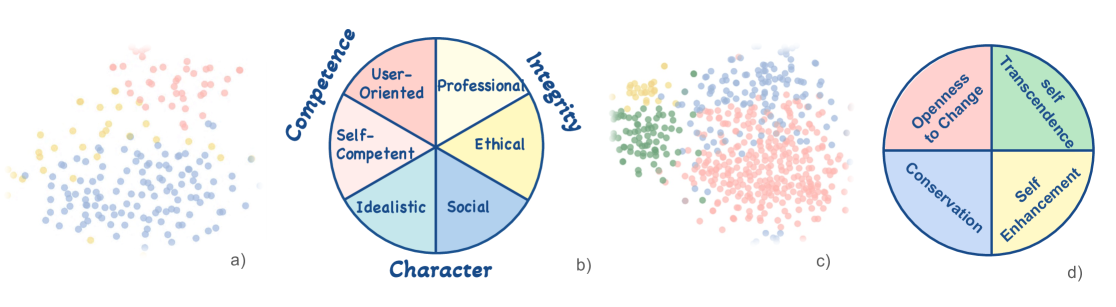
- 通过对30多个LLMs的分析,识别出三个核心价值维度,提供了对LLMs价值倾向的深入理解。
📝 摘要(中文)
近年来,大型语言模型(LLMs)的进展彻底改变了人工智能领域,但也带来了潜在的安全和伦理风险。解读LLMs内嵌的价值观对于评估和缓解这些风险至关重要。尽管已有大量研究探讨LLMs的价值观,但大多依赖于社会科学中的人类价值体系。本文提出了一种新颖的框架ValueLex,从头构建LLMs的独特价值体系,利用心理学方法论。基于词汇假设,ValueLex采用生成性方法从30多个LLMs中提取多样化的价值观,最终通过因子分析和语义聚类形成一个全面的价值框架。我们识别出三个核心价值维度:能力、品格和诚信,揭示LLMs拥有一个结构化但非人类的价值体系。基于该体系,我们进一步开发了量身定制的投射测试,以评估不同模型规模、训练方法和数据源下LLMs的价值倾向。
🔬 方法详解
问题定义:本文旨在解决大型语言模型(LLMs)内嵌价值观的识别与评估问题。现有方法过于依赖人类价值体系,无法揭示LLMs的独特价值。
核心思路:论文通过ValueLex框架,结合心理学方法,系统性地从头构建LLMs的价值体系,探索其与人类价值的异同。
技术框架:ValueLex框架包括数据收集、价值提取、因子分析和语义聚类四个主要模块。首先,从30多个LLMs中收集数据,然后提取多样化的价值观,接着进行因子分析以识别核心维度,最后通过语义聚类形成全面的价值框架。
关键创新:最重要的创新在于提出了基于词汇假设的生成性方法,能够系统性地揭示LLMs的独特价值体系,与传统依赖人类价值的研究方法形成鲜明对比。
关键设计:在技术细节上,采用了因子分析和语义聚类的组合方法,确保提取的价值观具有结构性和可解释性,同时设计了针对不同模型的量身定制的投射测试。
🖼️ 关键图片


📊 实验亮点
实验结果表明,ValueLex框架成功识别出LLMs的三个核心价值维度:能力、品格和诚信。与传统方法相比,本文框架在价值提取的准确性和多样性上有显著提升,提供了更全面的价值分析。
🎯 应用场景
该研究的潜在应用领域包括人工智能的伦理审查、模型调优和AI对齐等。通过理解LLMs的独特价值体系,可以更好地制定相应的安全和监管措施,促进AI技术的负责任发展。
📄 摘要(原文)
Recent advancements in Large Language Models (LLMs) have revolutionized the AI field but also pose potential safety and ethical risks. Deciphering LLMs' embedded values becomes crucial for assessing and mitigating their risks. Despite extensive investigation into LLMs' values, previous studies heavily rely on human-oriented value systems in social sciences. Then, a natural question arises: Do LLMs possess unique values beyond those of humans? Delving into it, this work proposes a novel framework, ValueLex, to reconstruct LLMs' unique value system from scratch, leveraging psychological methodologies from human personality/value research. Based on Lexical Hypothesis, ValueLex introduces a generative approach to elicit diverse values from 30+ LLMs, synthesizing a taxonomy that culminates in a comprehensive value framework via factor analysis and semantic clustering. We identify three core value dimensions, Competence, Character, and Integrity, each with specific subdimensions, revealing that LLMs possess a structured, albeit non-human, value system. Based on this system, we further develop tailored projective tests to evaluate and analyze the value inclinations of LLMs across different model sizes, training methods, and data sources. Our framework fosters an interdisciplinary paradigm of understanding LLMs, paving the way for future AI alignment and regulation.