From Form(s) to Meaning: Probing the Semantic Depths of Language Models Using Multisense Consistency
作者: Xenia Ohmer, Elia Bruni, Dieuwke Hupkes
分类: cs.CL, cs.AI
发布日期: 2024-04-18
💡 一句话要点
提出多感知一致性测试以评估语言模型的理解能力
🎯 匹配领域: 支柱九:具身大模型 (Embodied Foundation Models)
关键词: 语言模型 多感知一致性 自然语言理解 跨语言评估 同义改写 GPT-3.5 理解能力
📋 核心要点
- 核心问题:现有大型语言模型在理解能力上存在不足,尤其是在跨语言和同义改写的一致性方面。
- 方法要点:论文通过多感知一致性测试,评估语言模型在不同语言和任务中的表现,旨在揭示其理解的深度。
- 实验或效果:研究发现GPT-3.5在多感知一致性上表现欠佳,表明其理解能力与人类仍有显著差距。
📝 摘要(中文)
随着大型语言模型(LLMs)能力的快速提升,关于其“理解”能力的定义及其与人类理解的比较引发了广泛关注。许多LLMs仅在文本上进行训练,这使得其在基准测试中的优异表现是否真正反映了对问题的理解变得不确定。本文旨在通过一系列测试,探讨形式与意义之间的关系,特别关注跨语言和同义改写的一致性。以GPT-3.5为研究对象,评估其在五种不同语言和多项任务中的多感知一致性,结果显示模型在这一方面的表现仍然不足,且缺乏一致性与人类理解相距甚远,这对其在学习人类语言和理解方面的实用性产生了影响。
🔬 方法详解
问题定义:本文旨在解决大型语言模型在理解能力上的不足,特别是其在不同语言和同义改写中的一致性问题。现有方法往往未能有效区分形式与意义,导致对模型理解能力的误判。
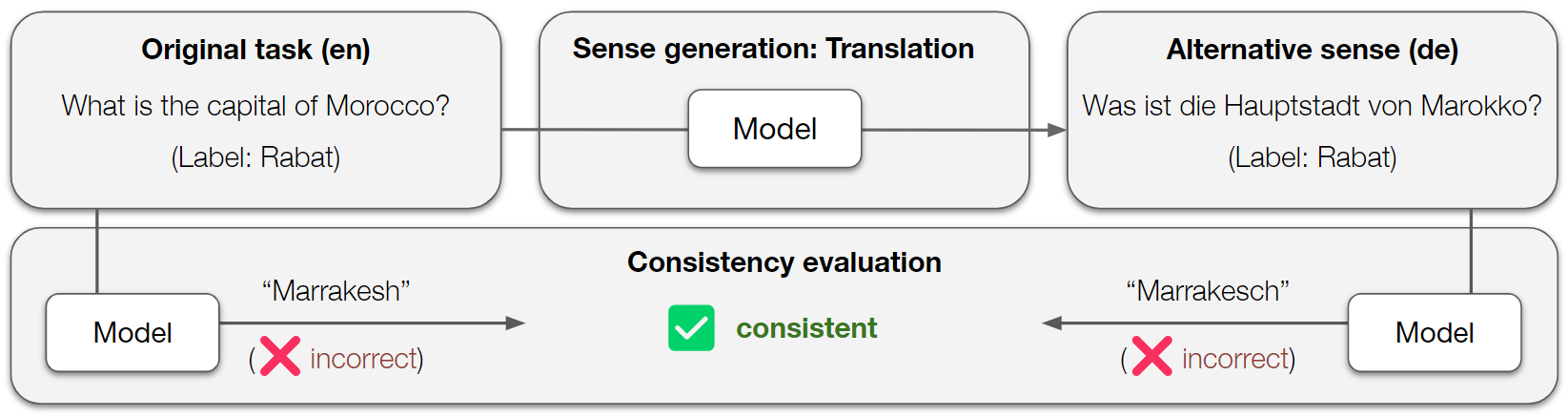
核心思路:论文提出通过多感知一致性测试来评估语言模型的理解能力,强调世界理解在不同表现形式下应保持一致,受Fregean感知理论启发。
技术框架:研究首先在受控环境中对模型进行简单事实的评估,随后在四个流行的自然语言理解基准上进行测试。整体流程包括数据准备、模型评估和结果分析三个主要阶段。
关键创新:本研究的创新点在于引入多感知一致性这一概念,系统性地评估语言模型在不同语言和同义改写下的表现,与现有方法相比,提供了更深入的理解能力分析。
关键设计:在实验中,采用了多种语言的事实问题和任务,设计了针对性的问题集,以确保对模型理解能力的全面评估。
🖼️ 关键图片


📊 实验亮点
实验结果显示,GPT-3.5在多感知一致性测试中的表现不佳,尤其是在跨语言和同义改写任务中,模型的一致性得分显著低于预期。这表明其理解能力与人类相比仍存在明显差距,影响了其在自然语言理解任务中的有效性。
🎯 应用场景
该研究的潜在应用领域包括自然语言处理、机器翻译和人机交互等。通过深入理解语言模型的能力,可以为改进模型设计和训练方法提供指导,进而提升其在实际应用中的表现和可靠性。
📄 摘要(原文)
The staggering pace with which the capabilities of large language models (LLMs) are increasing, as measured by a range of commonly used natural language understanding (NLU) benchmarks, raises many questions regarding what "understanding" means for a language model and how it compares to human understanding. This is especially true since many LLMs are exclusively trained on text, casting doubt on whether their stellar benchmark performances are reflective of a true understanding of the problems represented by these benchmarks, or whether LLMs simply excel at uttering textual forms that correlate with what someone who understands the problem would say. In this philosophically inspired work, we aim to create some separation between form and meaning, with a series of tests that leverage the idea that world understanding should be consistent across presentational modes - inspired by Fregean senses - of the same meaning. Specifically, we focus on consistency across languages as well as paraphrases. Taking GPT-3.5 as our object of study, we evaluate multisense consistency across five different languages and various tasks. We start the evaluation in a controlled setting, asking the model for simple facts, and then proceed with an evaluation on four popular NLU benchmarks. We find that the model's multisense consistency is lacking and run several follow-up analyses to verify that this lack of consistency is due to a sense-dependent task understanding. We conclude that, in this aspect, the understanding of LLMs is still quite far from being consistent and human-like, and deliberate on how this impacts their utility in the context of learning about human language and understanding.