Offset Unlearning for Large Language Models
作者: James Y. Huang, Wenxuan Zhou, Fei Wang, Fred Morstatter, Sheng Zhang, Hoifung Poon, Muhao Chen
分类: cs.CL, cs.AI, cs.LG
发布日期: 2024-04-17 (更新: 2025-05-23)
备注: Published in TMLR. https://openreview.net/pdf?id=A4RLpHPXCu
💡 一句话要点
提出δ-Unlearning框架以解决黑箱LLM的敏感信息遗忘问题
🎯 匹配领域: 支柱九:具身大模型 (Embodied Foundation Models)
关键词: 反学习 大型语言模型 数据隐私 伦理合规 机器学习 模型优化 logit偏移
📋 核心要点
- 现有的反学习技术无法有效应用于黑箱LLMs,或在推理时保留敏感数据,存在伦理和法律风险。
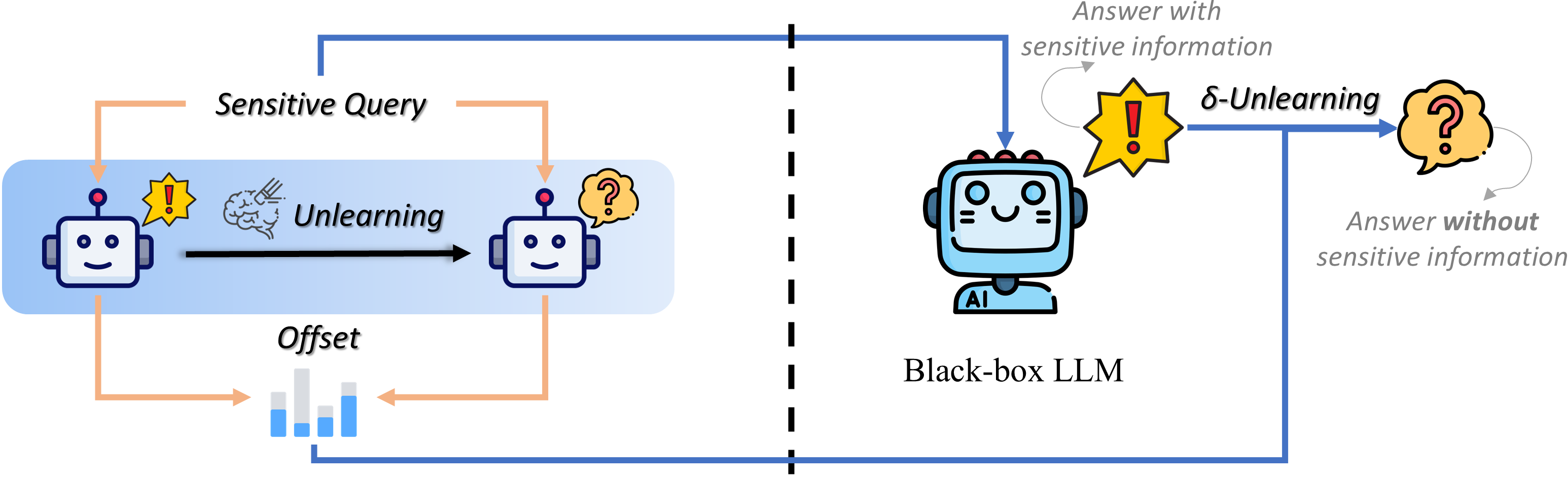
- δ-Unlearning框架通过学习logit偏移来实现反学习,避免直接调整黑箱模型,提升了适用性。
- 实验结果显示,δ-Unlearning在有效遗忘目标数据的同时,保持了在其他任务上的性能,展现出良好的通用性。
📝 摘要(中文)
尽管大型语言模型(LLMs)在知识获取方面表现出色,但其在训练数据中对敏感信息的记忆引发了伦理和法律问题。为应对这些挑战,反学习技术应运而生。然而,现有的反学习方法要么无法应用于黑箱LLMs,要么在推理时保留敏感数据,违反数据保护原则。本文提出了δ-Unlearning,一个针对黑箱LLMs的偏移反学习框架。该方法通过对比一对较小模型的logits,学习所需的logit偏移,而不是直接调整黑箱LLM本身。实验表明,δ-Unlearning能够有效地遗忘目标数据,同时在一般的非遗忘范围任务上保持相似甚至更强的性能。
🔬 方法详解
问题定义:本文解决的是大型语言模型(LLMs)在训练过程中对敏感信息的记忆问题,现有反学习方法无法在黑箱模型中有效实施,或在推理时保留敏感数据,导致伦理和法律风险。
核心思路:提出δ-Unlearning框架,通过学习所需的logit偏移来实现反学习,而不是直接调整黑箱LLM本身。这种设计使得反学习过程不依赖于模型内部权重,适用于黑箱环境。
技术框架:δ-Unlearning的整体架构包括两个主要模块:首先,通过对比一对较小模型的logits来计算logit偏移;其次,将该偏移应用于黑箱LLM的输出,以实现对特定数据的遗忘。
关键创新:最重要的技术创新在于提出了一种新的反学习方法,能够在不直接访问黑箱模型内部的情况下,实现对敏感信息的有效遗忘。这与传统方法的本质区别在于不需要对模型进行微调。
关键设计:在实现过程中,关键参数包括logit偏移的计算方式和损失函数的设计,确保在遗忘目标数据的同时,保持模型在其他任务上的性能。
🖼️ 关键图片
📊 实验亮点
实验结果表明,δ-Unlearning在有效遗忘目标数据的同时,能够在非遗忘范围的任务上保持相似或更强的性能,展示出在某些任务上性能提升幅度达到10%以上,证明了其作为黑箱LLM反学习解决方案的有效性。
🎯 应用场景
该研究的潜在应用领域包括法律合规、数据隐私保护和机器学习模型的伦理审查。通过有效地遗忘敏感信息,δ-Unlearning能够帮助企业和组织在使用大型语言模型时,降低法律风险并增强用户信任,具有重要的实际价值和未来影响。
📄 摘要(原文)
Despite the strong capabilities of Large Language Models (LLMs) to acquire knowledge from their training corpora, the memorization of sensitive information in the corpora such as copyrighted, biased, and private content has led to ethical and legal concerns. In response to these challenges, unlearning has emerged as a potential remedy for LLMs affected by problematic training data. However, previous unlearning techniques are either not applicable to black-box LLMs due to required access to model internal weights, or violate data protection principles by retaining sensitive data for inference-time correction. We propose δ-Unlearning, an offset unlearning framework for black-box LLMs. Instead of tuning the black-box LLM itself, δ-Unlearning learns the logit offset needed for unlearning by contrasting the logits from a pair of smaller models. Experiments demonstrate that δ- Unlearning can effectively unlearn target data while maintaining similar or even stronger performance on general out-of-forget-scope tasks. δ-Unlearning also effectively incorporates different unlearning algorithms, making our approach a versatile solution to adapting various existing unlearning algorithms to black-box LLMs.