From Model-centered to Human-Centered: Revision Distance as a Metric for Text Evaluation in LLMs-based Applications
作者: Yongqiang Ma, Lizhi Qing, Jiawei Liu, Yangyang Kang, Yue Zhang, Wei Lu, Xiaozhong Liu, Qikai Cheng
分类: cs.CL, cs.IR
发布日期: 2024-04-10 (更新: 2024-04-11)
备注: 9 pages, 2 figures, under review
💡 一句话要点
提出修订距离指标以解决LLMs应用中的文本评估问题
🎯 匹配领域: 支柱九:具身大模型 (Embodied Foundation Models)
关键词: 大型语言模型 文本评估 修订距离 人性化评估 AI写作辅助 学术写作 用户体验
📋 核心要点
- 现有的文本评估方法往往忽视用户体验,主要集中在模型的开发和性能上,导致评估结果缺乏人性化。
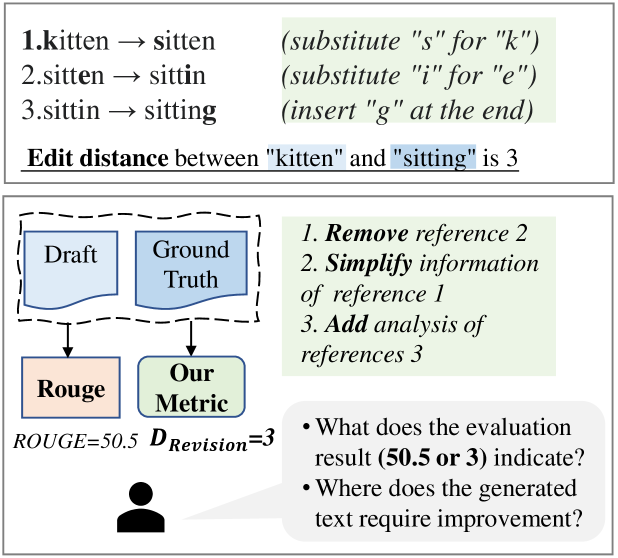
- 本研究提出的“修订距离”指标,通过模拟人类的写作修订过程,提供了一种以人为中心的文本评估方法。
- 实验结果显示,修订距离在简单写作任务中与传统指标一致,并在学术写作任务中表现出更高的可靠性和细致的反馈。
📝 摘要(中文)
评估大型语言模型(LLMs)在实际应用中的表现至关重要。传统的评估方法主要针对模型开发,通常只提供数值评分,忽视用户体验。因此,本研究将评估重点从模型中心转向以人为中心,提出了一种名为“修订距离”的新指标。该指标利用LLMs生成的修订编辑,模拟人类写作过程,通过计算生成的修订编辑数量来评估文本。实验结果表明,在简单写作任务中,修订距离与现有指标(如ROUGE、Bert-score和GPT-score)一致,但提供了更具洞察力和详细的反馈,并能更好地区分文本。在具有挑战性的学术写作任务中,该指标仍能提供可靠的评估,超越了其他指标的局限性。
🔬 方法详解
问题定义:本研究旨在解决现有文本评估方法忽视用户体验的问题,传统方法多依赖于数值评分,缺乏对文本质量的深入分析。
核心思路:提出“修订距离”指标,利用LLMs生成的修订编辑,模拟人类的写作过程,通过计算修订编辑的数量来评估文本质量,强调人性化的反馈。
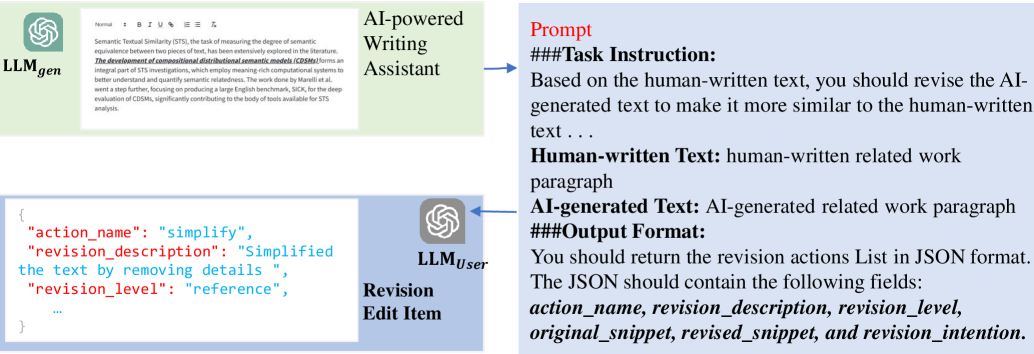
技术框架:整体框架包括三个主要模块:1) LLMs生成修订编辑,2) 计算修订距离,3) 提供可解释的评估结果。每个模块相互协作,形成完整的评估流程。
关键创新:修订距离作为一种新颖的评估指标,能够提供比传统方法更具洞察力的反馈,尤其在复杂的学术写作任务中表现优异,突破了传统评估的局限。
关键设计:在设计过程中,重点关注修订编辑的生成质量,确保其能够真实反映人类的写作修订行为,同时设置合理的参数以优化评估结果的准确性。
🖼️ 关键图片

📊 实验亮点
实验结果显示,在简单写作任务中,修订距离与ROUGE、Bert-score和GPT-score等传统指标一致,但提供了更详细的反馈。在学术写作任务中,修订距离仍能保持可靠性,超越了其他评估指标的表现,显示出其独特的优势。
🎯 应用场景
该研究的修订距离指标具有广泛的应用潜力,尤其在AI写作辅助工具中,可以帮助用户获得更具人性化的文本评估反馈。此外,该指标在缺乏参考文本的情况下仍能提供可靠的评估,具有重要的实际价值和未来影响。
📄 摘要(原文)
Evaluating large language models (LLMs) is fundamental, particularly in the context of practical applications. Conventional evaluation methods, typically designed primarily for LLM development, yield numerical scores that ignore the user experience. Therefore, our study shifts the focus from model-centered to human-centered evaluation in the context of AI-powered writing assistance applications. Our proposed metric, termed
Revision Distance,'' utilizes LLMs to suggest revision edits that mimic the human writing process. It is determined by counting the revision edits generated by LLMs. Benefiting from the generated revision edit details, our metric can provide a self-explained text evaluation result in a human-understandable manner beyond the context-independent score. Our results show that for the easy-writing task,Revision Distance'' is consistent with established metrics (ROUGE, Bert-score, and GPT-score), but offers more insightful, detailed feedback and better distinguishes between texts. Moreover, in the context of challenging academic writing tasks, our metric still delivers reliable evaluations where other metrics tend to struggle. Furthermore, our metric also holds significant potential for scenarios lacking reference texts.