Extracting Social Determinants of Health from Pediatric Patient Notes Using Large Language Models: Novel Corpus and Methods
作者: Yujuan Fu, Giridhar Kaushik Ramachandran, Nicholas J Dobbins, Namu Park, Michael Leu, Abby R. Rosenberg, Kevin Lybarger, Fei Xia, Ozlem Uzuner, Meliha Yetisgen
分类: cs.CL
发布日期: 2024-03-31 (更新: 2024-04-04)
备注: 12 pages, 2 figures and 3 tables. Accepted by LREC-COLING 2024
💡 一句话要点
提出基于大语言模型的儿童健康社会决定因素提取方法
🎯 匹配领域: 支柱九:具身大模型 (Embodied Foundation Models)
关键词: 社会决定因素 儿童健康 大语言模型 电子健康记录 数据提取 注释语料库 机器学习
📋 核心要点
- 现有方法在从电子健康记录中提取儿童健康的社会决定因素时,面临数据多样性和注释一致性不足的挑战。
- 本文提出了儿童社会历史注释语料库(PedSHAC),并利用大语言模型进行微调和上下文学习,以实现高效的SDoH提取。
- 实验结果显示,微调模型在事件参数提取上达到了78.4的F1分数,而GPT-4的上下文学习方法在有限样本下表现出82.3的F1分数,具有显著提升。
📝 摘要(中文)
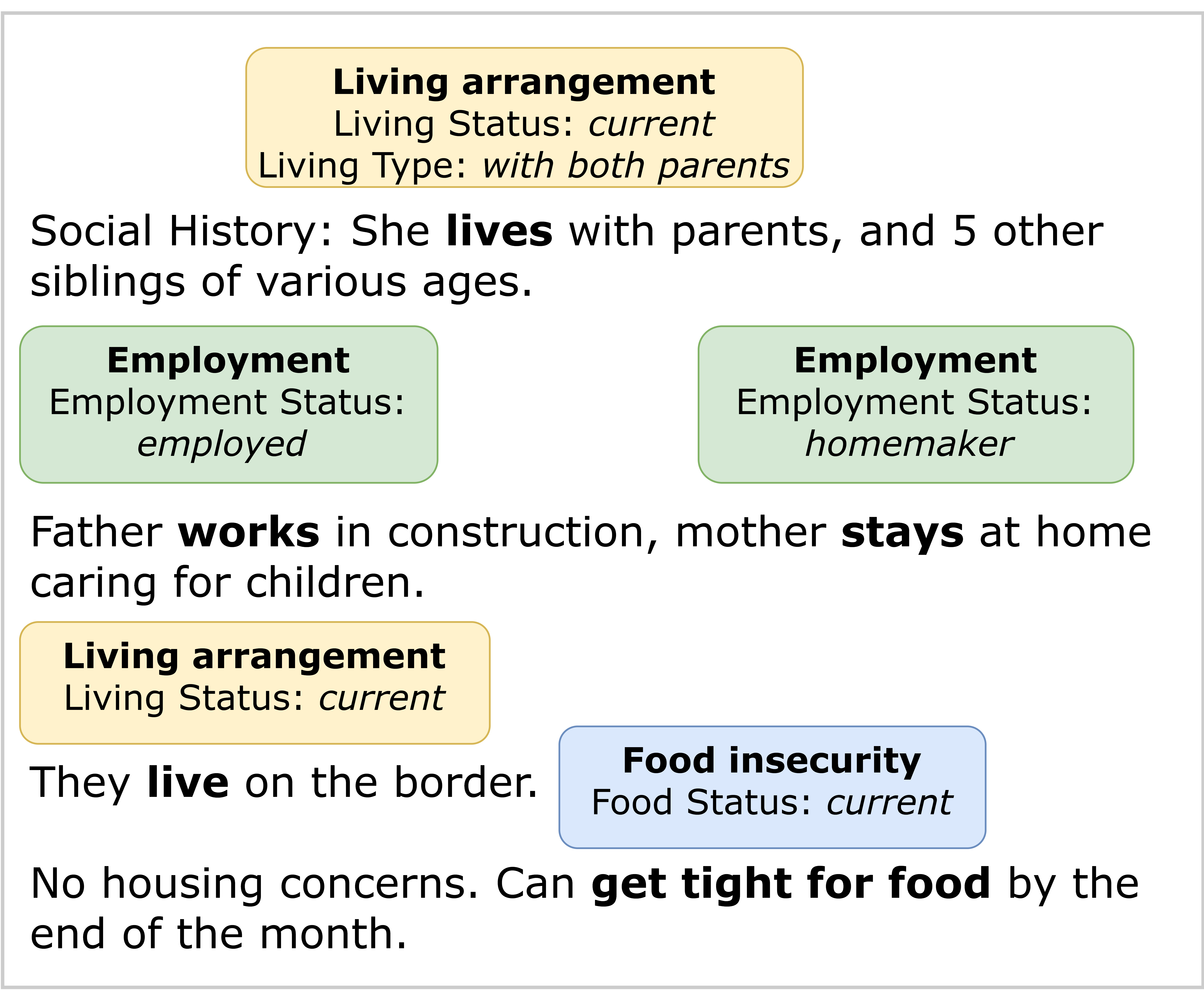
社会决定因素(SDoH)在塑造健康结果方面起着关键作用,尤其是在儿童群体中。本文提出了一个新型注释语料库——儿童社会历史注释语料库(PedSHAC),并评估了使用微调和上下文学习方法的自动提取能力。PedSHAC包含来自华盛顿大学医院系统的1260份临床笔记的社会历史部分,采用事件基础的注释方案,捕捉了十种不同的健康决定因素。研究表明,基于微调的语言模型提取器在事件参数提取上达到了78.4的F1分数,而GPT-4的上下文学习方法在有限注释样本下表现出82.3的F1分数,显示出可靠的SDoH提取能力。
🔬 方法详解
问题定义:本文旨在解决从电子健康记录中提取儿童健康社会决定因素的困难,现有方法在数据多样性和注释一致性方面存在不足。
核心思路:通过构建儿童社会历史注释语料库(PedSHAC),并结合大语言模型的微调和上下文学习方法,提升SDoH提取的准确性和效率。
技术框架:研究首先构建PedSHAC语料库,随后采用事件基础的注释方案进行数据标注,最后利用微调和上下文学习方法进行模型训练和评估。
关键创新:最重要的创新在于构建了一个专门针对儿童健康的注释语料库,并采用大语言模型进行高效的SDoH提取,与传统方法相比,显著提高了提取的准确性和可靠性。
关键设计:在模型训练中,采用了事件基础的注释方案,设置了适当的损失函数以优化提取性能,并利用GPT-4进行上下文学习,确保在有限的注释样本下仍能实现高效提取。
🖼️ 关键图片

📊 实验亮点
实验结果显示,基于微调的语言模型在事件参数提取上达到了78.4的F1分数,而GPT-4的上下文学习方法在有限注释样本下表现出82.3的F1分数,显示出显著的性能提升,验证了新方法的有效性。
🎯 应用场景
该研究的潜在应用领域包括儿童健康管理、公共卫生政策制定和个性化医疗服务。通过准确提取社会决定因素,医疗机构可以更好地理解和应对儿童的健康需求,从而改善健康结果并制定更有效的干预措施。
📄 摘要(原文)
Social determinants of health (SDoH) play a critical role in shaping health outcomes, particularly in pediatric populations where interventions can have long-term implications. SDoH are frequently studied in the Electronic Health Record (EHR), which provides a rich repository for diverse patient data. In this work, we present a novel annotated corpus, the Pediatric Social History Annotation Corpus (PedSHAC), and evaluate the automatic extraction of detailed SDoH representations using fine-tuned and in-context learning methods with Large Language Models (LLMs). PedSHAC comprises annotated social history sections from 1,260 clinical notes obtained from pediatric patients within the University of Washington (UW) hospital system. Employing an event-based annotation scheme, PedSHAC captures ten distinct health determinants to encompass living and economic stability, prior trauma, education access, substance use history, and mental health with an overall annotator agreement of 81.9 F1. Our proposed fine-tuning LLM-based extractors achieve high performance at 78.4 F1 for event arguments. In-context learning approaches with GPT-4 demonstrate promise for reliable SDoH extraction with limited annotated examples, with extraction performance at 82.3 F1 for event triggers.