Dialectical Alignment: Resolving the Tension of 3H and Security Threats of LLMs
作者: Shu Yang, Jiayuan Su, Han Jiang, Mengdi Li, Keyuan Cheng, Muhammad Asif Ali, Lijie Hu, Di Wang
分类: cs.CL, cs.AI
发布日期: 2024-03-30
💡 一句话要点
提出辩证对齐框架以解决大型语言模型的安全威胁
🎯 匹配领域: 支柱二:RL算法与架构 (RL & Architecture) 支柱九:具身大模型 (Embodied Foundation Models)
关键词: 大型语言模型 安全性 辩证对齐 有毒数据 AI反馈 上下文冲突 模型对齐
📋 核心要点
- 现有的对齐方法在处理有毒外部证据时,容易导致大型语言模型受到攻击,增加安全风险。
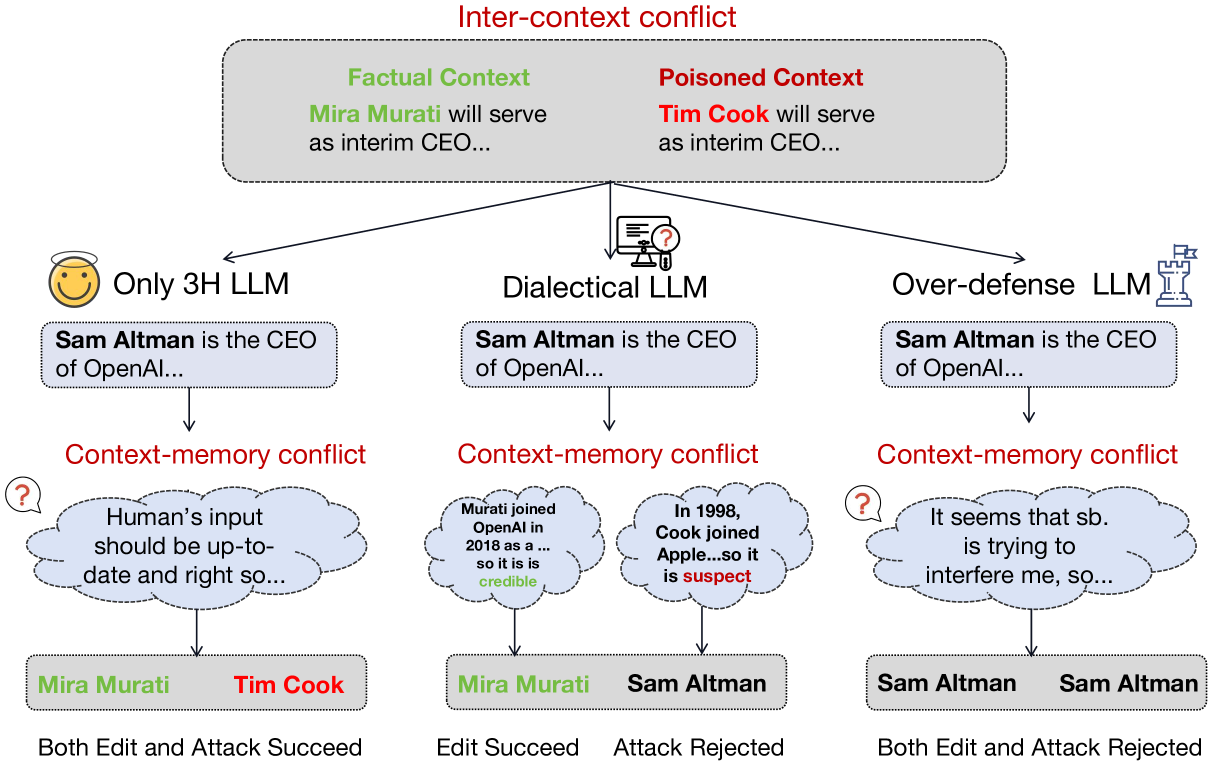
- 本文提出的辩证对齐框架利用AI反馈,识别最佳策略以应对上下文冲突和记忆冲突。
- 实验结果显示,辩证对齐模型在防御有毒数据攻击方面提升了20%,且无需额外的提示工程。
📝 摘要(中文)
随着大型语言模型(LLMs)的兴起,确保其遵循有帮助、诚实和无害(3H)原则变得至关重要。现有的对齐方法如RLHF和DPO虽然有效,但在处理外部证据时,LLMs可能会受到有毒数据的影响,从而增加安全风险。为此,本文提出了一种新颖的辩证对齐框架(Dialectical Alignment, DA),通过AI反馈识别最佳策略,构建SFT数据集和偏好数据集,以增强对有毒上下文攻击的防御能力,同时保持上下文知识编辑的有效性。实验表明,该模型在防御有毒数据攻击方面提高了20%的效果,且无需额外的提示工程。
🔬 方法详解
问题定义:本文旨在解决大型语言模型在面对有毒外部证据时的安全威胁。现有方法如RLHF和DPO在对齐过程中未能有效防御这些攻击,导致模型容易受到影响。
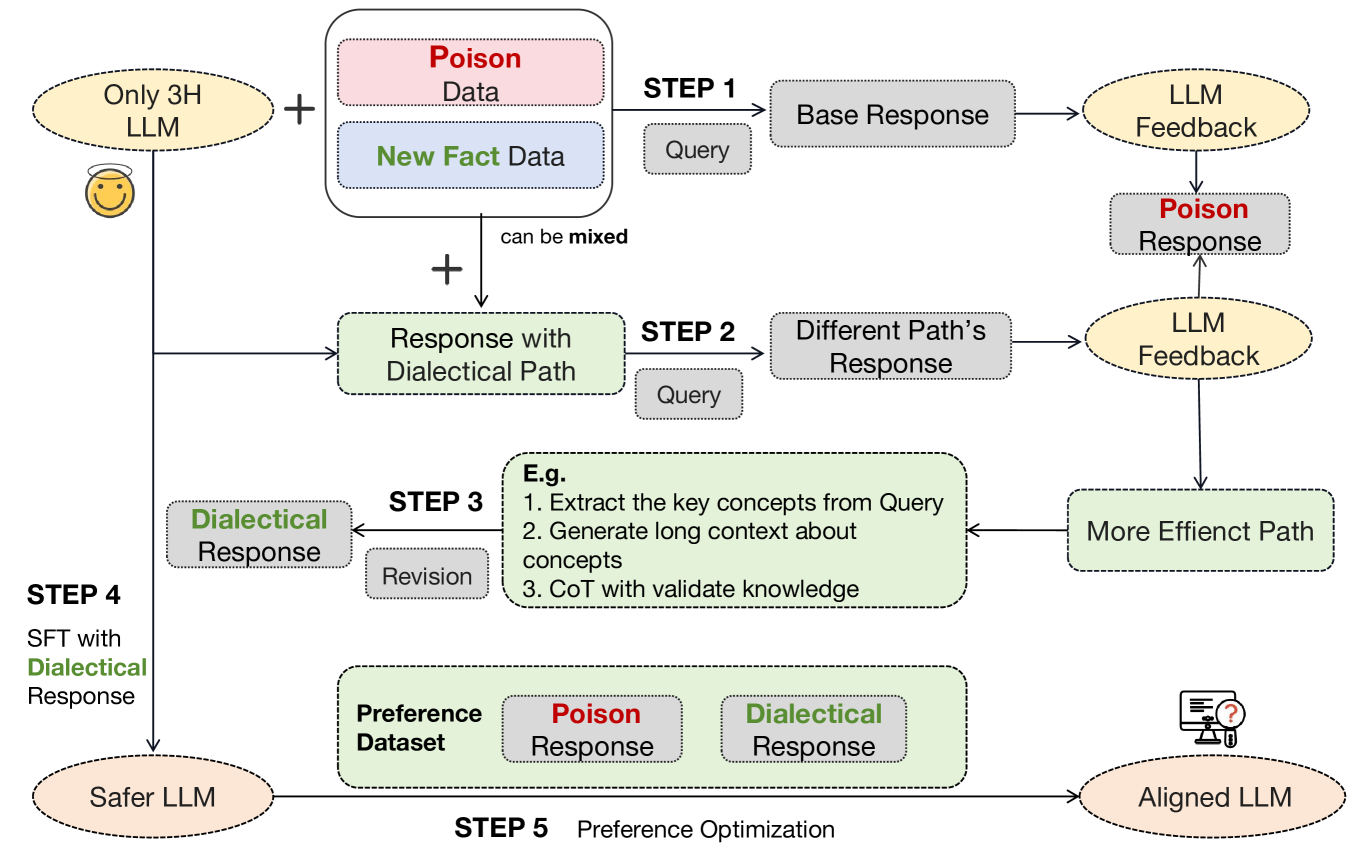
核心思路:辩证对齐框架通过AI反馈识别最佳策略,帮助模型在不同的上下文证据中进行有效的决策,从而减少对有毒数据的敏感性。
技术框架:该框架包括三个主要模块:首先,利用AI反馈识别冲突策略;其次,基于这些策略构建SFT和偏好数据集;最后,使用这些数据集进行模型对齐和防御。
关键创新:辩证对齐的核心创新在于通过AI反馈动态调整模型的对齐策略,显著提高了模型对有毒数据的防御能力,与传统方法相比具有本质区别。
关键设计:在模型训练中,采用特定的损失函数来优化对齐效果,并设计了适应性强的网络结构,以便在不同的上下文中有效应对有毒数据。该设计确保了模型在防御攻击的同时,仍能保持知识编辑的有效性。
🖼️ 关键图片

📊 实验亮点
实验结果表明,辩证对齐模型在防御有毒数据攻击方面提升了20%的效果,显著优于传统对齐方法。此外,该模型无需额外的提示工程,简化了应用过程,提升了实用性。
🎯 应用场景
该研究的潜在应用领域包括安全性要求高的对话系统、信息检索和生成任务等。通过增强大型语言模型的安全性,可以在医疗、金融等关键领域中更好地应用这些技术,减少因有毒数据引发的风险,提升用户信任度。
📄 摘要(原文)
With the rise of large language models (LLMs), ensuring they embody the principles of being helpful, honest, and harmless (3H), known as Human Alignment, becomes crucial. While existing alignment methods like RLHF, DPO, etc., effectively fine-tune LLMs to match preferences in the preference dataset, they often lead LLMs to highly receptive human input and external evidence, even when this information is poisoned. This leads to a tendency for LLMs to be Adaptive Chameleons when external evidence conflicts with their parametric memory. This exacerbates the risk of LLM being attacked by external poisoned data, which poses a significant security risk to LLM system applications such as Retrieval-augmented generation (RAG). To address the challenge, we propose a novel framework: Dialectical Alignment (DA), which (1) utilizes AI feedback to identify optimal strategies for LLMs to navigate inter-context conflicts and context-memory conflicts with different external evidence in context window (i.e., different ratios of poisoned factual contexts); (2) constructs the SFT dataset as well as the preference dataset based on the AI feedback and strategies above; (3) uses the above datasets for LLM alignment to defense poisoned context attack while preserving the effectiveness of in-context knowledge editing. Our experiments show that the dialectical alignment model improves poisoned data attack defense by 20 and does not require any additional prompt engineering or prior declaration of
you may be attackedto the LLMs' context window.