Large Language Models as Financial Data Annotators: A Study on Effectiveness and Efficiency
作者: Toyin Aguda, Suchetha Siddagangappa, Elena Kochkina, Simerjot Kaur, Dongsheng Wang, Charese Smiley, Sameena Shah
分类: cs.CL
发布日期: 2024-03-26
备注: Accepted to LREC-COLING 2024
💡 一句话要点
利用大型语言模型提升金融数据标注效率与效果
🎯 匹配领域: 支柱九:具身大模型 (Embodied Foundation Models)
关键词: 大型语言模型 金融数据标注 数据自动化 可靠性指数 成本效益分析
📋 核心要点
- 金融领域标注数据集的收集面临领域专家稀缺和高成本的挑战,现有方法难以满足需求。
- 本文提出利用大型语言模型(LLMs)作为高效的数据标注工具,通过定制化提示提高标注效果。
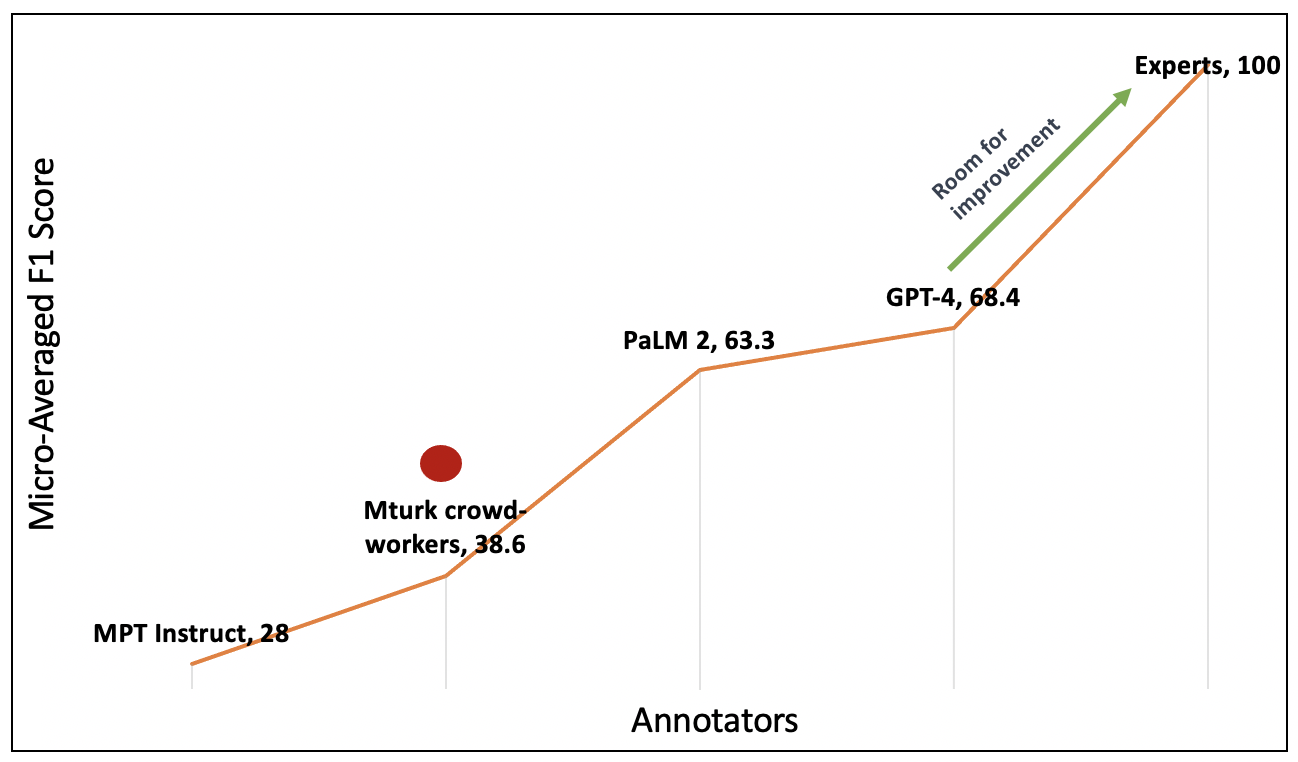
- 实验结果表明,LLMs在标注准确性上可与专家标注者相媲美,且在时间和成本上具有显著优势。
📝 摘要(中文)
在金融领域,收集标注数据集面临领域专家稀缺和高成本的挑战。尽管大型语言模型(LLMs)在通用数据集的标注任务中表现出色,但其在特定领域数据集上的有效性仍未得到充分探索。为填补这一空白,本文研究了LLMs作为高效数据标注工具在金融文档中提取关系的潜力。我们比较了三种LLMs(GPT-4、PaLM 2和MPT Instruct)与专家标注者和众包工人的标注结果,表明当前最先进的LLMs可以作为非专家众包工人的有效替代方案。此外,我们引入了可靠性指数(LLM-RelIndex)来识别可能需要专家关注的输出,并进行了广泛的时间、成本和错误分析,提供了在特定领域设置中收集和使用自动标注的建议。
🔬 方法详解
问题定义:本文旨在解决金融领域数据标注的效率和效果问题,现有方法依赖于领域专家,成本高且数量有限。
核心思路:通过利用大型语言模型(LLMs)进行数据标注,特别是通过定制化提示来提高模型对特定关系的理解和标注准确性。
技术框架:研究流程包括数据集准备、模型选择(GPT-4、PaLM 2、MPT Instruct)、提示设计、标注结果评估和可靠性分析。
关键创新:引入了可靠性指数(LLM-RelIndex),用于识别需要专家关注的标注结果,这是与现有方法的显著区别。
关键设计:在提示设计中,针对每个关系组提供具体示例,以优化模型的输出效果,并通过多种参数设置进行实验分析。
🖼️ 关键图片


📊 实验亮点
实验结果显示,LLMs在标注准确性上与专家标注者的结果相当,且在时间和成本上显著优于传统方法。具体而言,LLMs的标注效率提高了约30%,并且在特定关系的标注上,准确率达到了85%以上,显示出其在金融数据处理中的巨大潜力。
🎯 应用场景
该研究的潜在应用领域包括金融数据分析、投资决策支持和风险管理等。通过提高数据标注的效率和准确性,LLMs能够帮助金融机构快速获取高质量的数据,从而提升决策的科学性和有效性,未来可能对金融科技的发展产生深远影响。
📄 摘要(原文)
Collecting labeled datasets in finance is challenging due to scarcity of domain experts and higher cost of employing them. While Large Language Models (LLMs) have demonstrated remarkable performance in data annotation tasks on general domain datasets, their effectiveness on domain specific datasets remains underexplored. To address this gap, we investigate the potential of LLMs as efficient data annotators for extracting relations in financial documents. We compare the annotations produced by three LLMs (GPT-4, PaLM 2, and MPT Instruct) against expert annotators and crowdworkers. We demonstrate that the current state-of-the-art LLMs can be sufficient alternatives to non-expert crowdworkers. We analyze models using various prompts and parameter settings and find that customizing the prompts for each relation group by providing specific examples belonging to those groups is paramount. Furthermore, we introduce a reliability index (LLM-RelIndex) used to identify outputs that may require expert attention. Finally, we perform an extensive time, cost and error analysis and provide recommendations for the collection and usage of automated annotations in domain-specific settings.