Open Conversational LLMs do not know most Spanish words
作者: Javier Conde, Miguel González, Nina Melero, Raquel Ferrando, Gonzalo Martínez, Elena Merino-Gómez, José Alberto Hernández, Pedro Reviriego
分类: cs.CL
发布日期: 2024-03-21 (更新: 2024-09-24)
备注: Procesamiento del Lenguaje Natural, 73, 95-108
期刊: Procesamiento del Lenguaje Natural, n. 73, 2024. http://journal.sepln.org/sepln/ojs/ojs/index.php/pln/article/view/6603
DOI: 10.26342/2024-73-7
💡 一句话要点
评估开放对话LLM对西班牙词汇的掌握能力
🎯 匹配领域: 支柱九:具身大模型 (Embodied Foundation Models)
关键词: 大型语言模型 对话系统 西班牙语 语言公平性 开源模型
📋 核心要点
- 现有的开源对话LLM在多语言能力评估上存在不足,尤其是对西班牙语的掌握较差。
- 论文通过测试开源聊天LLM对西班牙词汇的理解,提出了评估语言知识的新方法。
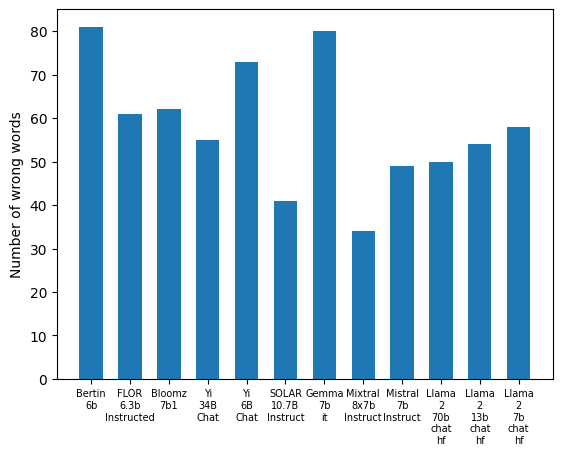
- 实验结果显示,开源聊天LLM对西班牙语单词的理解存在显著错误,表明需要改进其语言公平性。
📝 摘要(中文)
随着对大型语言模型(LLMs)特别是对话模型的兴趣日益增长,开发了大量开源聊天LLM。这些模型在回答问题和解决几乎任何主题的问题时进行了广泛的基准评估。然而,对这些模型在语言知识方面的评估却相对较少。本文通过测试一组参考词典中的西班牙单词,评估开源聊天LLM对西班牙词汇的掌握情况。结果表明,开源聊天LLM对相当一部分单词产生了错误的含义,并且无法正确使用大多数单词来写出有上下文的句子。这些结果显示西班牙语在开源LLM竞赛中被忽视,强调了在对话LLM中推动语言公平性的必要性,以确保它们在不同语言间提供相似的性能。
🔬 方法详解
问题定义:本文旨在解决开源对话LLM在西班牙语词汇掌握上的不足,现有方法未能充分评估模型的语言知识,导致其在多语言环境中的表现不均衡。
核心思路:通过对开源聊天LLM进行系统的西班牙单词测试,评估其对词汇的理解和使用能力,以揭示模型在语言处理上的不足。
技术框架:研究采用了参考词典中的单词作为测试样本,设计了一系列实验来评估模型对这些单词的理解和应用能力,主要模块包括词汇识别、语义理解和上下文生成。
关键创新:本研究的创新点在于首次系统性地评估开源对话LLM在特定语言(西班牙语)上的表现,填补了现有文献中对多语言能力评估的空白。
关键设计:实验中使用了标准的词汇测试方法,设置了多种上下文场景来检验模型的生成能力,关注模型在语义理解和句子构建中的表现。具体参数设置和损失函数的选择也进行了详细说明,以确保评估的准确性。
🖼️ 关键图片

📊 实验亮点
实验结果显示,开源聊天LLM对西班牙语单词的理解存在显著问题,约有相当一部分单词的含义被错误生成,且大多数模型无法在上下文中正确使用这些单词。这一发现强调了在多语言模型开发中需要关注语言公平性的重要性。
🎯 应用场景
该研究的潜在应用领域包括多语言对话系统、教育技术和跨文化交流工具。通过提升对西班牙语的理解能力,能够为用户提供更准确的对话体验,促进不同语言之间的交流与理解。未来,研究成果可推动对话LLM在多语言环境中的公平性和有效性。
📄 摘要(原文)
The growing interest in Large Language Models (LLMs) and in particular in conversational models with which users can interact has led to the development of a large number of open-source chat LLMs. These models are evaluated on a wide range of benchmarks to assess their capabilities in answering questions or solving problems on almost any possible topic or to test their ability to reason or interpret texts. Instead, the evaluation of the knowledge that these models have of the languages has received much less attention. For example, the words that they can recognize and use in different languages. In this paper, we evaluate the knowledge that open-source chat LLMs have of Spanish words by testing a sample of words in a reference dictionary. The results show that open-source chat LLMs produce incorrect meanings for an important fraction of the words and are not able to use most of the words correctly to write sentences with context. These results show how Spanish is left behind in the open-source LLM race and highlight the need to push for linguistic fairness in conversational LLMs ensuring that they provide similar performance across languages.