Zero-shot and Few-shot Generation Strategies for Artificial Clinical Records
作者: Erlend Frayling, Jake Lever, Graham McDonald
分类: cs.CL, cs.LG
发布日期: 2024-03-13 (更新: 2024-03-14)
备注: 4 pages
💡 一句话要点
提出零-shot与少-shot生成策略以解决临床记录隐私问题
🎯 匹配领域: 支柱九:具身大模型 (Embodied Foundation Models)
关键词: 合成医疗记录 零-shot学习 少-shot学习 链式思维 医疗数据隐私 自然语言生成 临床研究
📋 核心要点
- 现有方法在获取敏感患者数据以进行临床研究时面临隐私法规的限制,导致数据获取困难。
- 本文提出了一种利用合成医疗记录的创新方法,通过零-shot和少-shot提示策略生成医疗叙述,避免使用真实患者数据。
- 实验结果表明,采用链式思维提示的零-shot模型在Rouge指标评估中表现与微调模型相当,显示出显著的效果提升。
📝 摘要(中文)
在医学研究中,获取历史患者数据面临隐私法规的重大挑战。为了解决这一问题,本文提出了一种利用合成医疗记录的方法,这些记录在不使用真实患者数据的情况下,能够反映真实患者信息。研究评估了Llama 2大型语言模型在生成合成医疗记录方面的能力,采用零-shot和少-shot提示策略,并与需要敏感患者数据进行微调的方法进行比较。我们引入了一种新的链式思维提示技术,增强了模型生成更准确和相关的医疗叙述的能力。研究结果表明,这种链式思维提示方法使零-shot模型的表现与微调模型相当。
🔬 方法详解
问题定义:本文旨在解决在遵循隐私法规的前提下,如何生成合成医疗记录的问题。现有方法依赖于真实患者数据进行训练,面临数据获取困难和隐私泄露风险。
核心思路:论文提出了一种新的生成策略,利用零-shot和少-shot提示技术,特别是链式思维提示,来生成医疗叙述。通过这种方式,模型能够在没有微调的情况下,生成更准确的医疗记录。
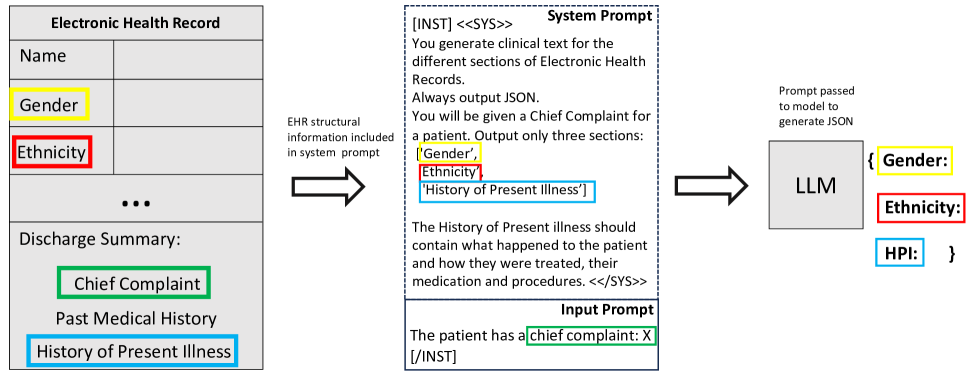
技术框架:整体架构包括数据预处理、模型选择(Llama 2)、提示设计(链式思维)和结果评估(Rouge指标)。主要模块包括数据集构建、合成记录生成和性能评估。
关键创新:最重要的技术创新在于引入链式思维提示技术,使得零-shot模型在生成医疗叙述时能够更好地理解上下文,从而提高生成质量。这与传统的微调方法形成鲜明对比。
关键设计:在模型设计中,采用了特定的提示格式以引导模型生成,损失函数选择了适合文本生成的标准损失函数,确保生成内容的连贯性和准确性。
🖼️ 关键图片
📊 实验亮点
实验结果显示,采用链式思维提示的零-shot模型在Rouge指标评估中达到了与微调模型相当的效果,表明该方法在生成医疗叙述方面具有显著的潜力和实用性。这一创新策略为合成医疗记录的生成提供了新的思路。
🎯 应用场景
该研究的潜在应用领域包括医疗记录生成、临床研究和医疗数据分析。通过生成合成医疗记录,研究人员可以在不侵犯患者隐私的情况下,进行有效的临床研究和数据分析,推动医学科学的发展。未来,该方法可能在更多医疗领域得到应用,促进数据共享与合作。
📄 摘要(原文)
The challenge of accessing historical patient data for clinical research, while adhering to privacy regulations, is a significant obstacle in medical science. An innovative approach to circumvent this issue involves utilising synthetic medical records that mirror real patient data without compromising individual privacy. The creation of these synthetic datasets, particularly without using actual patient data to train Large Language Models (LLMs), presents a novel solution as gaining access to sensitive patient information to train models is also a challenge. This study assesses the capability of the Llama 2 LLM to create synthetic medical records that accurately reflect real patient information, employing zero-shot and few-shot prompting strategies for comparison against fine-tuned methodologies that do require sensitive patient data during training. We focus on generating synthetic narratives for the History of Present Illness section, utilising data from the MIMIC-IV dataset for comparison. In this work introduce a novel prompting technique that leverages a chain-of-thought approach, enhancing the model's ability to generate more accurate and contextually relevant medical narratives without prior fine-tuning. Our findings suggest that this chain-of-thought prompted approach allows the zero-shot model to achieve results on par with those of fine-tuned models, based on Rouge metrics evaluation.