AgentsCourt: Building Judicial Decision-Making Agents with Court Debate Simulation and Legal Knowledge Augmentation
作者: Zhitao He, Pengfei Cao, Chenhao Wang, Zhuoran Jin, Yubo Chen, Jiexin Xu, Huaijun Li, Xiaojian Jiang, Kang Liu, Jun Zhao
分类: cs.CL, cs.AI
发布日期: 2024-03-05 (更新: 2024-09-21)
备注: Accepted by EMNLP 2024 Findings
💡 一句话要点
提出AgentsCourt框架以提升司法决策智能化
🎯 匹配领域: 支柱九:具身大模型 (Embodied Foundation Models)
关键词: 司法决策 多智能体系统 自然语言处理 法律知识库 深度学习
📋 核心要点
- 现有方法多集中于单一司法阶段,难以处理复杂的跨阶段司法决策任务。
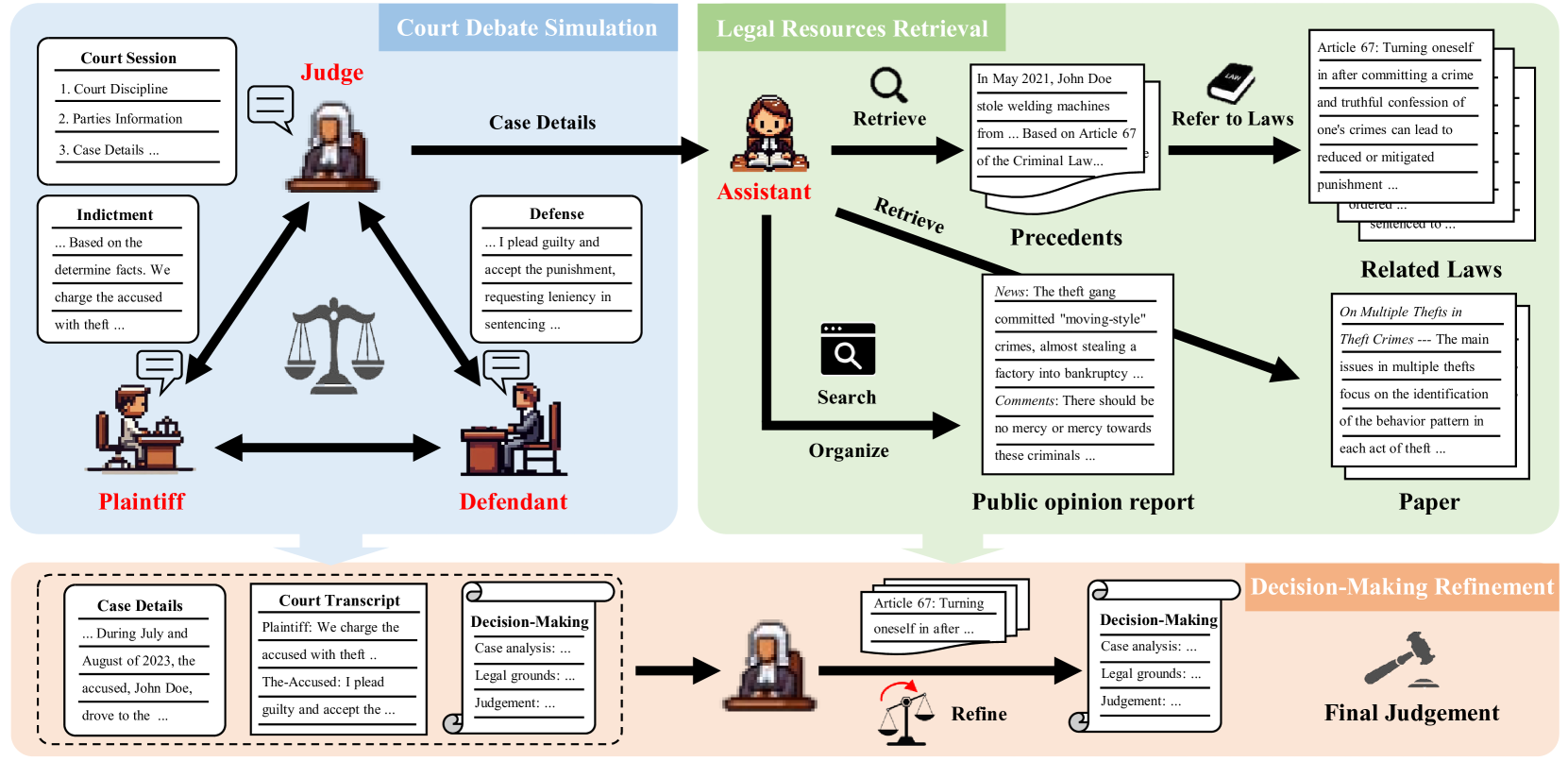
- 本文提出AgentsCourt框架,通过法庭辩论模拟、法律资源检索和决策优化,模拟法官的决策过程。
- 实验结果显示,AgentsCourt在生成法律文书方面的F1分数分别提升8.6%和9.1%,超越现有先进方法。
📝 摘要(中文)
随着深度学习的发展,自然语言处理技术有效提升了传统司法行业的效率。然而,目前的研究多集中于单一司法阶段,难以处理跨阶段的复杂任务。本文提出了一种新颖的多智能体框架AgentsCourt,模拟法庭辩论过程,结合法律资源检索与决策优化,模拟法官的决策过程。同时,构建了包含420份中国判决文书的基准数据集SimuCourt,并建立了大型法律知识库Legal-KB。实验结果表明,该框架在生成法律文书方面显著优于现有方法,第一和第二审设置下F1分数分别提升8.6%和9.1%。
🔬 方法详解
问题定义:本文旨在解决现有司法决策方法在处理跨阶段复杂任务时的不足,现有方法往往无法有效整合不同阶段的信息与资源。
核心思路:提出AgentsCourt框架,通过模拟法庭辩论、检索法律资源和优化决策过程,全面模拟法官的决策行为,以提升司法决策的智能化水平。
技术框架:AgentsCourt框架包含三个主要模块:法庭辩论模拟模块、法律资源检索模块和决策优化模块,依次进行信息的获取、处理和决策生成。
关键创新:本研究的关键创新在于构建了一个多智能体的框架,能够在模拟法庭环境中进行复杂的法律决策,且结合了丰富的法律知识库,显著提升了决策的准确性与效率。
关键设计:在模型设计中,采用了多层次的神经网络结构,结合特定的损失函数以优化法律文书生成的质量,同时通过大规模法律知识库的支持,增强了模型的知识背景和推理能力。
🖼️ 关键图片


📊 实验亮点
实验结果表明,AgentsCourt框架在生成法律文书方面表现优异,第一审和第二审设置下F1分数分别提升了8.6%和9.1%,显著超越了现有的先进方法,展示了其在司法决策中的实际应用潜力。
🎯 应用场景
该研究的潜在应用领域包括智能法律咨询、自动化判决生成和法律文书撰写等。通过提升司法决策的智能化水平,AgentsCourt框架有望在法律行业中实现更高的效率和准确性,推动司法智能化的发展。
📄 摘要(原文)
With the development of deep learning, natural language processing technology has effectively improved the efficiency of various aspects of the traditional judicial industry. However, most current efforts focus on tasks within individual judicial stages, making it difficult to handle complex tasks that span multiple stages. As the autonomous agents powered by large language models are becoming increasingly smart and able to make complex decisions in real-world settings, offering new insights for judicial intelligence. In this paper, (1) we propose a novel multi-agent framework, AgentsCourt, for judicial decision-making. Our framework follows the classic court trial process, consisting of court debate simulation, legal resources retrieval and decision-making refinement to simulate the decision-making of judge. (2) we introduce SimuCourt, a judicial benchmark that encompasses 420 Chinese judgment documents, spanning the three most common types of judicial cases. Furthermore, to support this task, we construct a large-scale legal knowledge base, Legal-KB, with multi-resource legal knowledge. (3) Extensive experiments show that our framework outperforms the existing advanced methods in various aspects, especially in generating legal articles, where our model achieves significant improvements of 8.6% and 9.1% F1 score in the first and second instance settings, respectively.