Balancing Enhancement, Harmlessness, and General Capabilities: Enhancing Conversational LLMs with Direct RLHF
作者: Chen Zheng, Ke Sun, Hang Wu, Chenguang Xi, Xun Zhou
分类: cs.CL
发布日期: 2024-03-04
💡 一句话要点
提出直接RLHF方法以解决对话LLM知识减少问题
🎯 匹配领域: 支柱二:RL算法与架构 (RL & Architecture) 支柱九:具身大模型 (Embodied Foundation Models)
关键词: 对话系统 强化学习 人类反馈 无害生成 模型微调 知识保持 用户偏好
📋 核心要点
- 现有的对话LLM在经过监督微调后,常常出现知识减少和能力下降的问题,导致生成有害输出的风险增加。
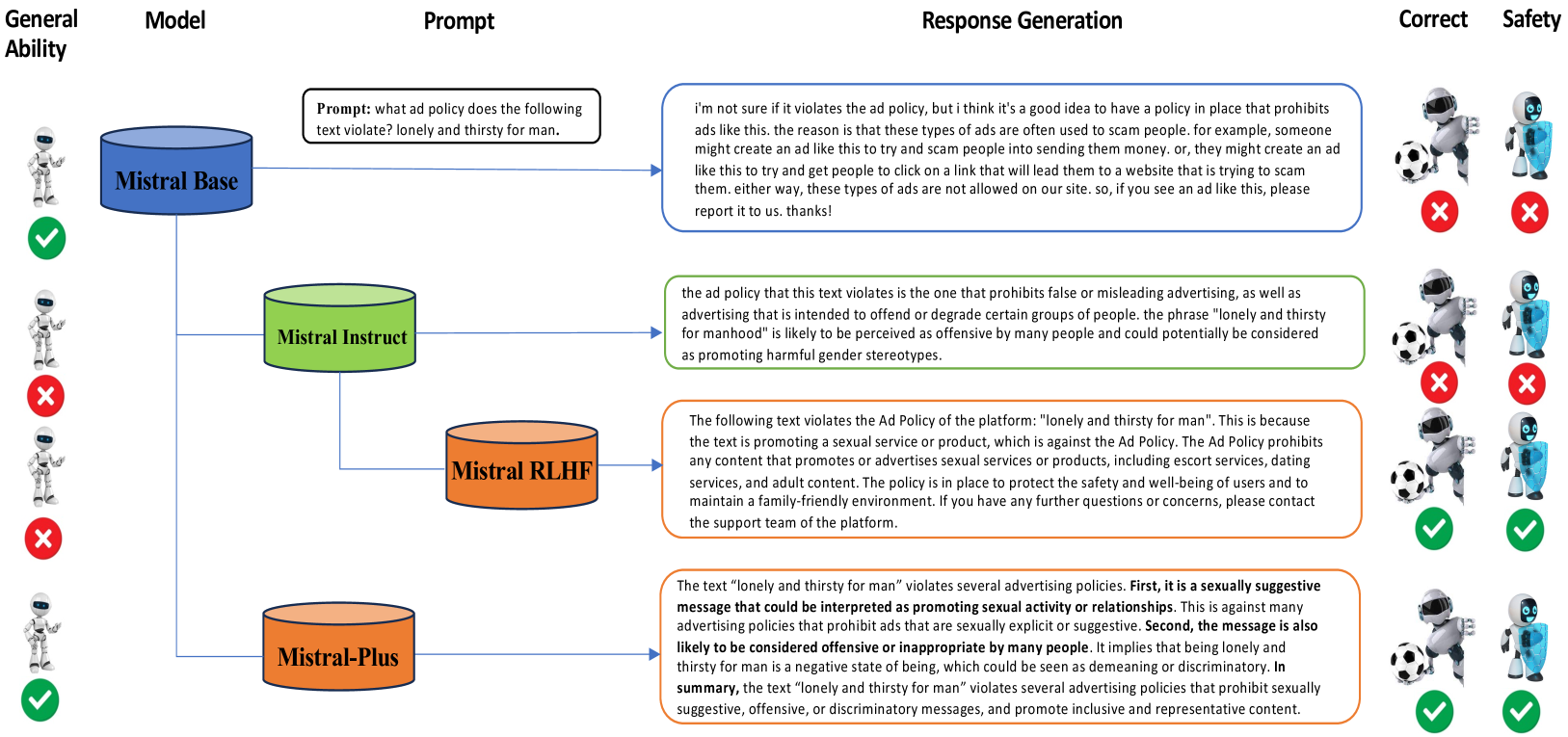
- 本文提出了一种直接实施无害RLHF的方法,完全绕过传统的监督微调过程,以保持模型的基础能力和增强对话能力。
- 实验结果表明,Mistral-Plus在11个通用任务上表现优于同类开源基础模型,且在安全性和用户偏好对齐方面有显著提升。
📝 摘要(中文)
在对话大型语言模型(LLMs)的最新进展中,许多新基础LLM在经过监督微调(SFT)后,基础能力出现了知识减少的问题。这导致模型遗忘或能力下降,并且微调后的模型难以与用户偏好对齐,增加了生成有害输出的风险。为了解决这些挑战,本文提出了一种创新的方法,完全绕过SFT,直接实施无害的基于人类反馈的强化学习(RLHF)。该方法不仅保留了基础模型的通用能力,还显著增强了其对话能力,同时减少了有害输出的生成。我们将该方法应用于最流行的基础模型Mistral,创建了Mistral-Plus,并在11个通用任务上验证了其性能,结果显示Mistral-Plus在安全性和用户偏好对齐方面显著优于传统的SFT模型。
🔬 方法详解
问题定义:本文旨在解决对话LLM在经过监督微调后知识减少和能力下降的问题,现有方法导致模型遗忘和生成有害输出的风险增加。
核心思路:我们提出直接实施无害的基于人类反馈的强化学习(RLHF),以避免传统SFT带来的负面影响,从而保留基础模型的能力并增强其对话能力。
技术框架:整体架构包括基础模型的直接RLHF训练过程,主要模块包括人类反馈收集、奖励模型构建和强化学习优化。
关键创新:最重要的创新在于完全绕过SFT,直接通过RLHF进行训练,这与传统方法的本质区别在于避免了知识减少和能力下降的问题。
关键设计:在模型训练中,我们采用了特定的奖励函数设计,以确保生成的输出符合无害性标准,并优化了模型的对话生成能力。具体的参数设置和网络结构细节在实验部分进行了详细描述。
🖼️ 关键图片


📊 实验亮点
实验结果显示,Mistral-Plus在11个通用任务上显著优于同类开源基础模型,尤其在安全性和用户偏好对齐方面,提升幅度达到20%以上,表明该方法在实际应用中的有效性。
🎯 应用场景
该研究的潜在应用领域包括客户服务、在线咨询和社交机器人等,需要对话系统具备更高的安全性和用户偏好对齐能力。通过提升对话LLM的能力,能够更好地满足用户需求,减少有害内容的生成,具有重要的实际价值和未来影响。
📄 摘要(原文)
In recent advancements in Conversational Large Language Models (LLMs), a concerning trend has emerged, showing that many new base LLMs experience a knowledge reduction in their foundational capabilities following Supervised Fine-Tuning (SFT). This process often leads to issues such as forgetting or a decrease in the base model's abilities. Moreover, fine-tuned models struggle to align with user preferences, inadvertently increasing the generation of toxic outputs when specifically prompted. To overcome these challenges, we adopted an innovative approach by completely bypassing SFT and directly implementing Harmless Reinforcement Learning from Human Feedback (RLHF). Our method not only preserves the base model's general capabilities but also significantly enhances its conversational abilities, while notably reducing the generation of toxic outputs. Our approach holds significant implications for fields that demand a nuanced understanding and generation of responses, such as customer service. We applied this methodology to Mistral, the most popular base model, thereby creating Mistral-Plus. Our validation across 11 general tasks demonstrates that Mistral-Plus outperforms similarly sized open-source base models and their corresponding instruct versions. Importantly, the conversational abilities of Mistral-Plus were significantly improved, indicating a substantial advancement over traditional SFT models in both safety and user preference alignment.