Acquiring Linguistic Knowledge from Multimodal Input
作者: Theodor Amariucai, Alex Warstadt
分类: cs.CL
发布日期: 2024-02-27
备注: in Proceedings of the BabyLM Challenge at the 27th Conference on Computational Natural Language Learning
💡 一句话要点
通过多模态输入提升语言模型的数据效率
🎯 匹配领域: 支柱九:具身大模型 (Embodied Foundation Models)
关键词: 多模态输入 语言模型 数据效率 消融研究 多任务学习 复杂语言遗忘 FLAVA模型 自然语言处理
📋 核心要点
- 现有语言模型在语言获取方面的数据效率远低于儿童,缺乏多模态输入可能是原因之一。
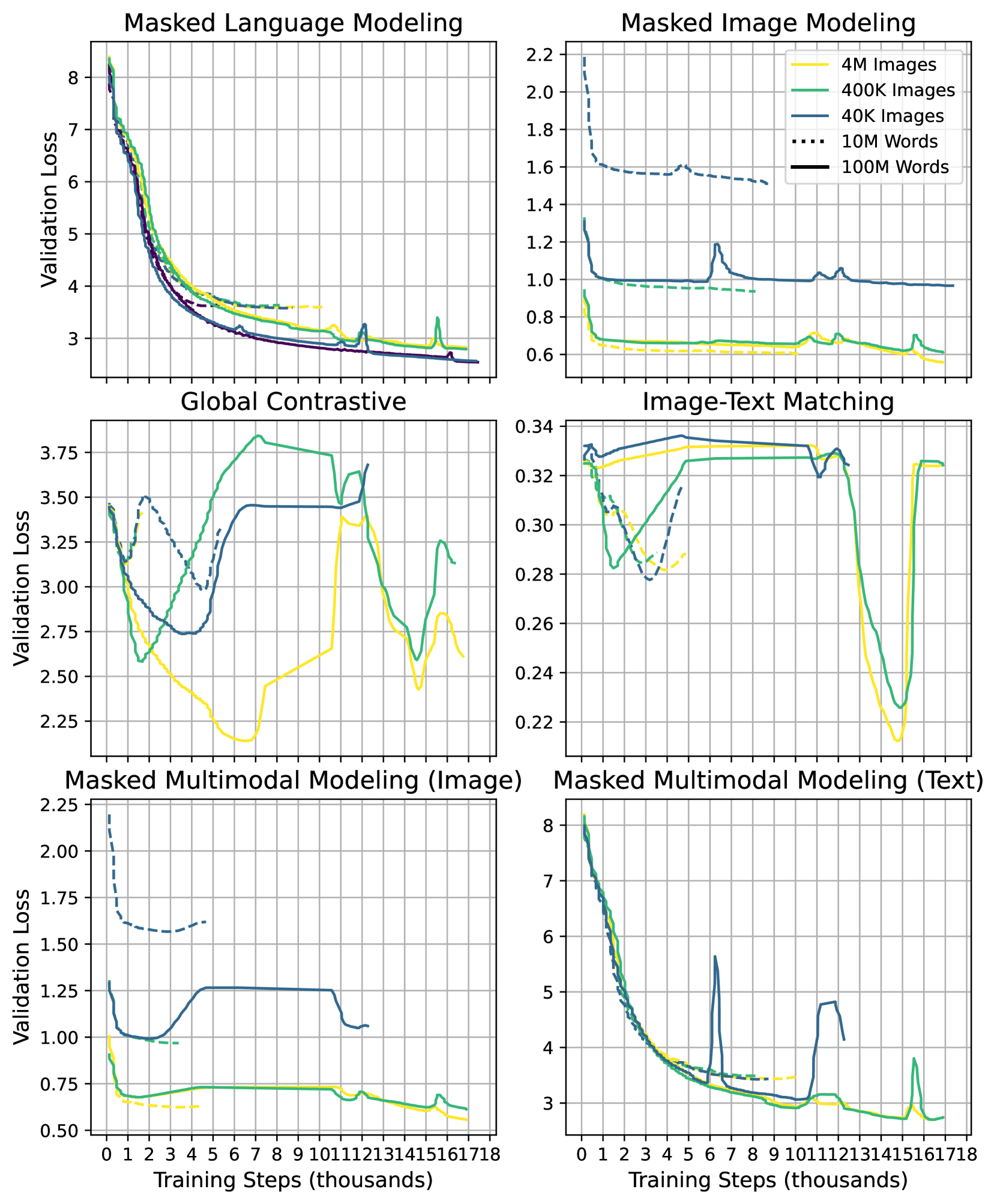
- 本文通过对FLAVA模型进行消融研究,探索文本和视觉输入的比例对语言性能的影响。
- 实验结果表明,多模态预训练未显著提升语言性能,未来研究需改进架构以验证假设。
📝 摘要(中文)
与儿童相比,语言模型在语言获取方面的数据效率显著较低。本文在BabyLM挑战赛中提出,数据效率差距部分源于语言模型缺乏多模态输入和学习环境的基础。尽管以往研究表明多模态训练可能会损害语言性能,本文推测此现象可能与在图像数据上进行微调导致的复杂语言遗忘有关。通过对FLAVA模型进行消融研究,独立调整文本和视觉输入的量,量化不同数据规模下视觉输入对文本数据的补偿效果。结果显示,多模态预训练未显著损害语言性能,但也未能一致提升。结论受限于实验次数较少,未来需更好的架构和技术来验证多模态输入对数据效率差距的影响。
🔬 方法详解
问题定义:本文旨在解决语言模型在语言获取中的数据效率低下问题,现有方法未能有效利用多模态输入,导致性能不足。
核心思路:通过对FLAVA模型进行消融研究,独立调整文本和视觉输入的比例,探索多模态输入对语言模型性能的影响,尤其是如何减少复杂语言的遗忘。
技术框架:研究采用多任务预训练框架,包含单模态文本任务和从WiT数据集中抽样的数据,以增强模型的多样性和鲁棒性。
关键创新:本研究的创新在于通过消融实验系统性地分析多模态输入对语言模型的影响,提出了在多模态训练中防止复杂语言遗忘的新思路。
关键设计:在模型设计中,采用了多任务学习策略,结合了不同规模的文本和视觉输入,确保模型在多模态环境下的稳定性和性能。
🖼️ 关键图片


📊 实验亮点
实验结果显示,多模态预训练未显著损害模型的语言性能,但也未能一致提升。尽管如此,研究为未来多模态训练架构的改进提供了重要的实验基础,强调了更好的模型设计和技术的重要性。
🎯 应用场景
该研究的潜在应用领域包括自然语言处理、计算机视觉和人机交互等。通过提升语言模型的数据效率,可以在教育、智能助手和自动翻译等多个领域实现更高效的语言理解和生成,推动相关技术的发展。
📄 摘要(原文)
In contrast to children, language models (LMs) exhibit considerably inferior data efficiency when acquiring language. In this submission to the BabyLM Challenge (Warstadt et al., 2023), we test the hypothesis that this data efficiency gap is partly caused by a lack of multimodal input and grounding in the learning environment of typical language models. Although previous work looking into this question found that multimodal training can even harm language-only performance, we speculate that these findings can be attributed to catastrophic forgetting of complex language due to fine-tuning on captions data. To test our hypothesis, we perform an ablation study on FLAVA (Singh et al., 2022), a multimodal vision-and-language model, independently varying the volume of text and vision input to quantify how much text data (if any) can be offset by vision at different data scales. We aim to limit catastrophic forgetting through a multitask pretraining regime that includes unimodal text-only tasks and data sampled from WiT, the relatively diverse Wikipedia-based dataset (Srinivasan et al., 2021). Our results are largely negative: Multimodal pretraining does not harm our models' language performance but does not consistently help either. That said, our conclusions are limited by our having been able to conduct only a small number of runs. While we must leave open the possibility that multimodal input explains some of the gap in data efficiency between LMs and humans, positive evidence for this hypothesis will require better architectures and techniques for multimodal training.