Investigating Continual Pretraining in Large Language Models: Insights and Implications
作者: Çağatay Yıldız, Nishaanth Kanna Ravichandran, Nitin Sharma, Matthias Bethge, Beyza Ermis
分类: cs.CL
发布日期: 2024-02-27 (更新: 2025-02-12)
💡 一句话要点
提出持续预训练方法以提升大语言模型的适应性与知识保留
🎯 匹配领域: 支柱九:具身大模型 (Embodied Foundation Models)
关键词: 持续学习 大语言模型 领域自适应 知识转移 模型适应性 预训练
📋 核心要点
- 现有研究主要集中于有限下游任务的持续微调,缺乏对大语言模型在动态数据环境中的适应性评估。
- 本文提出了一种新的持续领域自适应预训练方法,旨在使大语言模型能够有效整合新信息并保留已有知识。
- 实验结果显示,持续预训练显著提升了GPT-2系列模型的下游任务性能,并且较大模型在相同语料上表现更佳。
📝 摘要(中文)
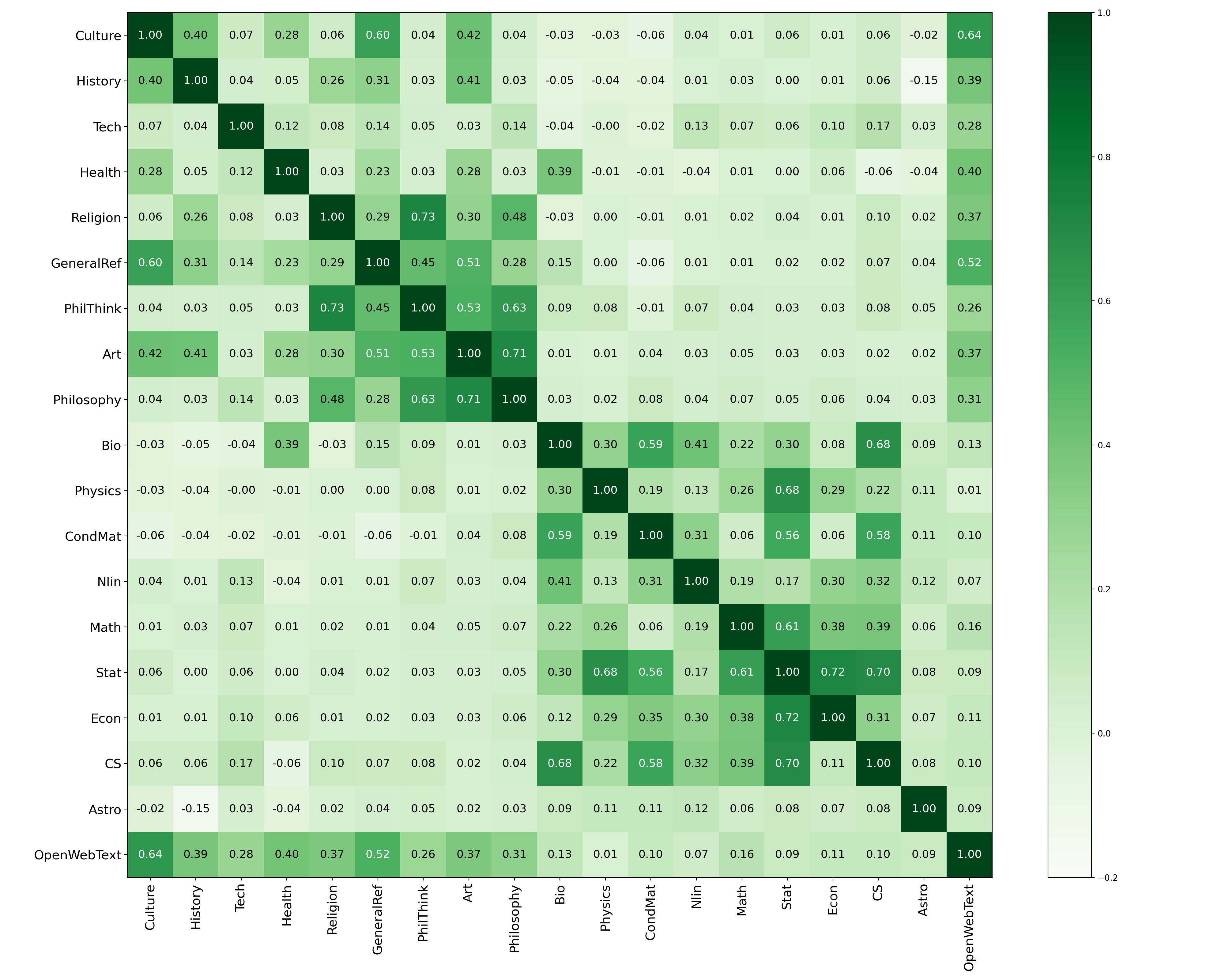
持续学习(CL)在大语言模型(LLMs)中是一个不断发展的领域,旨在开发高效且可持续的训练策略,以适应新兴知识并在动态环境中实现鲁棒性。本文重点探讨持续领域自适应预训练,旨在使LLMs能够整合来自不同领域的新信息,同时保留先前学习的知识。我们引入了一种新的基准,旨在评估LLMs对变化的预训练数据环境的适应能力,并研究模型规模对学习效果和遗忘的影响,以及新兴领域的进展和相似性如何影响知识转移。研究结果表明,持续预训练显著提升了模型性能,尤其是小模型在学习和遗忘方面表现出较高的敏感性。
🔬 方法详解
问题定义:本文旨在解决大语言模型在动态数据环境中适应性不足的问题。现有方法主要集中于有限的下游任务微调,未能全面评估模型的知识保留和转移能力。
核心思路:论文提出持续领域自适应预训练,允许模型在学习新领域信息的同时,保持对旧知识的掌握。通过引入新的基准,评估模型在变化数据环境中的适应性。
技术框架:整体架构包括数据预处理、模型训练和评估三个主要模块。首先,收集多样化的预训练数据,然后进行持续预训练,最后通过设定的基准测试模型的适应性和性能。
关键创新:最重要的创新在于提出了一种新的基准,专注于评估大语言模型在多领域知识转移中的表现。这一方法与传统的微调方法有本质区别,强调了模型在动态环境中的适应能力。
关键设计:在模型训练中,采用了不同的损失函数以平衡新旧知识的学习,设置了多种训练参数以优化模型的学习效果,特别关注小模型在持续预训练中的表现。通过实验验证了模型规模与学习效果之间的关系。
🖼️ 关键图片
📊 实验亮点
实验结果表明,持续预训练显著提升了小于1.5B参数模型的性能,且在相同语料上较大模型的困惑度始终优于小模型。此外,持续预训练使得GPT-2系列模型在下游任务中的表现得到了显著提升,尤其是在领域相似性较高的情况下,模型的专业化能力得到了增强。
🎯 应用场景
该研究的潜在应用领域包括自然语言处理、智能助手、自动化内容生成等。通过提升大语言模型的适应性和知识保留能力,可以更好地应对快速变化的信息环境,增强模型在实际应用中的鲁棒性和准确性,未来可能推动更智能的AI系统的发展。
📄 摘要(原文)
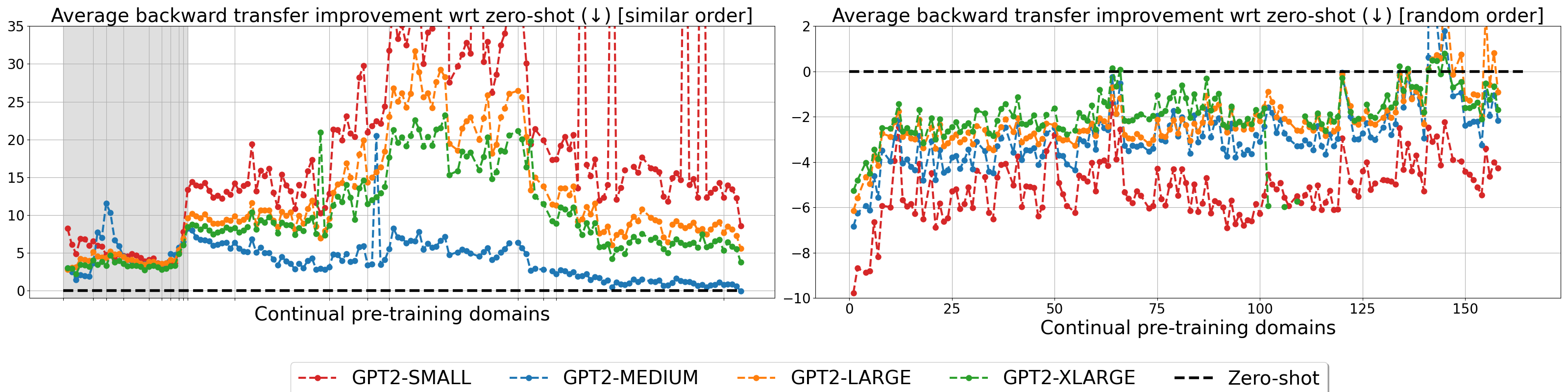
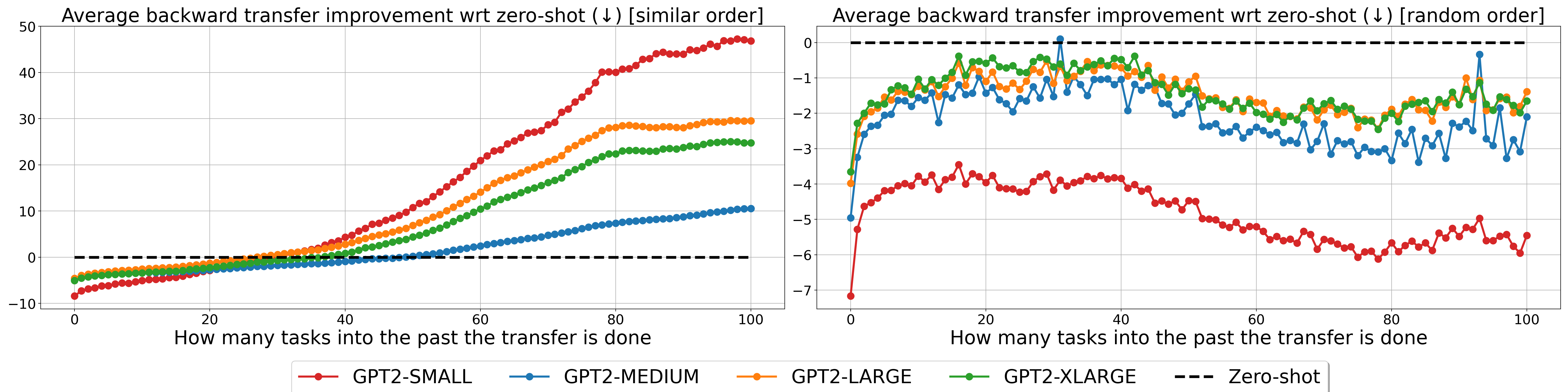
Continual learning (CL) in large language models (LLMs) is an evolving domain that focuses on developing efficient and sustainable training strategies to adapt models to emerging knowledge and achieve robustness in dynamic environments. Our primary emphasis is on continual domain-adaptive pretraining, a process designed to equip LLMs with the ability to integrate new information from various domains while retaining previously learned knowledge. Since existing works concentrate mostly on continual fine-tuning for a limited selection of downstream tasks or training domains, we introduce a new benchmark designed to measure the adaptability of LLMs to changing pretraining data landscapes. We further examine the impact of model size on learning efficacy and forgetting, as well as how the progression and similarity of emerging domains affect the knowledge transfer within these models. Our findings uncover several key insights: (i) continual pretraining consistently improves <1.5B models studied in this work and is also superior to domain adaptation, (ii) larger models always achieve better perplexity than smaller ones when continually pretrained on the same corpus, (iii) smaller models are particularly sensitive to continual pretraining, showing the most significant rates of both learning and forgetting, (iv) continual pretraining boosts downstream task performance of GPT-2 family, (v) continual pretraining enables LLMs to specialize better when the sequence of domains shows semantic similarity while randomizing training domains leads to better transfer and final performance otherwise. We posit that our research establishes a new benchmark for CL in LLMs, providing a more realistic evaluation of knowledge retention and transfer across diverse domains.