Fact-and-Reflection (FaR) Improves Confidence Calibration of Large Language Models
作者: Xinran Zhao, Hongming Zhang, Xiaoman Pan, Wenlin Yao, Dong Yu, Tongshuang Wu, Jianshu Chen
分类: cs.CL
发布日期: 2024-02-27 (更新: 2024-09-08)
备注: 17 pages, 10 figures
期刊: Findings of the Association for Computational Linguistics ACL 2024
💡 一句话要点
提出Fact-and-Reflection以改善大语言模型的置信度校准问题
🎯 匹配领域: 支柱九:具身大模型 (Embodied Foundation Models)
关键词: 大语言模型 置信度校准 提示策略 反思机制 问答系统 自然语言处理 实验研究
📋 核心要点
- 现有的提示方法在提高LLM的置信度校准方面存在不足,且可能导致模型在某些情况下过于自信。
- 本文提出的FaR提示方法通过引导模型提取相关事实并进行反思,旨在改善LLM的置信度校准。
- 实验结果显示,FaR提示显著提升了模型的校准能力,降低了23.5%的预期校准误差,并能在不自信的情况下引导模型表达顾虑。
📝 摘要(中文)
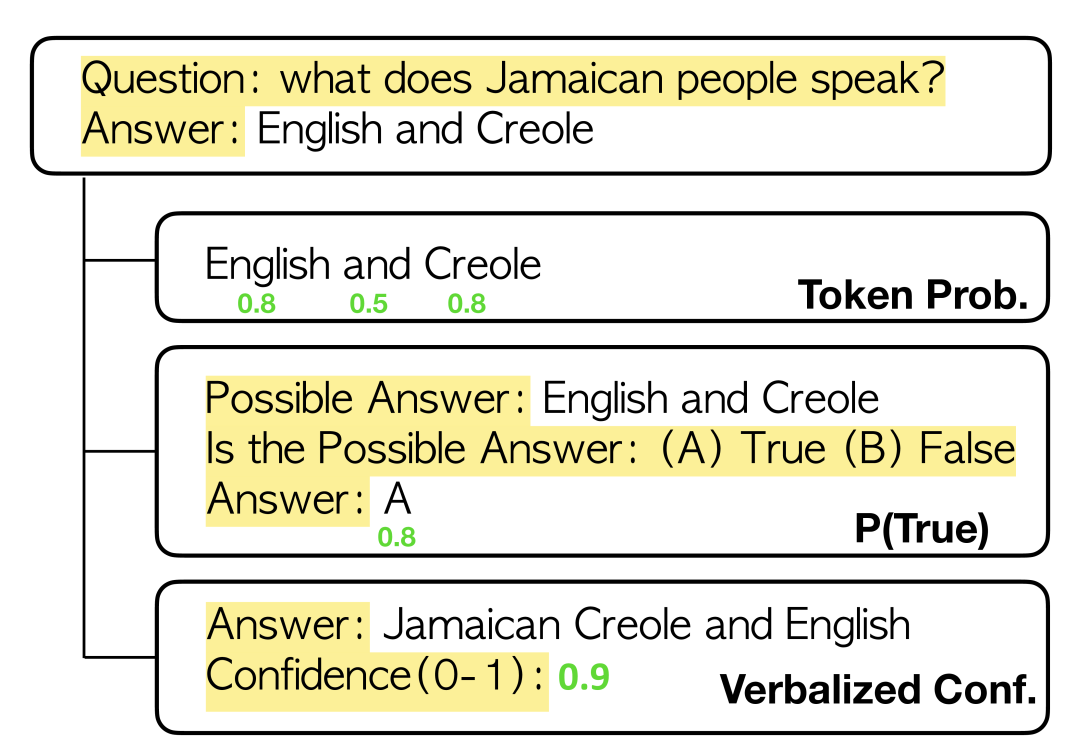
为了使大语言模型(LLM)更具可信度,其置信水平应与实际表现良好校准。尽管现有研究表明提示对LLM性能有显著影响,但在提示LLM时的置信度校准尚未得到充分探讨。本文研究了不同提示策略如何影响LLM的置信度校准,并提出了Fact-and-Reflection(FaR)提示方法。FaR通过两步提升LLM的校准能力:首先从模型中引出与输入提示相关的已知“事实”,然后要求模型对这些事实进行“反思”以生成最终答案。实验结果表明,FaR提示在多任务问答中将预期校准误差降低了23.5%。
🔬 方法详解
问题定义:本文旨在解决大语言模型在提示过程中置信度校准不足的问题。现有方法往往导致模型在某些情况下表现出过度自信,影响其可靠性。
核心思路:论文提出的FaR提示方法通过两步过程来改善LLM的置信度校准,首先引导模型提取与输入相关的事实,然后要求模型对这些事实进行反思,从而生成更为准确的答案。
技术框架:FaR提示的整体流程包括两个主要阶段:第一阶段是从模型中提取相关的“事实”,第二阶段是对这些事实进行反思以生成最终答案。
关键创新:FaR提示的核心创新在于其双重引导机制,通过引导模型提取和反思相关事实,显著改善了模型的置信度校准能力,与传统的单一提示方法形成鲜明对比。
关键设计:在FaR提示中,模型的输入设计和反思机制是关键,具体包括如何选择相关事实以及如何引导模型进行反思的策略,这些设计直接影响模型的输出质量和置信度。
🖼️ 关键图片


📊 实验亮点
实验结果表明,FaR提示方法在多任务问答中显著降低了23.5%的预期校准误差,表现出更好的置信度校准能力。此外,FaR提示还使模型在不自信的情况下能够表达顾虑,促进了信息检索的增强。
🎯 应用场景
该研究的潜在应用领域包括智能问答系统、对话系统和其他需要高置信度输出的自然语言处理任务。通过改善LLM的置信度校准,FaR提示方法能够提升用户对模型输出的信任度,从而在实际应用中产生更大的价值和影响。
📄 摘要(原文)
For a LLM to be trustworthy, its confidence level should be well-calibrated with its actual performance. While it is now common sense that LLM performances are greatly impacted by prompts, the confidence calibration in prompting LLMs has yet to be thoroughly explored. In this paper, we explore how different prompting strategies influence LLM confidence calibration and how it could be improved. We conduct extensive experiments on six prompting methods in the question-answering context and we observe that, while these methods help improve the expected LLM calibration, they also trigger LLMs to be over-confident when responding to some instances. Inspired by human cognition, we propose Fact-and-Reflection (FaR) prompting, which improves the LLM calibration in two steps. First, FaR elicits the known "facts" that are relevant to the input prompt from the LLM. And then it asks the model to "reflect" over them to generate the final answer. Experiments show that FaR prompting achieves significantly better calibration; it lowers the Expected Calibration Error by 23.5% on our multi-purpose QA tasks. Notably, FaR prompting even elicits the capability of verbally expressing concerns in less confident scenarios, which helps trigger retrieval augmentation for solving these harder instances.