StructLM: Towards Building Generalist Models for Structured Knowledge Grounding
作者: Alex Zhuang, Ge Zhang, Tianyu Zheng, Xinrun Du, Junjie Wang, Weiming Ren, Stephen W. Huang, Jie Fu, Xiang Yue, Wenhu Chen
分类: cs.CL
发布日期: 2024-02-26 (更新: 2024-10-07)
备注: Technical Report
💡 一句话要点
提出StructLM以解决结构化知识基础的模型能力不足问题
🎯 匹配领域: 支柱九:具身大模型 (Embodied Foundation Models)
关键词: 结构化知识基础 大型语言模型 模型训练 数据集构建 性能提升 泛化能力 智能问答 信息检索
📋 核心要点
- 现有大型语言模型在处理结构化数据时表现不足,尤其是在知识基础任务上,存在显著的性能差距。
- 论文提出了StructLM模型系列,通过一个包含110万示例的指令调优数据集来提升LLMs在结构化知识基础任务中的能力。
- 实验结果显示,StructLM在16个任务上超越了特定任务模型,并在8个SKG任务上达到了新的最新性能,展现出强大的泛化能力。
📝 摘要(中文)
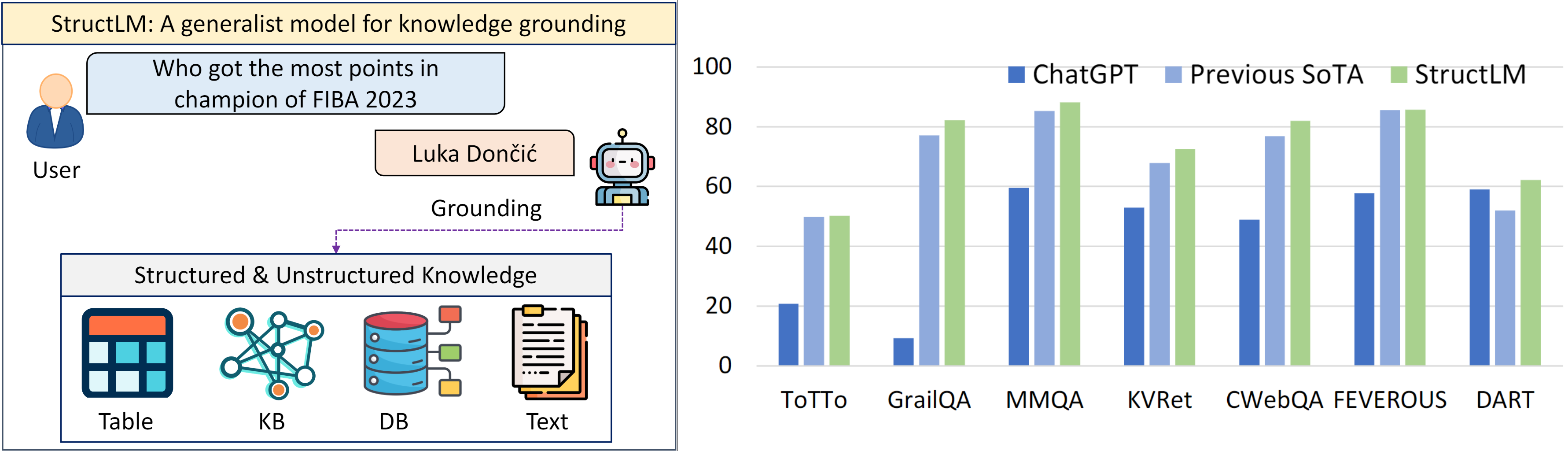
结构化数据源,如表格、图形和数据库,是普遍的知识来源。尽管大型语言模型(LLMs)在处理普通文本方面表现出色,但它们在解释和利用结构化数据方面的能力仍然有限。我们的研究发现,LLMs在处理结构化数据时存在显著不足,例如,ChatGPT在这一领域的表现比最新的模型平均低35%。为增强LLMs的结构化知识基础(SKG)能力,我们开发了一个包含110万示例的综合指令调优数据集。基于该数据集,我们训练了一系列名为StructLM的模型,参数范围从7B到34B。StructLM系列在18个评估数据集中的16个任务上超越了特定任务模型,并在8个SKG任务上建立了新的最新性能。此外,StructLM在6个新保留的SKG任务上表现出强大的泛化能力,平均超越TableLlama 35%和Flan-UL2 20B 10%。与预期相反,我们观察到模型规模的扩大带来的收益有限,StructLM-34B仅比StructLM-7B略有改善,这表明结构化知识基础仍然是一个具有挑战性的任务,需要更具创新性的设计来推动其发展。
🔬 方法详解
问题定义:本论文旨在解决大型语言模型在处理结构化数据时的能力不足,尤其是在结构化知识基础(SKG)任务中的表现较差,现有方法未能有效利用结构化数据源。
核心思路:通过构建一个包含110万示例的综合指令调优数据集,训练一系列新的模型StructLM,以增强LLMs在结构化数据处理中的能力,旨在提升其在SKG任务中的表现。
技术框架:StructLM的整体架构基于Mistral和CodeLlama模型系列,参数范围从7B到34B。模型训练分为数据集构建、模型训练和评估三个主要阶段,确保模型能够有效学习和应用结构化知识。
关键创新:StructLM的主要创新在于其针对结构化知识基础任务的专门训练数据集和模型设计,使其在多个SKG任务上超越了现有的特定任务模型,展示出更强的泛化能力。
关键设计:在模型设计中,StructLM采用了多层次的网络结构和优化算法,结合了适应性损失函数,以更好地处理结构化数据的复杂性,同时在参数设置上进行了细致调整,以平衡模型性能和计算效率。
🖼️ 关键图片


📊 实验亮点
实验结果显示,StructLM在18个评估数据集中的16个任务上超越了特定任务模型,并在8个SKG任务上建立了新的最新性能。此外,StructLM在6个新保留的SKG任务上平均超越TableLlama 35%和Flan-UL2 20B 10%,展现出显著的性能提升。
🎯 应用场景
该研究的潜在应用领域包括智能问答系统、数据分析工具和信息检索等,能够有效提升这些系统在处理结构化数据时的准确性和效率。未来,StructLM有望在更广泛的知识图谱构建和数据驱动决策支持中发挥重要作用。
📄 摘要(原文)
Structured data sources, such as tables, graphs, and databases, are ubiquitous knowledge sources. Despite the demonstrated capabilities of large language models (LLMs) on plain text, their proficiency in interpreting and utilizing structured data remains limited. Our investigation reveals a notable deficiency in LLMs' ability to process structured data, e.g., ChatGPT lags behind state-of-the-art (SoTA) model by an average of 35%. To augment the Structured Knowledge Grounding (SKG) capabilities in LLMs, we have developed a comprehensive instruction tuning dataset comprising 1.1 million examples. Utilizing this dataset, we train a series of models, referred to as StructLM, based on the Mistral and the CodeLlama model family, ranging from 7B to 34B parameters. Our StructLM series surpasses task-specific models on 16 out of 18 evaluated datasets and establishes new SoTA performance on 8 SKG tasks. Furthermore, StructLM demonstrates strong generalization across 6 novel held-out SKG tasks, outperforming TableLlama by an average of 35\% and Flan-UL2 20B by an average of 10\%. Contrary to expectations, we observe that scaling model size offers marginal benefits, with StructLM-34B showing only slight improvements over StructLM-7B. This suggests that structured knowledge grounding is still a challenging task and requires more innovative design to push to a new level.