PeriodicLoRA: Breaking the Low-Rank Bottleneck in LoRA Optimization
作者: Xiangdi Meng, Damai Dai, Weiyao Luo, Zhe Yang, Shaoxiang Wu, Xiaochen Wang, Peiyi Wang, Qingxiu Dong, Liang Chen, Zhifang Sui
分类: cs.CL
发布日期: 2024-02-25
💡 一句话要点
提出PeriodicLoRA以突破LoRA优化中的低秩瓶颈
🎯 匹配领域: 支柱九:具身大模型 (Embodied Foundation Models)
关键词: 低秩优化 参数高效微调 大型语言模型 监督微调 训练稳定性
📋 核心要点
- 现有的LoRA方法在微调大型语言模型时,因权重更新受限于低秩矩阵,导致性能未能达到完全微调的水平。
- 本文提出的PeriodicLoRA方法通过多次累积低秩更新矩阵,打破了低秩瓶颈,从而实现更高的更新秩。
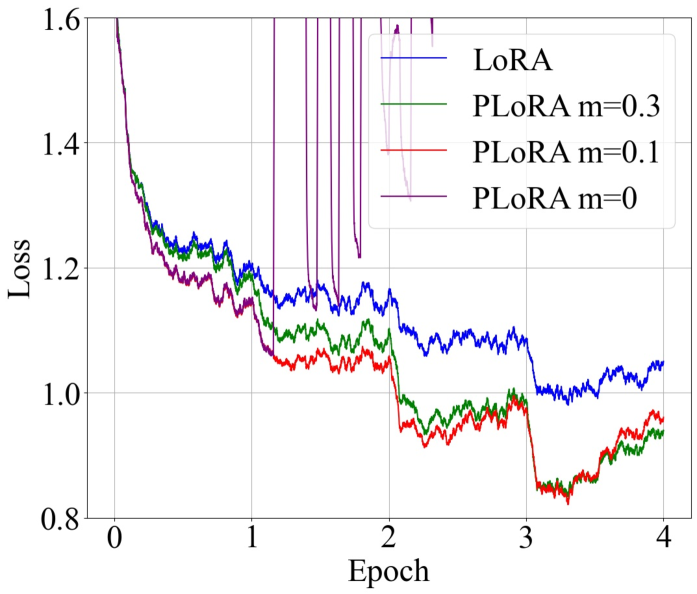
- 实验结果显示,PLoRA的学习能力比LoRA强约1.8倍,同时保持了内存使用不变,展现了良好的训练稳定性。
📝 摘要(中文)
监督微调是将大型语言模型(LLMs)适应下游任务的常用方法,但完全微调LLMs需要大量计算资源。最近,参数高效微调(PEFT)方法因其成本效益而受到广泛研究。LoRA是最常用的方法之一,但其权重更新仅限于低秩矩阵,导致与完全微调相比存在性能差距。为了解决这一问题,本文提出了PeriodicLoRA(PLoRA),通过多次累积低秩更新矩阵来实现更高的更新秩。PLoRA具有多个训练阶段,每个阶段仅更新LoRA权重,并在阶段结束时将LoRA权重卸载到主干参数中,然后重新初始化LoRA状态。实验结果表明,PLoRA的学习能力比LoRA强约1.8倍,但不增加内存使用。此外,我们引入了一种基于动量的卸载策略,以减轻训练不稳定性。
🔬 方法详解
问题定义:本文旨在解决LoRA方法在微调大型语言模型时因低秩矩阵限制而导致的性能瓶颈问题。现有方法在权重更新方面存在不足,无法充分利用模型的潜力。
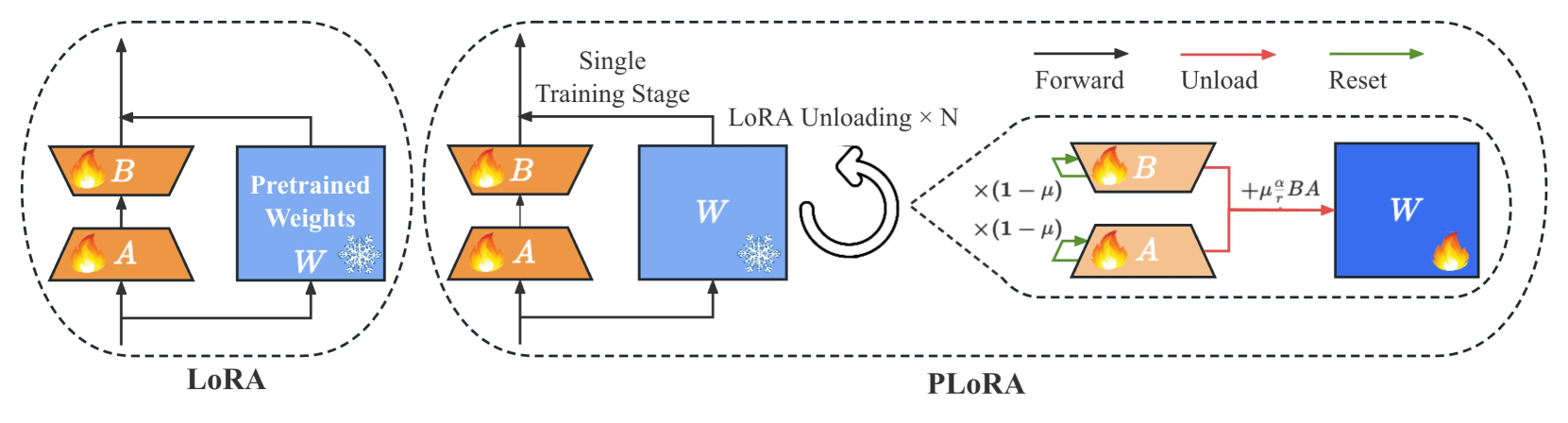
核心思路:PeriodicLoRA(PLoRA)通过在多个训练阶段中累积低秩更新矩阵,逐步提升更新秩,以此来增强模型的学习能力。该设计旨在在不增加内存使用的情况下,提升微调效果。
技术框架:PLoRA的整体架构包括多个训练阶段。在每个阶段中,仅更新LoRA权重;阶段结束时,将LoRA权重卸载到主干参数中,并重新初始化LoRA状态。
关键创新:PLoRA的主要创新在于通过多次累积低秩更新矩阵来突破低秩瓶颈,这与传统的LoRA方法形成了本质区别,后者仅依赖于单次低秩更新。
关键设计:PLoRA采用了动量基础的卸载策略,以减轻训练过程中的不稳定性。此外,参数设置和损失函数的设计也经过精心调整,以确保模型在不同阶段的有效学习。
🖼️ 关键图片

📊 实验亮点
实验结果表明,PLoRA的学习能力比LoRA强约1.8倍,且在内存使用上没有显著增加。这一提升展示了PLoRA在微调大型语言模型时的有效性和优势,尤其是在资源受限的环境中。
🎯 应用场景
该研究的潜在应用领域包括自然语言处理、对话系统和文本生成等任务。通过提高大型语言模型的微调效率,PLoRA能够帮助研究人员和开发者在资源有限的情况下,快速适应不同的下游任务,具有重要的实际价值和未来影响。
📄 摘要(原文)
Supervised fine-tuning is the most common method to adapt large language models (LLMs) to downstream tasks, but full fine-tuning LLMs requires massive computational resources. Recently, parameter-efficient fine-tuning (PEFT) methods have been widely studied due to its cost-effectiveness. LoRA is one of the most widely used methods, which assumes that the optimization process is essentially low-dimensional. Although LoRA fine-tuning is effective, there is still a performance gap compared to full fine-tuning, since its weight update is limited to low-rank matrices. In order to break the low-rank bottleneck in LoRA Optimization, we propose PeriodicLoRA (PLoRA), which accumulates low-rank update matrices multiple times to achieve a higher update rank. PLoRA has multiple training stages. During each stage, we still update only the LoRA weights. However, at the end of each stage, we unload the LoRA weights into the backbone parameters and then reinitialize the LoRA states. Experimental results show that PLoRA has stronger learning ability, approximately 1.8 times that of LoRA's learning ability at most, but it does not increase memory usage. Further, we introduce a momentum-based unloading strategy for PLoRA to mitigate the training instability.