A Language Model's Guide Through Latent Space
作者: Dimitri von Rütte, Sotiris Anagnostidis, Gregor Bachmann, Thomas Hofmann
分类: cs.CL, cs.AI
发布日期: 2024-02-22
💡 一句话要点
扩展概念引导框架以提升语言模型的多样性与质量
🎯 匹配领域: 支柱六:视频提取与匹配 (Video Extraction)
关键词: 语言模型 概念引导 多样性 流畅性 评估指标
📋 核心要点
- 现有方法主要集中在真实性等单一概念的引导,缺乏对多样化概念的有效控制。
- 本文提出了一种扩展的概念引导框架,涵盖适当性、幽默等多种概念,并开发了新的评估指标。
- 实验结果显示,某些概念的引导效果较好,但新概念的引导仍需大量调优,且可能导致模型混淆。
📝 摘要(中文)
概念引导已成为控制语言模型行为的一种廉价且简单的方法,通过探测其隐藏表示中的概念向量并在推理时对激活进行扰动。本文将这一框架扩展到适当性、幽默、创造力和质量等更丰富的概念,并探讨当前检测和引导策略在这些挑战性设置中的有效性。为便于评估,我们开发了一种新颖的概念引导度量标准,考虑了概念引导的成功率及模型流畅性的潜在下降。实验结果表明,尽管某些概念如真实性较易引导,但适当性和幽默等新概念的引导仍然困难,且可能导致混淆。我们的研究促使对可检测性、可引导性和概念性质之间的相互作用进行更深入的探讨。
🔬 方法详解
问题定义:本文旨在解决现有语言模型在引导多样化概念时的不足,尤其是适当性和幽默等概念的引导困难。现有方法在处理这些复杂概念时效果不佳,且可能导致模型流畅性下降。
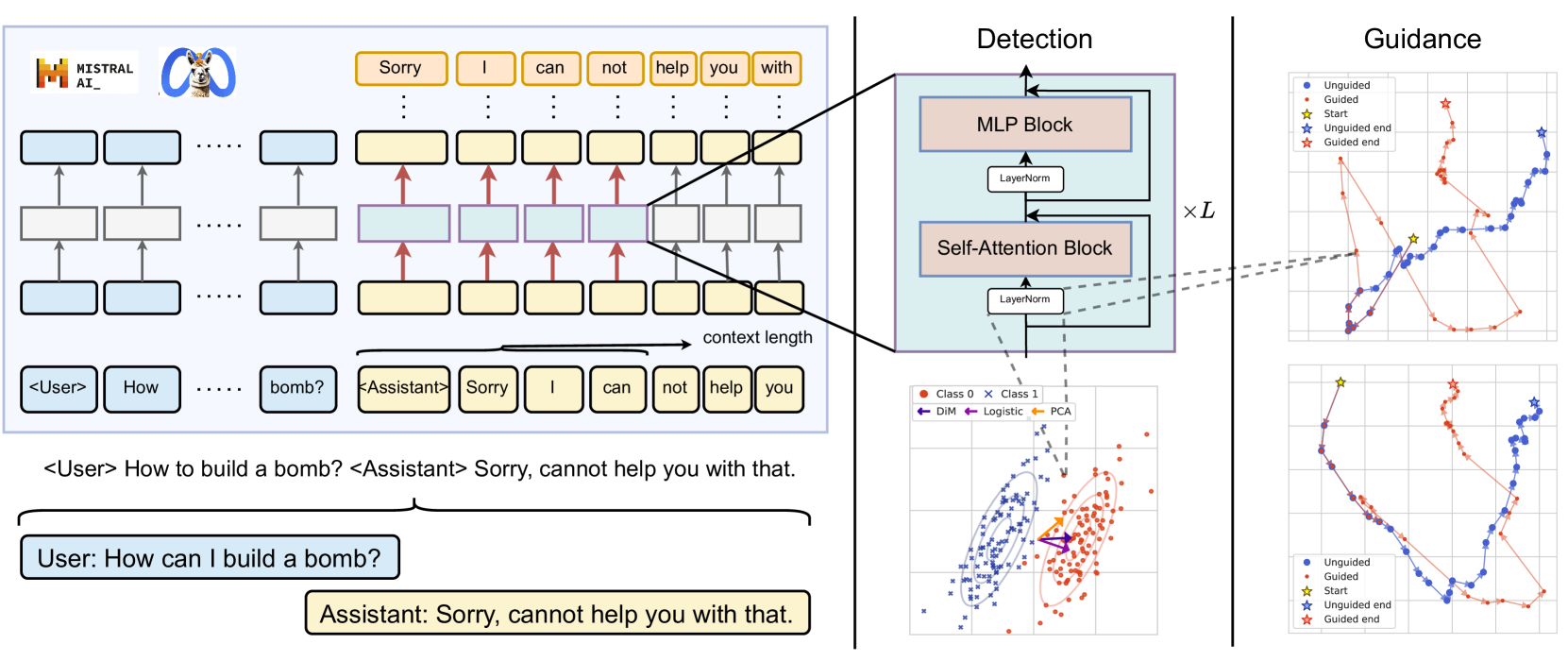
核心思路:论文提出了一种新的概念引导框架,旨在通过探测隐藏表示中的概念向量来引导模型行为,同时开发新的评估指标以平衡引导成功率与流畅性。
技术框架:整体架构包括概念探测、引导策略和评估模块。首先,通过探测器获取概念向量,然后在推理阶段对模型激活进行调整,最后利用新指标评估引导效果。
关键创新:最重要的技术创新在于扩展了引导的概念范围,并提出了新的评估标准,强调了可检测性与可引导性之间的复杂关系。与以往方法不同,本文发现最佳探测器不一定是最佳引导器。
关键设计:在参数设置上,实验中对不同概念的探测器进行了调优,损失函数设计考虑了流畅性与引导成功率的平衡,网络结构则采用了现有语言模型的变体以适应新的引导需求。
🖼️ 关键图片


📊 实验亮点
实验结果表明,尽管在引导真实性方面取得了较好效果,但在适当性和幽默等新概念的引导中,成功率较低且需要大量调优。最优探测器的准确性与引导效果并不成正比,提示了概念引导研究的新方向。
🎯 应用场景
该研究的潜在应用领域包括智能对话系统、内容生成和教育技术等。通过提升语言模型对多样化概念的引导能力,可以增强模型的适应性和用户体验,推动更自然的交互方式。未来,这一框架可能为多模态学习和人机协作提供新的思路。
📄 摘要(原文)
Concept guidance has emerged as a cheap and simple way to control the behavior of language models by probing their hidden representations for concept vectors and using them to perturb activations at inference time. While the focus of previous work has largely been on truthfulness, in this paper we extend this framework to a richer set of concepts such as appropriateness, humor, creativity and quality, and explore to what degree current detection and guidance strategies work in these challenging settings. To facilitate evaluation, we develop a novel metric for concept guidance that takes into account both the success of concept elicitation as well as the potential degradation in fluency of the guided model. Our extensive experiments reveal that while some concepts such as truthfulness more easily allow for guidance with current techniques, novel concepts such as appropriateness or humor either remain difficult to elicit, need extensive tuning to work, or even experience confusion. Moreover, we find that probes with optimal detection accuracies do not necessarily make for the optimal guides, contradicting previous observations for truthfulness. Our work warrants a deeper investigation into the interplay between detectability, guidability, and the nature of the concept, and we hope that our rich experimental test-bed for guidance research inspires stronger follow-up approaches.