Rethinking Scientific Summarization Evaluation: Grounding Explainable Metrics on Facet-aware Benchmark
作者: Xiuying Chen, Tairan Wang, Qingqing Zhu, Taicheng Guo, Shen Gao, Zhiyong Lu, Xin Gao, Xiangliang Zhang
分类: cs.CL
发布日期: 2024-02-22 (更新: 2025-05-02)
备注: 14pages
💡 一句话要点
提出Facet-aware Metric以解决科学摘要评估不足问题
🎯 匹配领域: 支柱九:具身大模型 (Embodied Foundation Models)
关键词: 科学摘要 评估方法 大型语言模型 语义匹配 数据集构建
📋 核心要点
- 现有的科学摘要评估方法在解释性和科学概念理解上存在显著不足,无法有效识别关键内容。
- 提出Facet-aware Metric(FM),通过LLMs进行语义匹配,从多个方面评估摘要,分解评估任务为简单子任务。
- 实验结果表明,FM在科学摘要评估中表现更优,且微调的小型模型在科学领域的表现可与LLMs相媲美。
📝 摘要(中文)
预训练的大型语言模型(LLMs)在一般领域的摘要能力已得到广泛验证,但在科学语料中的应用尚未充分评估。本文通过概念和实验分析,指出传统评估方法(如n-gram、嵌入比较和问答)在解释性、科学概念理解和关键内容识别方面的不足。为此,提出Facet-aware Metric(FM),利用LLMs进行高级语义匹配,从不同方面评估摘要。该方法将评估任务分解为更简单的子任务,提供了更全面的评估。此外,本文还构建了Facet-based科学摘要数据集(FD),并发现FM在科学摘要评估中更具逻辑性。研究表明,经过微调的小型模型在科学领域能够与LLMs竞争,而LLMs在科学领域的上下文信息学习上存在局限,提示未来的改进方向。
🔬 方法详解
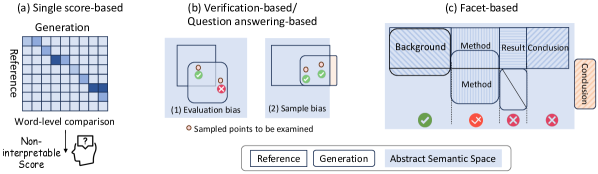
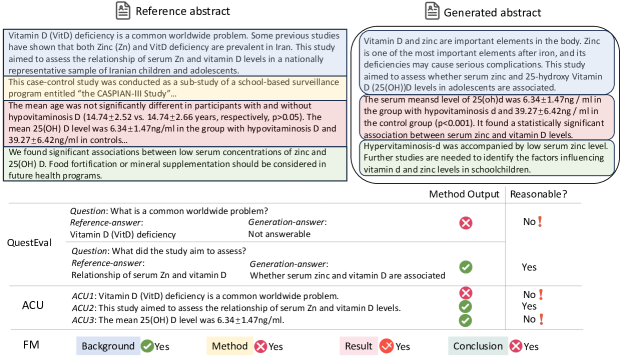
问题定义:本文旨在解决传统科学摘要评估方法在解释性和科学概念理解方面的不足,现有方法如n-gram和嵌入比较无法有效识别关键内容。
核心思路:提出Facet-aware Metric(FM),利用大型语言模型进行高级语义匹配,从不同方面对摘要进行评估,分解评估任务为更简单的子任务,以提高评估的全面性和准确性。
技术框架:整体架构包括数据预处理、LLM语义匹配、评估指标计算等模块。首先对科学摘要进行预处理,然后利用LLMs进行语义匹配,最后计算各个方面的评估指标。
关键创新:FM的核心创新在于其面向不同方面的评估能力,能够提供更为细致和逻辑的评估结果,与传统方法相比,FM更能适应科学领域的复杂性。
关键设计:在模型设计上,采用了特定的损失函数以优化语义匹配效果,并在数据集上进行了facet-level的注释,以确保评估的准确性和可靠性。通过微调小型模型,进一步提升了在科学领域的应用效果。
🖼️ 关键图片
📊 实验亮点
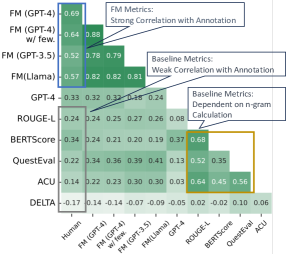
实验结果显示,Facet-aware Metric(FM)在科学摘要评估中表现优于传统方法,能够更好地识别关键内容和科学概念。此外,经过微调的小型模型在科学领域的表现与大型语言模型相当,展示了在特定任务上的竞争力,提示了未来LLMs改进的方向。
🎯 应用场景
该研究的潜在应用场景包括科学文献的自动摘要生成、科研成果的快速检索与评估等。通过改进的评估方法,能够提升科学研究的效率,帮助研究人员更快地获取关键信息,推动科学知识的传播与应用。未来,随着LLMs的不断发展,该方法有望在更广泛的科学领域中得到应用。
📄 摘要(原文)
The summarization capabilities of pretrained and large language models (LLMs) have been widely validated in general areas, but their use in scientific corpus, which involves complex sentences and specialized knowledge, has been less assessed. This paper presents conceptual and experimental analyses of scientific summarization, highlighting the inadequacies of traditional evaluation methods, such as $n$-gram, embedding comparison, and QA, particularly in providing explanations, grasping scientific concepts, or identifying key content. Subsequently, we introduce the Facet-aware Metric (FM), employing LLMs for advanced semantic matching to evaluate summaries based on different aspects. This facet-aware approach offers a thorough evaluation of abstracts by decomposing the evaluation task into simpler subtasks.Recognizing the absence of an evaluation benchmark in this domain, we curate a Facet-based scientific summarization Dataset (FD) with facet-level annotations. Our findings confirm that FM offers a more logical approach to evaluating scientific summaries. In addition, fine-tuned smaller models can compete with LLMs in scientific contexts, while LLMs have limitations in learning from in-context information in scientific domains. This suggests an area for future enhancement of LLMs.