Qsnail: A Questionnaire Dataset for Sequential Question Generation
作者: Yan Lei, Liang Pang, Yuanzhuo Wang, Huawei Shen, Xueqi Cheng
分类: cs.CL
发布日期: 2024-02-22
备注: Accepted to the LREC-COLING 2024
🔗 代码/项目: GITHUB
💡 一句话要点
提出Qsnail数据集以解决问卷生成的挑战
🎯 匹配领域: 支柱九:具身大模型 (Embodied Foundation Models)
关键词: 问卷生成 数据集 自然语言处理 机器学习 语言模型
📋 核心要点
- 现有的问卷生成方法面临着设计复杂性和缺乏高质量数据集的挑战。
- 本文提出了Qsnail数据集,专门用于问卷生成任务,包含大量人类编写的问卷。
- 实验结果显示,现有模型在生成问卷时无法达到人类编写的质量,尤其在多样性和特异性方面存在不足。
📝 摘要(中文)
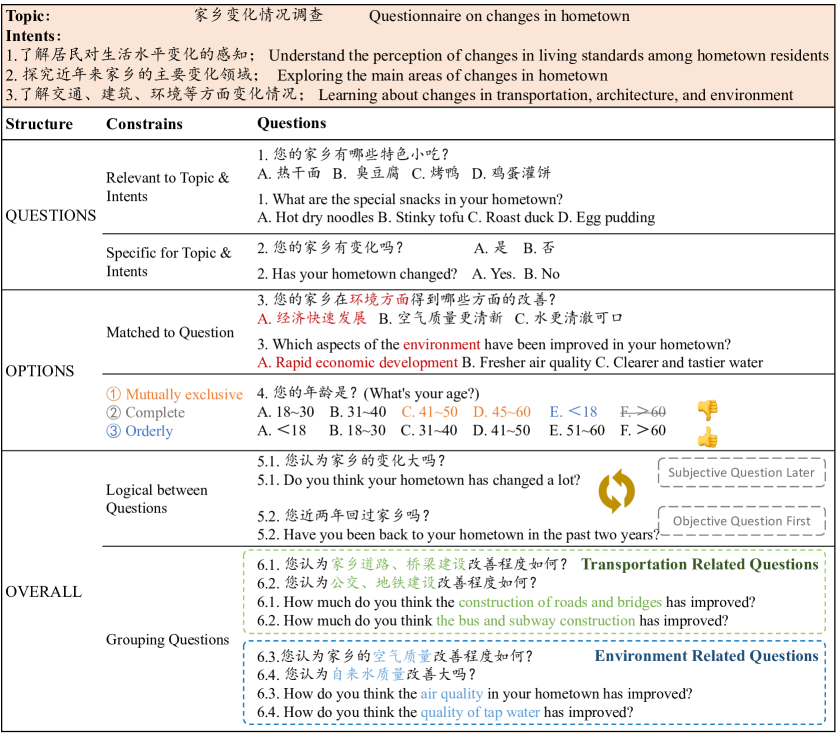
问卷是一种用于定性和定量分析人类意见、偏好、态度和行为的专业研究方法。然而,设计和评估问卷需要大量的努力,因为其结构复杂且精细。问卷中的问题必须与研究主题相关,并且选项需要互斥且有序。由于缺乏高质量的数据集,自动生成问卷面临重大挑战。为此,本文提出了Qsnail,这是第一个专门为问卷生成任务构建的数据集,包含来自在线平台的13,168份人类编写的问卷。实验结果表明,现有的检索模型和传统生成模型无法完全符合研究主题和意图,而大型语言模型在多样性和特异性方面也存在显著局限。因此,问卷生成仍需进一步探索。
🔬 方法详解
问题定义:本文旨在解决自动生成问卷的挑战,现有方法在生成的问卷质量和相关性上存在不足,尤其是缺乏高质量的数据集支持。
核心思路:提出Qsnail数据集,专门为问卷生成任务构建,旨在提供丰富的样本以提升生成模型的性能。通过对比不同模型的生成效果,探索问卷生成的有效方法。
技术框架:整体架构包括数据收集、数据标注、模型训练和评估四个主要阶段。数据收集阶段从多个在线平台获取问卷,标注阶段确保问卷的质量与相关性,模型训练阶段使用不同的生成模型进行训练,评估阶段则通过对比生成问卷与人类问卷的相似度进行效果评估。
关键创新:Qsnail数据集是首个专门针对问卷生成任务构建的数据集,填补了该领域的研究空白。与现有方法相比,Qsnail提供了更高质量和多样性的问卷样本,推动了问卷生成技术的发展。
关键设计:在模型训练中,采用了链式思维提示和微调技术,尽管如此,生成的问卷在多样性和特异性上仍未达到人类编写的水平。
🖼️ 关键图片

📊 实验亮点
实验结果表明,传统的检索模型和生成模型在问卷生成任务中表现不佳,尤其是在与研究主题和意图的相关性上。大型语言模型虽然更相关,但在多样性和特异性方面仍存在显著不足,生成的问卷质量未能达到人类编写的标准。
🎯 应用场景
该研究的潜在应用领域包括市场调查、心理学研究和社会科学等领域,能够帮助研究人员更高效地设计问卷,提升数据收集的质量和效率。未来,随着问卷生成技术的进步,可能会在自动化研究和智能问卷系统中发挥重要作用。
📄 摘要(原文)
The questionnaire is a professional research methodology used for both qualitative and quantitative analysis of human opinions, preferences, attitudes, and behaviors. However, designing and evaluating questionnaires demands significant effort due to their intricate and complex structure. Questionnaires entail a series of questions that must conform to intricate constraints involving the questions, options, and overall structure. Specifically, the questions should be relevant and specific to the given research topic and intent. The options should be tailored to the questions, ensuring they are mutually exclusive, completed, and ordered sensibly. Moreover, the sequence of questions should follow a logical order, grouping similar topics together. As a result, automatically generating questionnaires presents a significant challenge and this area has received limited attention primarily due to the scarcity of high-quality datasets. To address these issues, we present Qsnail, the first dataset specifically constructed for the questionnaire generation task, which comprises 13,168 human-written questionnaires gathered from online platforms. We further conduct experiments on Qsnail, and the results reveal that retrieval models and traditional generative models do not fully align with the given research topic and intents. Large language models, while more closely related to the research topic and intents, exhibit significant limitations in terms of diversity and specificity. Despite enhancements through the chain-of-thought prompt and finetuning, questionnaires generated by language models still fall short of human-written questionnaires. Therefore, questionnaire generation is challenging and needs to be further explored. The dataset is available at: https://github.com/LeiyanGithub/qsnail.