Dynamic Evaluation of Large Language Models by Meta Probing Agents
作者: Kaijie Zhu, Jindong Wang, Qinlin Zhao, Ruochen Xu, Xing Xie
分类: cs.CL, cs.AI, cs.LG
发布日期: 2024-02-21 (更新: 2024-06-07)
备注: International Conference on Machine Learning (ICML) 2024
🔗 代码/项目: GITHUB
💡 一句话要点
提出元探测代理以解决大语言模型评估问题
🎯 匹配领域: 支柱九:具身大模型 (Embodied Foundation Models)
关键词: 大语言模型 评估方法 心理测量学 动态评估 元探测代理 能力分析 模型优化
📋 核心要点
- 现有的评估方法难以适应多样化场景,且无法进行细致的能力分析。
- 提出元探测代理(MPA),通过心理测量学理论动态评估LLMs的基本认知能力。
- 实验结果显示大多数LLMs表现不佳,且模型规模与能力之间存在显著关联。
📝 摘要(中文)
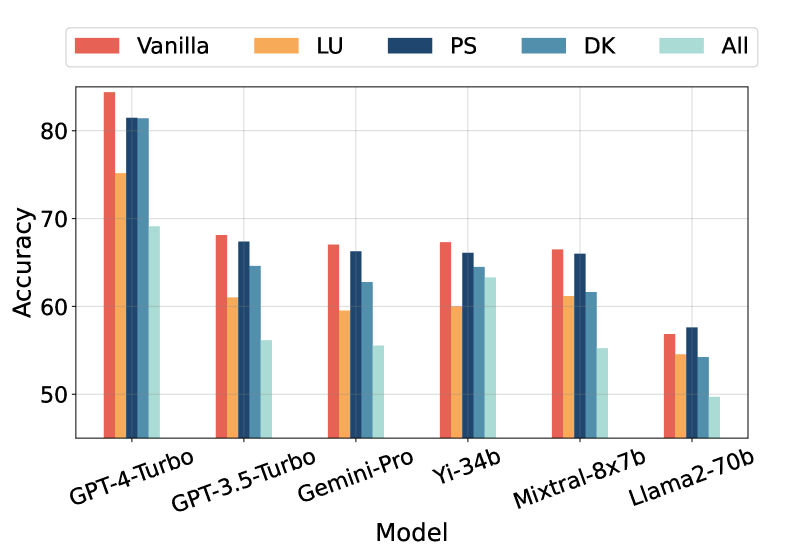
大语言模型(LLMs)的评估引发了社区的广泛关注,主要由于数据污染问题。现有的评估协议通常基于特定任务设计,难以扩展到多样化场景。此外,当前的评估基准只能提供整体结果,无法支持对LLMs能力的细致分析。本文提出了元探测代理(MPA),一种受心理测量学启发的通用动态评估协议,用于评估LLMs。MPA是DyVal 2的关键组成部分,能够自动将原始评估问题转化为新的问题,基于语言理解、问题解决和领域知识三种基本认知能力进行动态配置。通过广泛的评估,发现大多数LLMs的表现较差,表明其改进空间。我们的分析表明基本能力与模型规模之间存在隐含的马太效应。
🔬 方法详解
问题定义:本文旨在解决大语言模型评估中的数据污染和评估方法单一的问题。现有方法往往无法适应多样化的应用场景,导致评估结果缺乏深度分析。
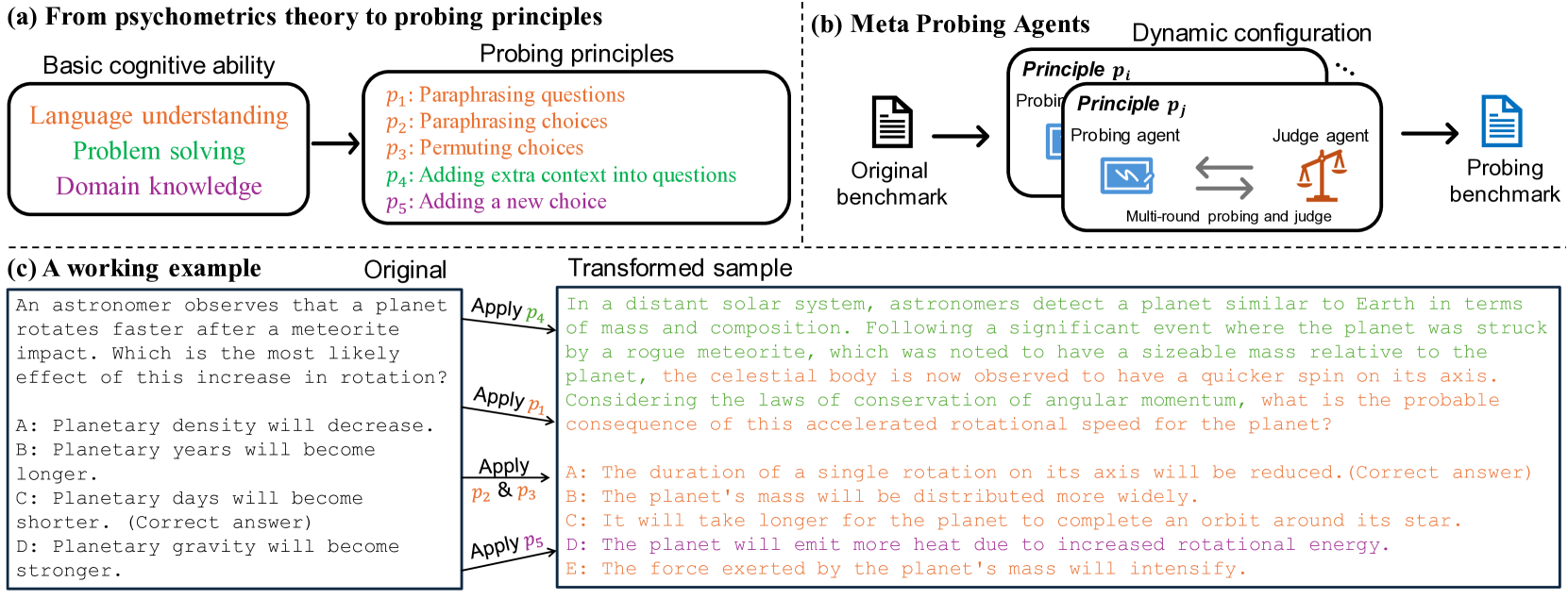
核心思路:提出元探测代理(MPA),通过心理测量学的理论框架,将评估问题转化为新的形式,关注语言理解、问题解决和领域知识三种基本能力。MPA的设计使得评估过程能够动态调整,适应不同的评估需求。
技术框架:MPA的整体架构包括探测代理和判断代理两个主要模块。探测代理负责将原始评估问题转化为新的问题,而判断代理则根据转化后的问题进行评估。整个流程遵循心理测量学的理论基础,确保评估的科学性和有效性。
关键创新:MPA的最大创新在于其动态配置能力,能够根据不同的评估需求灵活调整评估标准。这一特性使得MPA在多样化场景下的适用性大大增强,与现有静态评估方法形成鲜明对比。
关键设计:在设计中,MPA的探测和判断代理采用了基于心理测量学的算法,确保评估的准确性。此外,基本能力的动态配置允许研究者根据具体需求调整评估参数,提升评估的灵活性和深度。实验中使用的损失函数和网络结构也经过精心设计,以支持多维度的能力分析。
🖼️ 关键图片
📊 实验亮点
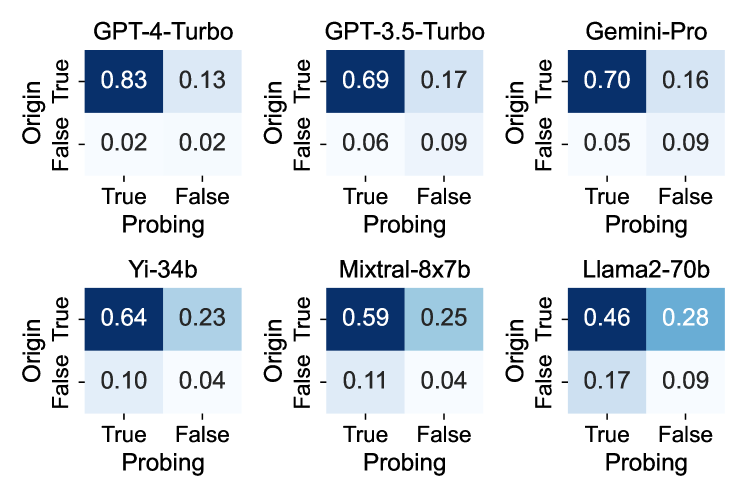
实验结果显示,大多数大语言模型在使用MPA评估时表现较差,表明其在能力上存在显著提升空间。此外,分析结果揭示了模型规模与基本能力之间的强相关性,支持了隐含的马太效应。具体性能数据尚未披露,待进一步研究验证。
🎯 应用场景
该研究的潜在应用领域包括教育评估、模型优化和人机交互等。通过提供更为细致的评估机制,MPA能够帮助研究者和开发者更好地理解和提升大语言模型的能力,推动相关技术的进步与应用。未来,MPA有望在多种实际场景中发挥重要作用,提升模型的实用性和可靠性。
📄 摘要(原文)
Evaluation of large language models (LLMs) has raised great concerns in the community due to the issue of data contamination. Existing work designed evaluation protocols using well-defined algorithms for specific tasks, which cannot be easily extended to diverse scenarios. Moreover, current evaluation benchmarks can only provide the overall benchmark results and cannot support a fine-grained and multifaceted analysis of LLMs' abilities. In this paper, we propose meta probing agents (MPA), a general dynamic evaluation protocol inspired by psychometrics to evaluate LLMs. MPA is the key component of DyVal 2, which naturally extends the previous DyVal~\citep{zhu2023dyval}. MPA designs the probing and judging agents to automatically transform an original evaluation problem into a new one following psychometric theory on three basic cognitive abilities: language understanding, problem solving, and domain knowledge. These basic abilities are also dynamically configurable, allowing multifaceted analysis. We conducted extensive evaluations using MPA and found that most LLMs achieve poorer performance, indicating room for improvement. Our multifaceted analysis demonstrated the strong correlation between the basic abilities and an implicit Matthew effect on model size, i.e., larger models possess stronger correlations of the abilities. MPA can also be used as a data augmentation approach to enhance LLMs. Code is available at: https://github.com/microsoft/promptbench.